Monday, September 26, 2022

The Sonnet

The Fountain of Vaucluse--a painting of Petrarch's villa in the south of France--by Thomas Cole (Dallas Museum of Art) 

One of the most famous forms of poetry is the sonnet. While most English speakers are most familiar with the Shakespearean sonnet--a form not invented by Shakespeare, though certainly mastered by him--the sonnet was originally created in Italy, where another famous form, the Petrarchan sonnet (similarly not invented by Petrarch, but mastered by him) emerged. 

The form is a fourteen line poem in iambic pentameter, with various rhyme schemes. Sonnets are divided into parts of different sizes. If you divide it into two parts of seven, you don't have a sonnet. 

The Italian/Sicilian forms are divided into two parts, first part of which is made of eight lines, with the second line having six, with a turn (or volta) that occurs in the second part. A turn is a reversal or shift in the theme, thought, or direction of the poem. As a consequence, the word "however" or "but" or some similar word is not uncommon at the turn. 

The Shakespearean sonnet is a little more complex. It is divided into four parts: an introduction of four lines, a thesis of four lines, an antithesis of four lines, and a synthesis in the final two lines. It can also simply have the turn with the final two lines.

The Petrarchan sonnet is made up of two Italian quatrains, abbaabba, which is known as an Italian octave. This is followed by an Italian sestet, cdecde, or a Sicilian sestet, cdcdcd.

The Sicilian sonnet is made up of a Sicilian octave, abababab, and a Sicilian or an Italian sestet.

The envelope sonnet rhymes abbacddc, followed by a Sicilian or an Italian sestet (rhymed, in this case, efgefg or efefef, respectively). 

The sonnetto rispetto has a ottava rima, abababcc, or a risotto, ababccdd, followed by either an Italian or a Sicilian sestet.

The Spencerian sonnet has three interlocking Sicilian quatrains, abab bcbc cdcd, followed by a volta and heroic couplet, ee. 

The terza rima sonnet contains a terza rima, aka bib cdc did, followed by a turn and a heroic couplet. A terza rima is, as you can see, made up of interlocking Sicilian triplet stanzas. 

The English or Shakespearean sonnet is the one most English readers are familiar with. It's made up of three Sicilian quatrains, abab cdcd efef, and a heroic couplet. 

The blues sonnet is made up of four blues stanzas and a couplet. The blues stanza is AAa, where AA are identical words, giving us the following form: AAa BBb Ccc Ddd ee.

Naturally, one could come up with a number of other rhyme schemes, and there have been poets who have abandoned rhyme altogether. And while sonnets have traditionally been in iambic pentameter, it's possible to have different line lengths and different rhythms as well. The main restrictions remain the requirement of fourteen lines, an uneven division, and a turn. 

Take, for example, the poem The Love Song of J. Alfred Prufrock by T.S. Eliot. It contains two full sonnets, both ending with the same couplet. I'll only discuss the first one, which opens the poem.

Let us go then, you and I,
When the evening is spread out against the sky
Like a patient etherized upon a table;
Let us go, through certain half-deserted streets,
The muttering retreats
Of restless nights in one-night cheap hotels
And sawdust restaurants with oyster-shells:
Streets that follow like a tedious argument
Of insidious intent
To lead you to an overwhelming question ...
Oh, do not ask, “What is it?”
Let us go and make our visit.

In the room the women come and go
Talking of Michelangelo.

First note that the lines are of different lengths: 7, 11, 12, 11, 6, 10, 10, 11, 7, 11, 7, 7, 9, and 8 syllables.

While many of the lines are iambic, including the 10-syllable, making them iambic pentameter, there is some variation in rhythms. And there is a rhyme scheme: aabccddeefgg hh. The scene seems to be a party, and the narrator is proposing to someone that they leave the party; however, in the turn, we have people at the party who are intending to stay. 

I'm not going to go into a full analysis. I just wanted to point to how one experienced, Modernist poet used the sonnet form within a longer poem, and did variations on the sonnet form itself. 

Finally, one can use sonnets in a series. 

The sonnet redoubled uses fifteen sonnets, with the first sonnet providing, line by line, the final line of each of the next fourteen sonnets. In other words, line one of the first sonnet will be the final line of the second sonnet, line two of the first sonnet will be the final line of the third sonnet, etc. To say this is difficult is an understatement, and it's very likely you'll have to go back and forth, massaging each sonnet until they all work and make sense. 

With my poem Time For Love and Art, I did my own kind of series of sonnets in which I used the couplet of each sonnet as lines 1 and 3 for the following sonnet, with the final sonnet having a couplet made of lines 1 and 3 of the first sonnet, making it the entire series circular and the sonnets themselves interlocking. I'm sure it's something someone else has probably done, but you never know. 

In the end, the sonnet remains a generative form. While Modernist and postmodernist poets complain about the restrictions of the form, I would argue that the restrictions make it highly generative. I certainly have used the sonnet--much more than any other form--and I do not feel restricted or that it's been remotely exhausted. I'm particularly attracted to the Shakespearean sonnet's dialectical movement, as I am myself a dialectical thinker. And while, traditionally, sonnets have been love poems, this has hardly been the case since Baudilaire, and you'll find a great many sonnets on a great many topics. 

Indeed, there are still many ways to use and challenge the sonnet form. One could take the forms divisible into four parts and write three quatrains and a couplet on a theme, as I do in my poem Four Displays, or you can even write those four sections as four unconnected poem and create a kind of surrealist or postmodernist juxtaposition that potentially pushes the reader into more complex ways of thinking and making connections. 

So, I encourage you to write sonnets. I have used the form too in my teaching, as I explain here. Again, the restrictions are precisely what are generative of good writing and interesting thoughts. And isn't that what we expect from poetry? 

Monday, September 19, 2022

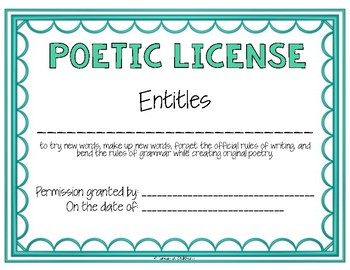
Earning Your Poetic License

You may be wondering by now why I have primarily been discussing the formal elements of poetry writing. While I have provided some reasoning for my choices--such as the relationship between the brain and rhythm, and the ear and line lengths--there are certainly other considerations when it comes to the practice of any art, including poetry. 

The argument that we should write in iambic pentameter, for example, because it's traditional expresses a sort of half-truth. In the same way that drawing and painting using point-perspective has a history--and a recent history, at that--the use of any particular form or structure in the poetry of a given language has a history. In English, iambic pentameter was introduced to English poetry by Chaucer. Old English poems were written primarily in alliterative verse. In each case, the style was developed within a given poetic tradition and came to dominate in typically organic ways, because it was able to communicate something within the language being used. 

Many mistakenly believe that because we can typically point to this or that poem as being the first to use a given structure, that means that structure was consciously developed by that person. More typically, the final form is a process of different people trying different things, with one person bringing those various elements together into that final form. While the 13th century Sicilian poet Giacomo di Lentini is the one credited with the invention of the sonnet, its form was an outcome of the poetry composed at the Court of Holy Roman Emperor Frederick II, including that of di Lentini. 

None of this is to take away from di Lentini's accomplishment. The sonnet as a form has since developed a long, strong history, and its form doesn't seem to be exhausted quite yet. Rather, this is to get you to think about how traditions actually emerge. If some single person developed a form or structure, it's easy to dismiss it as arbitrary. If instead it's a consequence of a process, of trial-end-error, and gained stability for good reasons, it's far less easy to dismiss its existence as arbitrary. Something that has evolved and survived is something we ought to take seriously. 

Whenever someone does something weird in a poem--invert syntax, use strange images, violate form, etc.--the common defense is that the poet can, of course, use their poetic license to do what they want. But too often, people use "poetic license" not because they were making purposeful choices, but because they did not know what else to do, and now they need an excuse for what they did. 

Did you use an inverted syntax to create a particular effect or, as Milton did, to introduce Latin structures to the English language; or did you do it because you had no idea how to fit what you wanted to say into the form you were trying to use? 

Did you use a strange image to challenge readers' conceptual categories and open their thinking to greater complexity; or did you do it because you wanted to be weird for the sake of being weird? (Not that the latter is at all problematic; I'm just asking you to be honest with yourself and others about what you're doing.)

Did you violate form, perhaps even write in free verse, because you had mastered form and are now seeking ways to create meaning through other rules you've created for yourself, creating different kinds of surprises and violations of readers' set patterns; or did you do it because you don't have the slighted idea how to write an iambic pentameter couplet, so are left with writing nothing more than prose with line breaks?

In each of the three examples above, the first scenario was an example of the poet making an artistic choice, of solving an artistic problem. It was made because the poet could in fact make a choice, having the tools available to chose among. In each of the second scenarios, the writer did what they did because they had no other choice, having not mastered the most basic skills of the art of poetry. Are you writing ungrammatical sentences because you have no idea how to write good, grammatically correct sentences? Or are you doing so because you have mastered grammar, and now you want to bend the rules for effect? Only the latter is an artistic choice. The former is merely incompetence. 

Thus, the poet must earn his or her poetic license. Master the sonnet, and then show me your free verse. Master grammar, then show me your ungrammatical sentences. Master imagery, then show me your odd images and juxtapositions. 

It is precisely because you have to earn your poetic license that this blog focuses on formalism. You cannot deform without knowing what the form is or was supposed to be. More, you need to understand what poetic form and structure do, why poems have across history and across cultures developed similar structures that allow us to universally recognize certain combinations of words as poetry. You are proposing to work within a particular global tradition. That means you have to know and understand what that tradition is. And it means you need to know and understand what poems are and why they have the structures they do. A house has a frame and paint, but that doesn't make it a painting any more than a set of words with line breaks make that set of words a poem. 

(It's been said that mediocre artists borrow, but great artists steal. Here is where I stole the above image.)

Monday, September 12, 2022

Poetry, the Quadrivium, and the Trivium

The Trivium - The Regina Academies

The Trivium is part of a Medieval educational system that was designed to provide the student with a complete education. The Trivium is made up of grammar, rhetoric, and logic. The other part of that educational system was called the Quadrivium--arithmetic (number), geometry, astronomy, and music. 

You may be wondering what the Quadrivium could possibly do with poetry. Well, one can view geometry as number in space (patterns), music as number in time (rhythms), and astronomy as number in space and time. Using this formula, one could easily argue that well-written poetry is akin to astronomy, especially those poems that use things like iambic pentameter (note the use of number--"penta" means "five," which is the number of iambic syllable patterns in a line). As John Steinbeck once wrote, "Poetry is the mathematics of writing and closely kin to music." 

We have already spent a great deal of time discussing several aspects of the Quadrivium within poetry, even if we haven't exactly been calling it that, and we will spend even more on the issue of number in the future. However, for this lesson, I want us to focus on the Trivium.

Poets, perhaps more than anyone else (excepting lawyers), must master the Trivium. 

Mastery of grammar should be obvious: how can you be said to be a language artist if you have not mastered the language itself? Only if you fully know and understand why your language works the way it does can you properly use it, beautifully use it, twist and bend it. Thus, it is important that one understand how the different parts of speech work, what kinds of sentences there are, and how to diagram sentences. To be a poet, one must love language enough to want to know how the words and the sentences work.

I'm not going to be spending time on grammar lessons. That's not the point of this blog. I'm assuming you have mastered grammar and that you are here to learn about the tools you need to write poetry, and to give you some ideas about poetry writing, challenge the way you think about poetry, and provide you with my own ideas about poetry. However, there is much that can be said about the other elements--logic and rhetoric--and their importance to poetry.

First, logic. You may think that logic has nothing to do with poetry. You may even have some romantic idea that poetry transcends logic and reason. And you are, perhaps, right about the latter statement. But, in order to transcend something, you have to include it. But there is, as I have argued, a rationality in poetic verse. 

Poetry both infers and, in complex ways, demonstrates. Logic shows when inference and demonstrations are valid. We have to keep in mind that the word "logic" comes from the Greek "logos," which can be translated as word, account, thought, reason, idea, or principle. A dialogue thus occurs "through logos"--meaning there is necessarily a logic to dialogue, and thus to plays, which combine action with dialogue. Insofar as poetry is made up of words and ideas, and are products of our thoughts, it should be clear that we cannot avoid logic. Logic just clarifies our thinking. 

You have perhaps heard complaints about "logocentrism" and about logic itself. However, those who oppose "logocentrism" have to use logic to make their arguments. Those arguments can only be better or worse, and use good or bad logic, but logic is inescapable. Given this fact, I would argue that you should master logic--certainly before you can criticize it. And at least a familiarity with formal logic should benefit your thinking and, thus, your poetry. (Symbolic logic is another thing altogether--we'll leave that to the logicians over in the philosophy department.)

Rhetoric is the art of making an argument, the art of persuasion. Each work of art is trying to make some sort of argument, and the language arts perhaps more clearly and obviously. After all, we make most arguments using language. Thus, rhetoric is central to all forms of poetry. 

Aristotle argued that good rhetoric requires the use of logos, ethos, and pathos. 

Logos we have just covered. 

Ethos, from which we derive the word "ethics," has to do with the reader trusting the writer or speaker. Part of persuasion comes from your reader trusting you, and you can only create true trust by being a trustworthy person. How that can be demonstrated in a poem will certainly vary form poem to poem, from topic to topic, and is perhaps less tangible in poetry than in a scholarly paper or a speech. 

Pathos is emotion, how we create emotion in our writing or in a speech. We do not create true pathos by being melodramatic or sentimental. It has been said that sentimentality occurs when there's a lack of sentiment. Sentimentality if felt by the reader when the writer fails to communicate emotion well. One could perhaps say that sentimentality is pathos without ethos. 

It should be obvious that pathos is central to poetry. It's perhaps the one thing most early poets focus on--sometimes to the exclusion of all else. Which is why there is so much sentimental poetry out there. The way to create true pathos is through the use of appropriate imagery and through the use of story. But in the end, like most aspect of poetry, it takes practice to communicate emotions well, and you are bound to miss the mark on either side, by being either too sentimental or too cold. More, what works for one reader won't work for another. You just have to play the numbers--if you find a large-enough number of your readers get the emotion in the poem, you can consider it a success in its pathos. 

To be persuasive, you have to have good style. Of course, good style means different things for different kinds of writing. "A good style must, first of all, be clear. It must not be mean or above the dignity of the subject. It must be appropriate" (Aristotle). The style of an article intended for a mass audience is necessarily going to be different from that intended for scientists with advanced degrees, and both should be different for different kinds of novels, whether romance or literary, and everything in-between. And of course, poetry should itself have its own, and each poem should have its own, style. 

Style is more than just decoration. "Style ought to prove that one believes in an idea; not only that one thinks it but also feels it" (Nietzsche). The reader ought to be able to feel your conviction. Style, then, is part of the ethos of rhetoric. 

It is important for poets to master the Trivium. The Trivium must be mastered before you can challenge any part of it--if you decide to challenge any part of it. To paraphrase Don Barthelme, you have to be able to write masterfully well-written sentences before you can write bad sentences in your poetry or prose. Thus, it is important to know the rules of the language before one can challenge them. And challenge them we must for, as Octavio Paz once wrote, "Social criticism begins with grammar and the re-establishing of meanings." The greatest poets have always challenged the rules of grammar, logic, and rhetoric--and of ethos and pathos. But they have also always been their masters as well. 


Monday, September 5, 2022

Meter

*

Verse is metered language. What, though, is meter? 

"Meter" comes from the Ancient Greek "metron," meaning "measure." When we measure, or count, our lines, we are writing in meter. 

The simplest way to write meter is to simply count syllables. When we are writing poems with lines containing the same numbers of syllables, we are writing in what is called syllabics. In syllabics, we are not concerned about the placement of stressed and unstressed syllables or the length of syllables. These are common in languages which are not stressed, like Japanese, or tonal, like Chinese. However, in a language like English or German, our words are either stressed or unstressed. As a result, syllabics often sound stressed anyway.

Coincidentally, the Greek language, on which we have based most of our regular syllabic structures, wasn't stressed, but rather was made of long and short syllables. Such poetry is called quantitive verse. 

Most readers of poetry will be familiar with poetry with lines containing patterns of stressed and unstressed syllables, called feet. The best-known poetic foot in the English language is the iambic foot, which is a simple alternation of unstressed and stressed syllables. 

We mark stressed syllables with a "/" and unstressed syllables with a "˘", which sounds "da-DUM."

   ˘ / ˘ / ˘ / ˘ / ˘ /

Shall I compare thee to a summer's day?

  ˘ / ˘ / ˘ / ˘ / ˘ /

Thou art more lovely and more temperate!

Here, in Shakespeare's famous sonnet, we have lines of alternating iambic feet. Since there are five iambs, we call this a pentameter--"penta" for "five," meaning five-count. An iambic pentameter is thus a five-count of iambs. 

  • Dimeter: contains two metrical feet
  • Trimeter: contains three metrical feet
  • Tetrameter: contains four metrical feet
  • Pentameter: contains five metrical feet
  • Hexameter: contains six metrical feet

These are going to be the most typical meters. As Frederick Turner and Ernst Poppel argue in their essay The Neural Lyre (also found in Turner's book Natural Classicism, above), we're typically going to find the ten syllables of iambic or trochaic pentameter to be most "comfortable" in English because it fits into our auditory moment of about 3-4 seconds. If we're using anapest or spondee, then, a trimeter or tetrameter would fit that moment best. 

This, of course, gets us to the issue of regular rhythms. The most common regular rhythms in poetry are the following:

iamb:      ˘ / (ex: compare)

trochee: / ˘ (ex: summer)

spondee: / / (ex: Bang! Bang!)

anapest: ˘ ˘ / (ex: of unstressed)

dactyl: / ˘ ˘ (ex: beautiful)

There are, of course, others:

pyrrus: ˘ ˘

tribrach: ˘ ˘ ˘

amphibrach: ˘ / ˘

bacchius: ˘ / /

cretic: / ˘ /

antibacchus: / / ˘

molossus: / / /

The tribrach and the molossus are the most difficult to create because if there are three unstressed syllables in a row, we'll tend to hear one of the unstressed syllables as stressed; and equally, if there are three stressed syllables in a row, we'll tend to hear one of them as unstressed. To get your listener to hear a tribrach, you would likely have to have a very strongly stressed syllable on either side of it.

With most of these feet (excepting tribrach and molossus), you can use each of them to create a regular rhythm. With all of them, though, you can use them in combinations. For example, the Sapphic stanza is made up of three Sapphic lines and an adonic line. The Sapphic lines are two trochees, a dactyl, and two trochees, while the adonic line is a dactyl followed by a trochee. Thus, the Sapphic stanza is as follows:

/ ˘ / ˘ / ˘ ˘ / ˘ / ˘

/ ˘ / ˘ / ˘ ˘ / ˘ / ˘

/ ˘ / ˘ / ˘ ˘ / ˘ / ˘

/ ˘ ˘ / ˘

Note that the first three are 11-syllable lines (hendecasyllabics) in pentameters of mixed feet.

As one can imagine, there are a large number of potential combinations of syllabics, meters, and feet--an infinite variety if we ignore the requirement for the creation of line lengths that fit in the auditory moment. It's possible to create very complex meters and then repeat them in each line--or in alternating lines, or some other pattern. I would recommend that if you want to retain the word as a form of verse, though, that there be some kind of regularity--the simple and the complex have to be in balance--otherwise, you'll simply end up creating prose. And there's no need to figure out the meter and feet to write prose.

Another way meter is created is through the use of the caesura. A caesura is a pause in the middle of a line. The caesura helps to create a rhythm both within the lines and across the lines. If you use punctuation in the middle of your line, you'll create a natural caesura. But even without punctuation, the reader will create a natural (though weaker) pause in the middle of a long-enough line. While many English poems aren't built around caesuras, traditional Germanic (including Old English/Anglo-Saxon) verse was built around the caesura, with patterns of alliteration being determined by that internal pause.

Finally, in contradistinction to the caesura, where there's a pause in the middle of a line, there's enjambment, which means the syntax of a line isn't contained by that line, but is rather continued into the next line. Another way of putting it is that the line doesn't end with punctuation. The result is that a line that ends with punctuation is a harder pause than one without punctuation.

Regular number of syllables, feet, caesuras, and enjambment (and rhymes) are all ways to create meter, and to make for complex meters. It's important to both maintain regularity and disrupt that regularity simultaneously in order to prevent the reader from getting bored.

Remember, too, that changes in patterns are meaningful to the reader. Take advantage of that fact. If there's a change in feet (using a trochee instead of an iamb in a particular line, for example), then that word should probably be important. The same could be said of rhymes--your rhyming words should be more important than articles or prepositions, unless they're being used there for some kind of effect (meaning, they have meaning in being there).

Of course, there are also variations in stress--some syllables are more stressed than others, and this creates a more complex music over the regularity of the meter.

Things get even more complex if we read poems aloud, because then we add things like pitch, loudness, length, and timbre. Much of this will of course depend on how the reader chooses to read it, if the person has a high or low voice, if they think it would sound better loud or quiet, with longer or shorter time pronouncing given syllables, and personal, regional, or cultural speaking patterns.

All of this means that metered poetry is fundamentally musical. Encyclopedia Britannica's entry on rhythm even contains musical notation. This musicality brings both sides of the brain together--music and language--into a fuller, more complex art.

Verse is metered language. Meter is an artistic tool. It is what makes poetry a language art. The more we think about these kinds of rules, the more artistic our art will be.

Monday, August 29, 2022

Patterns and Poetry

*

"All art [is] cognitive play with pattern"--Brian Boyd, Why Lyrics Last, pg. 5

Rhythm and pattern are fundamental to understanding and finding meaning in the world. Rhythms and patterns are examples of a particular rule found at every scale of nature. Both involve repetitions of either objects (which would include grammatical structures and syntax) or sounds (such as rhymes and regular rhythms such as iambic). Poetry that has rhythms and patterns are thus participating in and adding to nature as nature itself expresses itself.

In Aeon Magazine there is a fascinating article on repetition and music. In it the author notes that people consider repeated sounds as more musical. More, repeated words become more like songs.  And by extension, more like poetry. 

What this implies, then, is that Fred Turner is right about poetry in, well, everything he has written about poetry. Poetry is repetition. It is repeated sounds, repeated rhythms, repeated words, repeated structures. This would also explain why some forms of poetry involve repeated lines. 

Sonnets, for example, have repeated sounds in the end rhymes and in the iambic pentameter rhythms.

With ghazals there is the repetition of the end phrase.

Then there is the villanelle, in which we have entire lines repeated. 

But if we take a poem like my poem In the Multiverse, one may wonder how it is any different from prose simply cut up into lines:

In the Multiverse

If there are really many universes,
As many physicists now claim, if there
Are infinite universes out there–
Then I exist an infinite number
Of times and places, and so do my wife
And baby daughter. In some, sadly, I
Do not exist; in some, my wife and I,
We never met. And that’s the tragedy.
But out there too my mother also lives
And, living, knows and loves my daughter who,
In my own universe, she’s never seen
–
And, knowing that, I think on it with joy.

Well, first, the poem is in iambic pentameter, so there is that level of repetition. But it is in blank verse, so sound repetition seems gone. But note that there are in fact several repetitions of sentence patterns:

"If there are..." is repeated. "In some," is repeated. "And, [progressive verb]," is repeated. As we've discussed before, parallelism such as this is a kind of repetition, and is not uncommon in poetry--see for example the Psalms. 

But is non-repetitive poetry even possible? If not, what do we make of the works out there called poetry but do not have repetition? Are they merely prose with line breaks? 

The writer who wants to successfully move his audience is one who will use repetition. If you want to make memorable works, you have to use repetition. If you want your work--poem, prose, play--to embed itself in the minds of your readers, you have to use repetition. With repetition, your reader, viewer, listener will go away with you forever in their minds. The more repetitions (without being overbearing), the more patterns and rhythms, the more memorable overall.

Patterns are spatially organized. They are arrangements of forms and/or colors, which is to say, they are designs. In literature, they create meaning and motif. They are imitations or copies, which comes from the etymology of “pattern,” derived from the Old French, patron, since a client would copy his patron, since the patron provided a model for the client to follow–the patron would act as the ideal, example, exemplar. Thus there a connection between patterns and ethics, and between beauty and ethics, since patterns are part of beauty. 

Rhythms, from the Greek rhein, to flow, are temporally organized. Rhythms are regular repetitions over time, typically of sound. Nonetheless, there is a connection to pattern: in a work of art, a rhythm holds the parts together to create a harmonious whole through the repetition of form and/or color. Since rhyme come from the Greek rhythmós, we see that rhyme is a kind of rhythm. There is also an ethical component to rhythm, since a rhythm in biology is a pattern of involuntary behavior or action that occurs regularly and periodically. 

In the realm of behavior, rhythms are involuntary actions, whereas patterns are consciously followed. A rhythm is meant to carry us along, to help our actions flow, while patterns help create meaning by making us more conscious. In this formulation, one could see rhythm as Dionysian, or (to use Milan Kundera’s terms) Demonic, while patterns would be Apollonian, or Angelic. A tragic work of art, using Nietzsche’s formulation, would be one that contains both rhythm and pattern.

Brian Boyd, in his book Why Lyrics Last, argued that we have an "innate attraction to information that we can see as patterned, since if we recognize patters we can process information rapidly, in real time" (5). He also argues that there is a "hyperconcentration of pattern in pure lyric" (5), by which he means the regular rhythms, rhymes, etc. typically found in formalist verse. However, there are other patterns which can emerge when we have stories. If the story is long enough, such as a novel, we can end up with very complex patterns--fractal patterns--of theme words, as I demonstrated in my dissertation (the relevant chapter of which you can find and read here). 

Stories make poems easier for the reader to engage with the poem because narrative structure is the pattern we live and think by. This isn't to say that lyric poems ought to have what we typically think of as a standard story structure, but certainly if you have some sort of story in mind, the reader will fill in the blanks and make the implied story their own. This also suggests that storytelling shouldn't be shunned in poetry--nor, I would argue, should poetry be shunned in storytelling. The patterns which storytelling create are complex, and they will complexify your poems, just as making stories poems (including plays, in verse) will also complexify and make more memorable your stories. 

Boyd, again, points out that patterns are vital elements to the arts, and that storytelling in particular provides complex patterns to the reader:

We incrementally fine-tune our neural wiring through our repeated and focused engagement in each of the arts. Fiction in particular, by harnessing the advanced power of human social cognition, our ability and inclination to track actions, intentions, and thoughts of others, also expands our imaginations so that we can make sustained forays into possibility space. (11)

In other words, "human art refines our performance in our key perceptual and cognitive modes, in sight (the visual arts), sound (music), and social cognition (story)" (11). 

Combining the patterns of rhythmic lines, rhymes, sound repetitions, word repetitions, and storytelling create a set of patterns within patterns The creation of patterns within patterns creates fractal depth, and unity among diversity, as found in nature. And as the brain is part of nature, in art too. Nature has fractal geometry–the repetitious repetition of repetitions. Great works of art have fractal geometry too, in the same way that nature is fractal, not in the repetition of the same fractals, but of the superposition of different fractal geometries on top of each other. Again, uniformity in variety. We again see the use of repetition, of patterns, and therefore, of rhythm, at the most basic levels of nature. And it goes all the way down. 

Light is made of waves – they are repetitious and have a steady rhythm. Quantum particles (including quantum strings) all vibrate–they have steady rhythms (this quality of vibrating at a steady rhythm is why we use Cesium–which vibrates at a known, constant rate–in our atomic clocks). Crystals all have patterns, planets all orbit in steady rhythms (as do stars in the galaxy). That is, nature is rhythmical, patterned, all the way down. It has fractal depth. So we should not be surprised to find the use of rhythm in the development of biological organisms, including humans–and our brains. 

Nor should we be surprised we find rhythms and patterns comforting–and beautiful. This suggests we would expect our art to be patterned, rhythmical, since both the creator and the audience finds patterned, rhythmic art beautiful. At the same time, one cannot have just regular patterns repeating over and over and over and over and over again. Violation of patterns is also important. It catches your attention. It is meaningful to the reader/viewer. It prevents the reader from getting board. 

Imagine a regular rhythm of grasses as a breeze blows across the savanna. It's calming, soothing. A little boring, but that's ok. Then, you notice a disruption in that regular pattern. Now you're paying attention, you're on alert. What could that be? What could it mean? Is there an enemy approaching? A lion? You focus on the disruption in the regular pattern, at the new pattern which is emerging. 

Regular patterns, then, have the danger of making the reader board. That's why it's important to introduce irregularities and complex patterns. It draws the attention. 

This same problem of boredom keeps artists innovating, creating new patterns, suggesting new rhythms that can potentially help us to see new things in the world, helping us to better adapt to and learn about the world. That is the true power of patterns. It's not just in their regularity, but in their irregularities as well. 

Monday, August 22, 2022

Metamodern Poetry: An Introduction

Join us free HERE. Meeting ID: 938 7189 9376 | Passcode: 786705Abduction, by Jesse Mockrin

 Here, at last, is the promised post on metamodern poetry--or, at least, what I think metamodern poetry is and ought to be, or at least, how I practice metamodern poetry. In other words, I'm going to present you with my theory of poetry writing. In any class on poetry writing--even in a blog of mini-lessons--one ought to know the teacher's theory of poetry. That way, you know where they are coming from, and you can make up your own mind about what you want to pay attention to and what you want to ignore in the development of your own poetry. 

There are several ideas on what "metamodernism" means, from cultural analyses to aesthetic ones. Obviously, we are more interested in the aesthetic aspects, but both are concerned with the synthesis of Modernism and Postmodernism, and with the affirmation of paradox. In aesthetics, the affirmation of paradox includes such things as bring both serious and ironic simultaneously, or in turn. 

Now, depending on what one means by "Modernism," a synthesis of Modernism with Postmodernism can mean several things. Aesthetic Modernism is typically considered to have developed in the late 19th through early 20th century. Literary Modernism can be considered to have started with any number of writers, though I would argue that its foundations are certainly in such writers as Walt Whitman (free verse), Flaubert, Dostoevsky, and Baudelaire. 

With the aesthetic Modernists, there is a self-conscious break with past forms and an infusion with the ideas of people like Nietzsche, Freud, and Marx. However, there is another kind of Modernism, which starts much earlier, with the work of Descartes, and which has its origins in the Renaissance (which itself created a break with the past, with Medieval culture). This era comes to an end with the ideas of Nietzsche, Marx, and Freud, who are the fathers of Postmodern culture, which can be considered to have begun (in my mind) at the same time as Aesthetic Modernism. 

Meanwhile, what we consider to be Aesthetic Postmodernism began in the 1960s with the advent of pop art in the visual arts and in literature (with Don Barthelme, who is often considered the father of postmodern literature). Postmodern art tends to be fragmented, and gradually became academic art, dominated by university artists and writers. Postmodern art gave us and is the product of the creative writing class at our universities. 

Metamodernism in both cases is an attempted synthesis of Modernism and Postmodernism. However, an Aesthetic Metamodernism that only embraces and synthesizes (in an atonal fashion, without full synthesis of either) Aesthetic Modernism and Postmodernism is going to be different than one that embraces and synthesizes (again, agonally) Cultural Modernism and Postmodernism. After all, the literature of Cultural Modernism included Enlightenment literature, Romantism, Neo-Classicism, Realism, and Naturalism, while Cultural Postmodernism includes Aesthetic Modernism and Postmodernism. 

For my money, I think that Aesthetic Metamodernism ought to include influence from all of the movements within both Cultural Modernism and Cultural Postmodernism. A consequence of this is that I fully embrace all of the formalism used in the literatures of the Enlightenment, Romanticism, Neo-Classicism, Realism, and Naturalism as well as the aesthetic discoveries made by the Modernists and Postmodernists of the past 150 years or so. It makes little sense to me to only embrace Aesthetic Modernism and Postmodernism, as there is much more continuity between them than the Cultural versions. 

Indeed, I would argue that Aesthetic Postmodernism is the "normal art" of Aesthetic Modernism. Here, I'm using Thomas Kuhn's paradigm theory and applying it to the arts. Aesthetic Modernism was a paradigm shift, but Postmodernism wasn't. Postmodernism was merely a fine-tooth development of all that Modernism had discovered in the aesthetic realm. This had happened, too, with the Academic Art of the 19th Century, where the Academic Artists merely covered the same ground as the Renaissance, Baroque, and Rococo periods, and whatever they developed was well within that paradigm. Postmodern art, too, does the same thing--and it's even more properly called "Academic Art" due to its almost exclusive presence in our Universities and by those trained in our Universities. 

If Metamodernism is to be a new paradigm shift, it will have to do something revolutionary in relation to the Aesthetic Modernism/Postmodernism that runs through Cultural Postmodernism. 

What will that look like? I have a few suggestions. While such wonderful novelists as Dave Eggers, Michael Chabon, and Jonathan Franzen are now considered Metamodernists, from the standpoint of their being part of the New Sincerity, I have to wonder if they are truly revolutionary. Perhaps closer to what I'm talking about are writers like Zadie Smith, Haruki Murakami, and Frederick Turner, who synthesize the Modern with the Postmodern, and their own cultures with others. Further, Turner writes sci-fi epic poetry, which synthesizes a more ancient form with a more contemporary one. 

My own version of Metamodernism looks more like Frederick Turner's, as he describes his aesthetics in his nonfiction books, Natural Classicism*, Beauty*, and The Culture of Hope*. In other words, a synthesis of Postmodernism, Modernism, Medievalist literature, and ancient literature, as well as not just the West, but cultures across the world, from (ancient to contemporary) China and Japan to India and Iran, Mali and Nigeria, the Americas, and throughout the world. This would include a recognition that there's no such thing as an "African culture," for example (an idea which is the ultimate kind of kitsch), but rather that there are hundreds of different cultures across Africa, about which we should all learn something, and whose literatures we ought to be reading just as much as we ought to be reading the works of the ancient Greeks and Romans. In other words, in Turner's formulation, we ought to embrace a "natural classicism."

If you were to embrace natural classical metamodernism, what kinds of poetry do you think you would produce?  


Monday, August 15, 2022

Inspiration and Knowledge

Muses in popular culture - Wikipedia

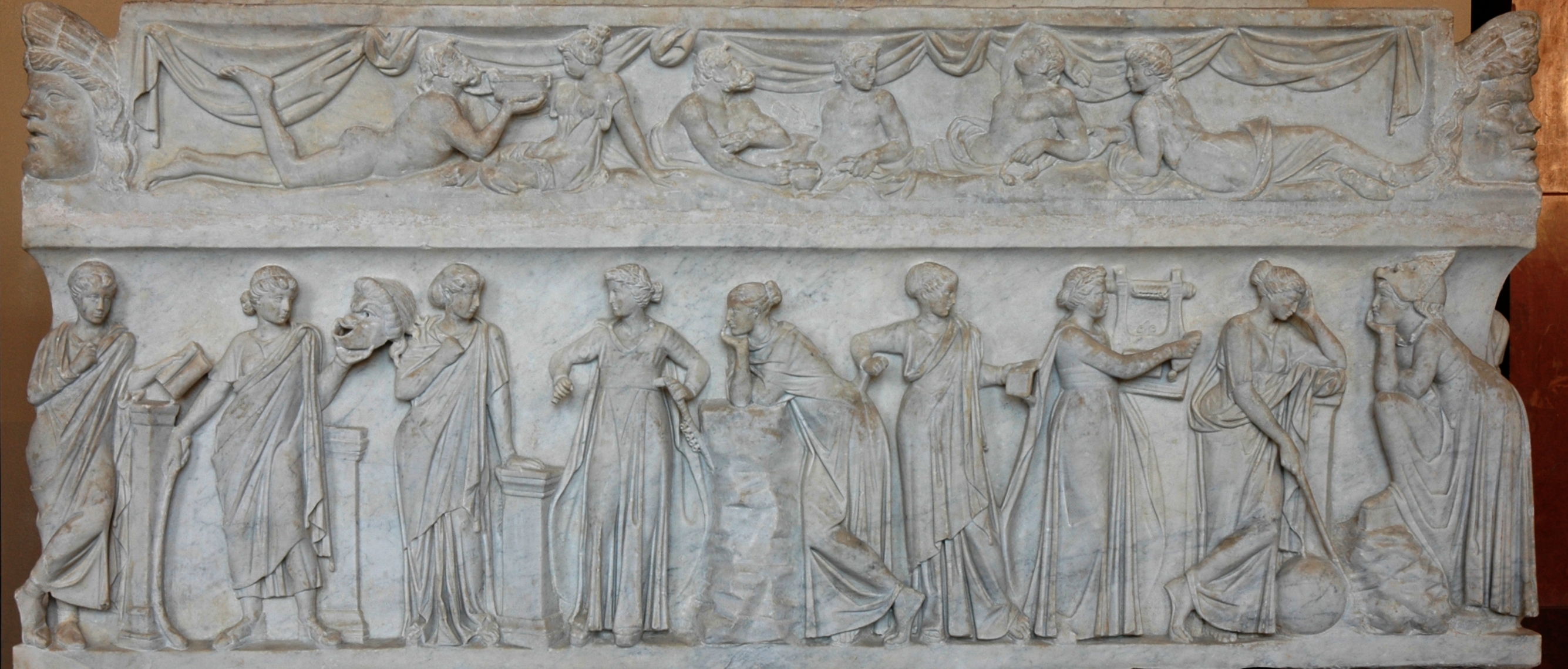
 The Greeks believed that the Muses were the offspring of Zeus (God) and Memneke (Memory). One way of understanding this insight is that poets produce their art due to a combination of inspiration and memory. 

In other words, we have to have some kind of knowledge in order to create good poems. You cannot be an ignorant poet. Indeed, one could argue that there is no such thing as a great poet who is ignorant. Think about the great poets. Goethe was a scientist who studied the physics of light and biology, a bureaucrat who helped manage a princedom, a well-read writer, and a traveler. He studied languages and history, read philosophers and ancient writers. Shakespeare demonstrated his knowledge of the Trivium, of history, of philosophy, and of the literatures of other cultures in his works. Keats was a doctor, as was Chekov. The point is that these were educated people. 

The poet must be an educated person. Not just educated in a narrow sense--having a B.A. in English, a M.A. in English, and a Ph.D. in English is being educated in a narrow sense--but in as broad and universal a sense as possible. There are English-major Marxists, English-major Freudians and Jungians, and English-major theorists; unfortunately, actual economists, psychologists, and philosophers barely recognize the English-major versions of their fields. 

This is not to denigrate English as a degree. I do, after all, have a major in English, a Master's in English, and a Ph.D. in the Humanities that focused on creative writing and literary studies, and I learned a great deal from my literary theory classes--and I took as many literary theory classes as I could, because I enjoyed them so much. However, I did also major in biology and minor in chemistry, I do have two years of graduate classes in molecular biology, and I taught myself enough economics, psychology, and sociology to have peer-reviewed publications in those fields. I have studied mythology on my own and to get my Humanities degree. I truly believe in the synthesis of science and the humanities, that there shouldn't be "two cultures." I don't know if any of this makes me a great poet, but it certainly means I have a great many things in memory. 

This knowledge of course has to include thousands of poems, as well as novels, short stories, and plays. There is no such thing--anywhere at any time--as a poet who is anything less than mediocre who isn't well-read. This "reading" includes oral traditions, including songwriters who are inspired/influenced by other songwriters. There's no such thing as a writer who wasn't a prolific reader. The two go hand-in-hand. 

But knowledge and ideas are not enough. We also need inspiration. 

The word "inspiration" literally means "breathe in." However, in many languages, the word for soul or spirit is "breath." To have inspiration is thus to have a spirit within you. You may call that spirit God, or you may call it, along with Socrates, a "daimon," but whatever it may be, it feels like it's coming from somewhere other than yourself. It's certainly coming from somewhere other than your conscious self. If you feel inspired, there is a kind of sudden insight that makes you want to write (or paint, or make music, etc.). 

If you prefer a less mythical/mystical version of inspiration, there's also a psychological one. Our minds are often working on problems in the background, then feed the finished solution to our conscious minds all at once, in what we call "a flash of insight." This can happen with scientists--Einstein being a famous case, with his insight about relativity coming to him in a dream--and it can certainly happen with poets. 

With poets, though, inspiration is more of a learning something that is of personal importance to us. That is, it's a kind of subjective knowledge. When we communicate what we have learned in verse, we express poetic truth. How well we communicate that truth depends upon our skills as poets. 

When you communicate your subjective understanding, you add to the wealth of human knowledge. We need your insight, your understanding, your interpretation of things--and we need you to write so well someone will read it, so it actually becomes part of human knowledge by becoming a part of your reader and how your reader ever after thinks. And that means writing something people can and will remember.

At the same time, if you are only relying on inspiration, you may write a few dozen poems in your life, none of them any good. As we've already seen, there's more to writing poetry. 


Syllabics

 If you were to come across a ten-syllable lined poem, you would probably expect it to be iambic pentameter. And you would probably be right...