Showing posts with label constraints. Show all posts

Monday, January 30, 2023

Syllabics

 If you were to come across a ten-syllable lined poem, you would probably expect it to be iambic pentameter. And you would probably be right. However, regular meter is not the only possibility when creating a poem with a regular number of syllables. 

A poem with a regular number of syllables, but without meter, is known as a syllabic poem. There can be something charming in such a poem, where the regularity of the lines creates the pattern. The inclusion of other patterns--end rhymes and alliteration, for example--can bring a little more poetic order to the irregularity of the rhythms within the lines. 

Syllabics is hardly a new form for most people. Most people are familiar with the haiku, a popular Japanese form. The haiku is created by counting syllables and putting them into three lines. Five syllables, followed by seven, followed by five. (Note, a poem is only a haiku if it's a nature poem; if your 5-7-5 syllable poem isn't about nature, it's a senryu.) Thus, a haiku (or senryu) is a syllabic form. This is the case with many Chinese and Japanese forms, because of the sound structures of the languages. However, as the popularity of this form among Anglophone poets indicates, English can certainly fit well into these forms. 

How I Was Moved to Feed the Birds

The black grackle hopped
Up onto the patio
Its feet puddle-damp.

As you can see, the above is a proper haiku. If you are concerned about being too constricted by the number of syllables, you can always give it a nice, long title, as I have done with this one. Let me show you a poem in which I balance out the syllabics (10-count in this case) with rhyme:

Constructal Trees

I love the branching form of dicot trees--
Order, chaos, criticality please
The eye with expectation and a tease
Of difference. The bald cypresses have knees
That clear the water. Mangroves border seas
And branch above and below their trunks. Breeze
Brings movements to branches as their leaves seize
The air. A few have flowers, attract bees
And bats and birds and butterflies. Decrees
Are sung from their branches. We feel disease
If we're too far away from their firm lees
And their shadow darkening a few degrees
From the heat. And what other guarantees
Our air, ensuring that we do not wheeze
Through life? (Unless their pollen makes us sneeze.)
Complex beauty belongs to all of these--
We thus must always be all life's trustees.

The use of the same rhyme in each line is intended to box in the poem a little more, making up for the looseness of the syllabics. Of course, you don't have to do that at all. You can just leave it loose, which itself creates its own sonic feel:

 Rebirth

The man I was, the child I've become
Are separated by the gulf of Hell--
A sea-voyage past terrible islands,
Into storm-tosses seas of chaos--without
The benefit of the taste of Lethe.
Surrounded by black flames and spirits I
Wrestled with the Devil until I won
The right to sail from the storm and away
From the beautiful islands of joy--bliss
Blew in from the west to carry me, cold, 
Up to the rising sun creating new 
Horizons of rosy-red, orange, and gold 
Spread across the sea--evening's rainbow sea
Shining smooth in front of me in blue miles.
Nothing can be the same for me from now.
I have returned to these stone shores, reborn,
A child once again, I'm living wonder--
A child returned from graves of living men--
A child with eyes that learned to understand
In ways the man I was could never do,
Blinded by my dark, preconcepted world.
Now, I see the world I thought I knew--dark
Is light. I return to these shores, reborn. 

There are some who may, perhaps, consider this a kind of prose with line breaks (I have complained about such in the past), but the regularity of the line breaks creates a different feeling than if the line breaks were more irregular. This makes it something other than free verse. Forms are all created through regularities.

I think that syllabics are more interesting once you have mastered meter. There's a difference between creating syllabics because you want to and creating them because you don't know how to write in meter. I encourage you to work on mastering meter first, and then trying your hand at syllabics. There's a lot of potential in syllabics, but only among the most skilled at the other poetic forms. 

Monday, January 16, 2023

Bob and Wheel

Bardic Gawain: Sir Gawain and the Green Knight - YouTube

 Different languages have developed different poetic traditions because of the sound structures of those languages. For example, the Germanic languages had, early on, before the influence of Latin poetry and those of the Latinate languages (especially Italian and French), been dominated by alliterative forms. 

Alliteration is, of course, the repetition of initial sounds. The Old English poem, Beowulf, and those Norse Sagas written in verse are all alliterative. There are fewer words with end rhymes in the Germanic languages than in the Latinate languages, so as a consequence, other sound patterns emerged. Further, the languages are dominated by hard consonants, so it would be natural for hard consonants in particular to emerge as a rhythmic structuring device. 

In the Latinate languages, we find a lot of end rhymes. Thus, we should not be surprised to find that there is a lot of use of end rhymes in their poetry. Latin poetry was heavily influenced by Greek poetry, which emphasized rhythms such as iambic (which the Greeks considered to be a comic rhythm). As French and Latin entered into the English language, their styles of poetry did as well. Regular rhythms emerged, as did end rhyme. But of course, these things did not just happen overnight.

Thus, after the Norman conquest of England in the 11th Century, it's not surprising that we would find transitional poetry such as that of Sir Gawain and the Green Knight in the 14th century. While the main part of each stanza of The Green Knight is alliterative, each also ends with what is known as a "bob and wheel," in which regular rhythms and end rhyme come into play. 

All three translations I have of The Green Knight include the bob-and-wheel, but only two--Marie Borroff's and Brian Stone's translations--attempt to alliterate throughout the work, while W.S. Merwin's does not (nor do his bob-and-wheels rhyme correctly). The latter does, however, have the original on the facing page. We'll discuss issues of translation at a later date, so I will only note that in the tension between meaning and music, some translators tend toward one over the other. 

The stanza structure in The Green Knight is approximately 15-25 alliterative lines followed by a bob-and-wheel, which has the following structure:

rhythm    rhyme     structure

u/u/           a            bob
u/u/u/        b            wheel
u/u/u/        a            wheel
u/u/u/        b            wheel
u/u/u/        a            wheel

Here is an example of Stone's translation of stanza 30, the last two alliterative lines leading into the bob-and-wheel:

And there was none but said his nay, for never in their lives
Had they set eyes on someone of such hue
        As green.
    His way was wild and strange
    By dreary hill and dean.
    His mood would many times change
    Before that fane was seen. 

I would perhaps have made "many times" "often" in order to perfect the rhythm, but you get the idea of what this structure looks like. In any case, you will note that the bob is enjambed with the last line of the alliterative portion of the stanza. This ensures the continuity of the alliterative portion with the bob-and-wheel.

I've played with this structure myself, though I created a longer bob and a shorter wheel:

        Guide Light

        In the blue is the moon, a milk mass
        Whose place is purple dawn, a pregnant
        Betrayal of time and expectation
        When the sun is supposed to be set in the sapphire
        Alone to light our lives. Who's she
                Who'll be
                So free
            Beside the sun --
            Why won't she run?

        I thought the dark was destined to draw
        Me through my life, to thread and to threaten
        In ceaseless new moon nights that would nudge
        Me graveward and grant me a gravity that death
        Couldn't strangle out of me. Still the steel,
                Reveal
                The wheel
            That turned my life
            From death's blue knife.

        But the moon that is doubling the day will dip
        Into the night enough so that nothing
        Is encompassed by the dark that has come to claim
        My mind -- she will mend my heart and move
        Me to the dawn so the devils will dance
                The lance.
                Entrance
            Me to the day
            Where I can stay.

Certainly, there are other ways you can play with the bob-and-wheel structure, or you can simply use it as originally conceived. While alliteration has gotten a bad name in English poetry for a long time, I suspect that bad name has come about from a degree of Latin-based snobbery. I think there's probably a lot of potential still in alliterative verse, especially to the degree that it draws us into the Germanic origins of English through sound. More, I think there's something charming about the bob-and-wheel structure. It's something worth playing with. What can you create using this transitional structure? How might it become a transitional structure for you? 


Monday, November 28, 2022

Constrained and Unconstrained Poets

 The economic way of thinking begins with understanding that human choice is all walks of life is always exercised against a background of constraints.

The reality of choice within constraints implies that we face trade-offs in making decisions.

Peter Boettke, Living Economics, pg. 22


F. A. Hayek argues that there are two kinds of individualism, one which embraces the "constrained vision" and the other which embraces the "unconstrained vision." Those who believe humans are constrained believe we are naturally social and that there are evolved rules that restrict how humans can act and interact with each other. Those who believe human are unconstrained believe human beings are infinitely malleable, that we can be socially constructed into anything. The former Hayek identifies with the "tragic sense of life." The poet Frederick Turner identifies it with the development of a “culture of hope.” The latter is embraced by the avant-garde of the 20th and 21st centuries.

In poetry, the constrained vision is clearly accepted by the formalists. Of course, I have already argued elsewhere that all poetry—including free verse poetry—is built upon constraints, but formalist poets make those constraints more consciously-chosen. What we could call “unconstrained poets” would be those who write in free verse, but also in avant-garde styles such as dadaism, surrealis, and L=A=N=G=U=A=G=E poetry, among others. 

Free verse poets tend to believe constraints restrict their freedom. Free verse poetry and many of the experiments of literary modernism and postmodernism were attempts at shedding constraints—and were quite often attempts to deny the natural existence and validity of constraints. In their ideal of “automatic writing,” surrealism attempted to deny the validity of making a decision—or at least, conscious decisions—and therefore attempted to create an "act" without decision, direction/goal, or structure. The surrealist artists all considered themselves to be the artistic expression of Marxism, and Marxism is certainly a version of the unconstrained vision of man.

Formalist poets understand that constraints are not necessarily restricting, but rather that they are a necessary condition for freedom. The world is full of constraints, and interesting rules/constraints can create new possibilities you may not have thought of had you been writing a free verse poem. In a certain sense, then a sonnet thus makes one more entrepreneurial, because you have to be alert to new possibilities, because you have constraints in what you can say next (or, in revision, perhaps what you said before). In formalist poetry there are a number of constraints that can force you to make choices—many more choices than you would have to make in free verse, for example.

Of course, not all constraints are the same. There are natural and imposed constraints. There are internally-imposed and externally-imposed constraints. There are predictable and unpredictable constraints. Formalist poetry embraces a combination of natural (rhythms and rhymes) and imposed (this or that particular rhyme scheme or rhythm), internally imposed (by our choices) and externally imposed (by our traditions, within which we necessarily work), and predictable (in a heroic couplet the last word of the second line necessarily rhymes with the first) and unpredictable (having to rhyme may send the writer—and, subsequently, the reader—into a different direction than (s)he first thought the poem was going). But note that the formalist poet is making use of both simultaneously and is not using one at the expense of the other. 

Many of the modernist and postmodernist avant-garde writers insisted that they were rejecting the artificiality of formalism and embracing a more "natural" kind of poetry. The surrealists thought they were being natural, unpredictable, and internal, for example. There was an assumption that nature was chaotic/unpredictable—and that man imposed (and should impose) order from the outside. Self-organization theory helps us to see that a kind of predictable-unpredictable, internal-external natural order can exist, that no external orderer is necessary in nature, or in society. Thus, a good formalist poem is much more like a self-organizing natural system than is a surrealist poem. Neither is more natural than the other, but one could perhaps argue that the former embraces more aspects of reality than does the latter.

On the other hand, one can go in the other direction and have externally imposed, predictable art—but this is propaganda and/or is a product of censorship. In the visual arts, Futurism tried to embrace the completely "imposed"/non-natural. Language, being a spontaneous order itself, always necessarily embodies both elements, making a purely "unnatural" poetry all but impossible—except perhaps in various Dadaist experiments. 

This suggests, then, that the kinds of poetry flourishing at a given time are likely to reflect the way the poets understand the world—as being naturally constrained or naturally unconstrained. Does this mean there are more formalist poets with the tragic view of life? Does this mean that free verse poets are more optimistic about humans being able to design the world? Perhaps. One would expect to see this in the world views they express in their art. 


As we learn more and more about the world, we learn that the world is in fact full of constraints, that there is a power in limits, and that these elements of the world are what have led to ever-greater complexity and order in the cosmos. Does this mean the formalist poets are the one who “got it right”? Hardly. There are plenty of areas in our cultures and societies in which we can and do consciously structure our environments—not the least of which being businesses, legislation, and our organizations. And these are necessary. The free verse poets have their place, and the formalists have their place. Each contributes, and each finds their own kinds of freedoms. 


Each poet must find their voice, and each, I think, can only find their voice by experimenting across the different forms and various versions of free verse and avant-garde poetry. What you end up choosing, though, might say a great deal more about your world view than perhaps you realized.

Monday, November 21, 2022

Making Meter

*

In a previous lesson, I discussed the nature of meter. However, knowing what meter is and knowing why using it in poetry is important, and writing meter are hardly the same thing. Since these lessons are intended to help you write poetry, theory has to meet practice. 

There's a degree to which the English language follows a simple iambic pattern, which results in many people writing mostly iambic verse unconsciously. But art is supposed to be purposeful--at least, to a great degree. As an artist, I want to make sure that I am using the words I want to use, the rhythm I want to create, and so on. To this end, we need to try to understand how the English language naturally falls into certain rhythmic patterns. 

Most people have difficulty learning to write in rhythm. Many fall into writing free verse because of this difficulty. However, nobody should be writing free verse because they cannot write in iambic pentameter, trochaics, or whatever rhythmic patterns you can imagine. That is like becoming an abstract expressionist artist because you cannot draw. You're not making a choice in the matter--the lack of skill is what's directing what you do--and if you're not making a choice, you're not an artist. That's why getting all the fundamentals down is important. 

There are many words and syllables which are naturally stressed or unstressed. However, there is variability of how stressed a given syllable may be, and context can certainly matter. A weakly unstressed syllable or word can be pressed into becoming stressed by being surrounded by more strongly unstressed syllables/words. The same is true of stressed words and syllables--if a weakly-stressed syllable is surrounded by more strongly stressed syllables/words, it will become unstressed. To practice, though, it's probably good to try to stick with simple, clear stressed-unstressed syllables.

There are several shortcuts to getting a rhythm down in your poem.

The first thing to note is that the articles--a, an, the--are all unstressed words. 

   ˘ /

The rock

It's hard to push an article into being stressed, but hardly impossible. 

A word like "of" is typically going to be unstressed, but it can be easily pushed into being stressed. For example:

   ˘ / ˘ /

The Book of Forms

   ˘ / ˘ / ˘ / ˘

The Making of a Poem

In the above book titles, the rhythm of the word "of" is different because of the words which surround it. In the first, "book" and "forms" are both strongly stressed, so there's no question about whether or not "of" should be unstressed. In the second, "making" is stressed-unstressed, and "a" is unstressed. "Of" is thus surrounded by strongly unstressed syllables, pushing it into being slightly stressed. 

This can also happen within words. For example, the word "able" is stressed-unstressed. However, notice what happens when you make it a suffix of "believe":

 ˘ / ˘ /

believable

The strong stress of the second syllable of "believe" pushes the "a" of "able" into becoming unstressed, and the "ble" into becoming stressed. You'll note that this is very common in words with the suffix "able."

Indeed, the stresses in "believe" are strong enough that they will even turn a prefix such as "un," which is typically unstressed, into being stressed:

/ ˘ / ˘ /

unbelievable

Here, we have another example of a natural unstressed syllable, which is the suffix. Much of the time, both prefixes and suffixes are unstressed. (Ironically, the words "prefix" and "suffix" violate this general pattern.)

As just noted, prefixes are typically unstressed.

  ˘ / ˘ / ˘ /

unkempt        unloved       unfair

  ˘ / ˘ / ˘ / ˘

before            behind          befuddled

Notice that, though the "b" sound is a strong sound and might typically be part of a stressed syllable, the "be" prefix is nevertheless unstressed.

In "befuddled," we also see that the "ed" ending, when fully pronounced, is unstressed. This is typical of suffixes. If we take the stressed word "love," and add the "ly" suffix, we get

  / ˘

lovely

Suffixes added to a stressed word will thus be unstressed:

  / ˘.  / ˘    / ˘

granted          truly         walking

Again, the presence of an unstressed syllable at the end of the root word can press the suffix into being stressed:

/ ˘ / / ˘ /

fidgeted          nervously

As you can see, then, this is more an art than a science (it is poetry, after all). However, the general rule that articles, prefixes, and suffixes are unstressed will generally help you create regular meters. As you practice using very strongly stressed and unstressed words, you will eventually hear the rhythm and internalize it more and more. Once that happens, you can then play around with less clearly stressed and unstressed words and syllables, and play around with metrical patterns to create meaning in violations of a regular meter. 

The greatest art, including the greatest poetry, is balanced between regularity and irregularity. The variations within stressed and unstressed syllables themselves help to create additional music/rhythms on top of the regular rhythms of iambic, anapestic, trochaic, etc. meters. As you learn to hear the regularities, you'll start to write good, solid meter. Once you hear the regularities, you'll then be more able to hear the irregularities as well. And then, you'll start to write more complex, more beautiful meter--and do so more intentionally as well. 


Monday, November 7, 2022

Acrostic Poetry

By Dearborn - American Broadsides and Ephemera, Series 1, Public Domain

 An acrostic poem is a poem in which the first letter of each line, read from top to bottom, makes a word, phrase or sentence. This can be a fun way to create a poem through yet another kind of restriction--in this case, a restriction on what the word beginning of each line must be. 

Let's say, for example, that I wanted to write a love poem to my wife, Anna. I could have an acrostic of

TROY LOVES ANNA

The weight within me has been borne by you,
Rewarding in this constant rain of sun
Over the clouds, the clouds that blanket through
Your warmth, your warmth which past this pain has run.

Low though I go, I can but go so low
Out in the wilderness where all the snakes,
Vipers have struck, but shed their skins--we know
Enough to know we'll be reborn. Cool lakes
Shall baptize us and, cleansed, we both shall grow.

A warmth has broken through--the stones will warm,
Now we shall settle in the sun together,
Naked to all the world in our new norm
Of love resisting venom, drowning, weather.

If we really wanted to challenge ourselves, we could even do an acrostic with a telestich (the last letters spell out the word), to do a double acrostic. Here, we could do 

TROY (first letters of the lines) and ANNA (last letters of the lines)

There's nothing in the lovely realm of flora
Rewarding to my eyes as what I've won
On that July where us truly'd begun--
You are my ever-shining, bright aurora. 

For my money, using acrostics in a free verse poem would "cheating" simply because that would make your task much easier. And where's the fun in that? The point of all constraints is precisely that it's supposed to make you wrack your brain, twist and turn your words and sentences, until you find something that fits. The more restrictions you have, the more twists and turns you'll have to make, and the more likely it will be that you'll have to find something you wouldn't have otherwise thought of on your own. And that's when your poetry truly gets interesting. 

Of course, with something like acrostic poetry, there are inevitably going to be those who object that you're simply engaging in word play, that it's not serious. Well, what else is poetry in general but word play? And what else is play than a nonserious thing done seriously? An acrostic poem is or can be as serious as any other form. More, you can add layers to the poem, having a serious sentence read down in an otherwise light poem, or vice versa. Especially if you don't point out that the poem is acrostic. Just let your reader discover it. 

Of course, there are any number of other things you could do to play around with the idea of acrostic. You could have the first letter of the last word of each line spell out a word. You could have a triple acrostic in which the first letters of the first word, the caesura, and the last word could each make a word. Or you could write a triple acrostic with the last letter of the last word spelling out the word. One could even invent a kind of alliterative "acrostic" in which the alliterating letters are what spell out the word(s) in question. 

I'm tempted to try, to tip-toe these terms
Round rhythms and rhymes that reel through the real,
On over through other orbiting orbs
Of yesterday's yearnings for yokes of yore.

Monday, October 31, 2022

Against Self-Expression

If you search for images of "self-expression" on Google, you'll get a collage of photos that are going to look like this. I could think of no better way of showing exactly what I mean when I talk about--and criticize--self-expression. 

The irony here is that in all of this so-called self-expression, the results are almost universally identical. It's all a miss-mash, with lots of color. What this suggests is that everyone's self-expression is like everyone else's self-expression. And what does that mean for either the self or it's expression? It means you're just like everyone else if this is what self-expression looks like. And that's precisely the problem with self-expression as art. It isn't art. It isn't even, as one of the pictures suggests, self-love. Love is always of a particular thing or person, and if there's anything this example of self-expression is not, it's particular. 

 With that kind of introduction, it's probably not surprising that I would say that perhaps the worst thing that ever happened to poetry was the emergence of the cult of self-expression. Although one can find this cult at play in the other arts, it seems to have hit poetry the hardest, and ruined several generations of poets. 

Of course, the opposite end of this is the kind of academic poetry that is only produced in university English departments, only read by other academic poets, and only commented upon by academics trying to get scholarly papers published--a task made easier when one is dealing with "difficult" poetry. 

Karl Popper once defined true artists as those who are attempting to work out artistic ideas and problems--which is to say, those related to myth, structures, traditions, etc., in light of changing social conditions in which the artists are working. It is an evolutionary process, and it always is in touch with what came before it. 

Certainly, one could argue that contemporary academic poetry is doing precisely that. However, the avant-garde, as the academic poets fancy themselves to be, pride themselves in making radical breaks with the past. This is, of course, unlikely to be literally true, in much the same way that the surrealists never really allowed their "automatic writing" to go unaltered (a simple example: what are "automatic" line-breaks?). 

The real problem with what I'm calling academic poetry is that it, much like academic art in general, is created after the "artist's statement" is created--even if it's created only in the artist's head. This is in part the fault of most of our artists having become academic artists because they first passed through university classes. 

The funny thing, though, is that the undergrad poetry writing classes all tend to encourage "self-expression." The professors don't want you to stifle your self-expression by using form or any kind of constraint. In the meantime, many of them are writing poetry most of their students wouldn't understand. As the creative writers move into grad school, those who are writing more academic poetry tend to get more encouragement while the self-expression poets get left by the wayside. 

One of the main problems with self-expression poetry--and the reason it gets left by the wayside, and why most such poets eventually stop writing--is that there is really only so much self to express. Most people are like most other people. And really, almost nobody has anything particularly interesting to say--and if you do have something interesting to say, it's likely going to be said in a few poems, a few short stories. And then, you'll be done. 

While the academic poets do seemingly at least try to work out some kind of artistic problem, the problem they have is that they don't produce anything anyone wants to read. Not even the academics writing scholarly papers on today's academic art aren't interested in it. They just need to publish, and it's easier to publish something on a work that is contemporary and difficult and, therefore, hasn't been touched by anyone else, than it is to try to say something new about Shakespeare's sonnets, for example. 

This would seem to put us in a quandary. If self-expression doesn't create lasting art or artists, and academic poetry isn't going to be read by anyone, when where does that leave us? 

Fortunately, these are not the only options.

Another way forward is to first abandon self-expression as self-centered, narcissistic, and indulgent; then, we need to familiarize ourselves with the global traditions, become global classicists, and familiarize ourselves with the world's myths, poetic structures, and forms. We must keep in mind, though, that postmodern academic art is now part of that tradition. It was at least participating in the art of poetry in the Popperian sense, even if it sent itself into abject unpopularity due to the direction the poets went with it. However, to move forward, we have to bring things back to foundations, writing works that people would actually want to read, because they tap into the brain's love or rhythms, sounds/music, and archetypal imagery. Challenge, yes--but do so from a place of familiarity. 

None of this is to say that you will no longer appear in your poetry. How is that even possible? Your poetry is necessarily going to reflect your world view, your attitudes, your fundamental beliefs, your passions, and so on. How can they not? Just don't make the mistake of either thinking that your art is all about you, and do not think your poetry is going to change the world because you're undermining capitalism by subverting grammar or some such nonsense. You're not. That's not how poetry works. Its power is elsewhere. 

Remember, the Muses are the daughters of memory and inspiration, of what your brain retained of external knowledge, and the way your brain unconsciously processed that knowledge through your emotions. The "you," the "self" that is being expressed is in that unconscious processing leading to inspiration. It's not vomiting your emotions onto the page. Indeed, self-expression is the subversion of poetry to your emotions, ideas, and thoughts rather than entering into a dialogue with the world's other poets, and your audience. You have  to love the art enough that you want to serve it rather than make it serve you. And that means entering into the global history of poetry, bringing not just yourself, but your contemporary society, culture, and knowledge with you.

Monday, September 26, 2022

The Sonnet

The Fountain of Vaucluse--a painting of Petrarch's villa in the south of France--by Thomas Cole (Dallas Museum of Art) 

One of the most famous forms of poetry is the sonnet. While most English speakers are most familiar with the Shakespearean sonnet--a form not invented by Shakespeare, though certainly mastered by him--the sonnet was originally created in Italy, where another famous form, the Petrarchan sonnet (similarly not invented by Petrarch, but mastered by him) emerged. 

The form is a fourteen line poem in iambic pentameter, with various rhyme schemes. Sonnets are divided into parts of different sizes. If you divide it into two parts of seven, you don't have a sonnet. 

The Italian/Sicilian forms are divided into two parts, first part of which is made of eight lines, with the second line having six, with a turn (or volta) that occurs in the second part. A turn is a reversal or shift in the theme, thought, or direction of the poem. As a consequence, the word "however" or "but" or some similar word is not uncommon at the turn. 

The Shakespearean sonnet is a little more complex. It is divided into four parts: an introduction of four lines, a thesis of four lines, an antithesis of four lines, and a synthesis in the final two lines. It can also simply have the turn with the final two lines.

The Petrarchan sonnet is made up of two Italian quatrains, abbaabba, which is known as an Italian octave. This is followed by an Italian sestet, cdecde, or a Sicilian sestet, cdcdcd.

The Sicilian sonnet is made up of a Sicilian octave, abababab, and a Sicilian or an Italian sestet.

The envelope sonnet rhymes abbacddc, followed by a Sicilian or an Italian sestet (rhymed, in this case, efgefg or efefef, respectively). 

The sonnetto rispetto has a ottava rima, abababcc, or a risotto, ababccdd, followed by either an Italian or a Sicilian sestet.

The Spencerian sonnet has three interlocking Sicilian quatrains, abab bcbc cdcd, followed by a volta and heroic couplet, ee. 

The terza rima sonnet contains a terza rima, aka bib cdc did, followed by a turn and a heroic couplet. A terza rima is, as you can see, made up of interlocking Sicilian triplet stanzas. 

The English or Shakespearean sonnet is the one most English readers are familiar with. It's made up of three Sicilian quatrains, abab cdcd efef, and a heroic couplet. 

The blues sonnet is made up of four blues stanzas and a couplet. The blues stanza is AAa, where AA are identical words, giving us the following form: AAa BBb Ccc Ddd ee.

Naturally, one could come up with a number of other rhyme schemes, and there have been poets who have abandoned rhyme altogether. And while sonnets have traditionally been in iambic pentameter, it's possible to have different line lengths and different rhythms as well. The main restrictions remain the requirement of fourteen lines, an uneven division, and a turn. 

Take, for example, the poem The Love Song of J. Alfred Prufrock by T.S. Eliot. It contains two full sonnets, both ending with the same couplet. I'll only discuss the first one, which opens the poem.

Let us go then, you and I,
When the evening is spread out against the sky
Like a patient etherized upon a table;
Let us go, through certain half-deserted streets,
The muttering retreats
Of restless nights in one-night cheap hotels
And sawdust restaurants with oyster-shells:
Streets that follow like a tedious argument
Of insidious intent
To lead you to an overwhelming question ...
Oh, do not ask, “What is it?”
Let us go and make our visit.

In the room the women come and go
Talking of Michelangelo.

First note that the lines are of different lengths: 7, 11, 12, 11, 6, 10, 10, 11, 7, 11, 7, 7, 9, and 8 syllables.

While many of the lines are iambic, including the 10-syllable, making them iambic pentameter, there is some variation in rhythms. And there is a rhyme scheme: aabccddeefgg hh. The scene seems to be a party, and the narrator is proposing to someone that they leave the party; however, in the turn, we have people at the party who are intending to stay. 

I'm not going to go into a full analysis. I just wanted to point to how one experienced, Modernist poet used the sonnet form within a longer poem, and did variations on the sonnet form itself. 

Finally, one can use sonnets in a series. 

The sonnet redoubled uses fifteen sonnets, with the first sonnet providing, line by line, the final line of each of the next fourteen sonnets. In other words, line one of the first sonnet will be the final line of the second sonnet, line two of the first sonnet will be the final line of the third sonnet, etc. To say this is difficult is an understatement, and it's very likely you'll have to go back and forth, massaging each sonnet until they all work and make sense. 

With my poem Time For Love and Art, I did my own kind of series of sonnets in which I used the couplet of each sonnet as lines 1 and 3 for the following sonnet, with the final sonnet having a couplet made of lines 1 and 3 of the first sonnet, making it the entire series circular and the sonnets themselves interlocking. I'm sure it's something someone else has probably done, but you never know. 

In the end, the sonnet remains a generative form. While Modernist and postmodernist poets complain about the restrictions of the form, I would argue that the restrictions make it highly generative. I certainly have used the sonnet--much more than any other form--and I do not feel restricted or that it's been remotely exhausted. I'm particularly attracted to the Shakespearean sonnet's dialectical movement, as I am myself a dialectical thinker. And while, traditionally, sonnets have been love poems, this has hardly been the case since Baudilaire, and you'll find a great many sonnets on a great many topics. 

Indeed, there are still many ways to use and challenge the sonnet form. One could take the forms divisible into four parts and write three quatrains and a couplet on a theme, as I do in my poem Four Displays, or you can even write those four sections as four unconnected poem and create a kind of surrealist or postmodernist juxtaposition that potentially pushes the reader into more complex ways of thinking and making connections. 

So, I encourage you to write sonnets. I have used the form too in my teaching, as I explain here. Again, the restrictions are precisely what are generative of good writing and interesting thoughts. And isn't that what we expect from poetry? 

Monday, August 1, 2022

Building from Words

 My friend, Brandon, and I play Wordle and Quordle together and share the results via text. Quordle is basically a Wordle where all your guesses go into four grids, and you have nine chances to get all four words. 

One day, after we shared our results, I jokingly told him, "Now, make a story with the four Quordle words." The words that day were: woken, brown, field, and ovary. This is what he responded with:

"Woken in a brown field of wheat, springs new life from mother earth's ovaries."

Let me first note that Brandon isn't a poet. Do note, though, that his response is without question an example of poetry. The restriction of using the four words in a sentence (I had said story, but he restricted himself further to a sentence) resulted in his creating both strong imagery and a very strong metaphor. By using these constraints, Brandon was able to create a very poetic sentence. This is the power of limits.

When I was working on my Master's in English, I was talking with someone about writing poetry, and I bragged that if she gave me five nouns and a verb, I could turn it into a poem. The words that day were: heart, rose, bird, door, apple, and open. This is what I wrote:

Open

My heart opens --
A book, a rose,
The beak of a baby bird
In an old, bent apple tree --
Until I know, now
Its warmth is not wasted
On your door, cracked open.

This was when I was still writing free verse poetry. Now, I would add the additional restrictions of iambic pentameter and rhyme. 

I have also found that making a point of using certain words helped me to write better stories. I consider my short story, "Regret," to be my first successful short story. It came about because of an assignment in a short story writing class. We were supposed to build a story around lists (something I already tended to do, and still tend to do), but a took that assignment in a different direction than the rest of the class. What I did was make a list of words that I semi-randomly found by flipping open both a regular dictionary and a dictionary of biological terms. I then took the words and used each one at the beginning of each paragraph--not as the first word, but as a word that would then be defined by that paragraph. Out of it came a coherent story. You can read it here. 

In each of these cases, the restriction to have to use certain words pushed us to find a poetic way of fitting the words together. 

There is also a form where the strict use of words is a necessary part of the form. In the sestina, you have six stanzas of six lines each, ending with a triplet (called an envoy). You have to use the same six end words in each of six stanzas, while in the envoy, one word has to be buried in the line while the second word has to end the line. Further, the words have to be in a specific order:

ABCDEF

FAEBDC

CFDABE

ECBFAD

DEACFB

BDFECA

Envoy:

(Line 37): BE

(Line 38): DC

(Line 39): FA

As you can see, the result is a 39-line poem.  

Here's my example of a sestina:


My Spring

The winter ends with the emergent crocus
That violates the snow. Bright daffodils
Add sun to melting sun. The fiery tulip
Cups sun and dew before the watery iris
Brings violet once again. The blood-tipped dogwood
Flowers spread white beside the rosy redbud.

Is this a tiny pea upon the redbud
Tree, smaller than the tiny grounded crocus?
The flat and woody flowers of the dogwood
Approach in size the nodding daffodils,
While all the twisted petals of the iris
Bring beauty different from the simple tulip.

In streaks of color, there's no simple tulips --
In small complexity, match the rich redbud
While solid color, simple lines on iris
Flowers balance complexity, and crocus
Delight us with their sign. Fields of daffodils
Spread dancing delight beneath the dogwood.

The forests turn white in the spring with dogwood
When snows are gone. I fill a crystal tulip
Vase, bring the spring in yellow daffodils
Into my home. Outside our window redbud
Trees purple yards. There's but a final crocus
Left in our yard, transferring roles to iris.

The ground shoots forth the green blades of the iris,
A contrast with the trunk and limbs the dogwood
Displays. And lost within the grass the crocus
Hides thin leaves. Waxy, wavy, thick, the tulip
Leaves look so artificial. The dark redbud
Twigs hide in hearts. Strap leaves grow daffodils.

You are the dance and sun of daffodils,
As complex and as bold as are the iris,
The red and heart of fractal-branching redbud,
As solemn and as layered as the dogwood,
Delightful and inspiring as tulip
Flowers, you break my snows like the first crocus.

The daffodils all fade beneath the dogwood
Cross -- then the redbud beans. Aspiring tulip
Beds fail. The iris seize spring from the crocus.

As you can well imagine, constructing such a poem isn't easy. The sestina--especially with the added restriction of iambic pentameter--may come close to pushing the upper limits of constraints being generative of something interesting. There is always a delicate balance when it comes to using constraints to create greater freedom in your writing. 

Ensuring that you use certain words in a poem can be a fun way to write. And I think you'll often be surprised at the things you'll come up with. Rules often make us cleverer--and sometimes more of a poet--than we actually are. 

Monday, July 25, 2022

Rhyme Schemes


Rhyme is the repetition of sounds. As previously noted, alliteration is a form of rhyme. However, when most people think of rhyme, they think of end rhyme. While end rhyme has fallen out of favor in poetry, it's never fallen out of favor in songs, and it's an absolutely vital element of rap. In fact, a well-known term for rap battles and freestyle rapping is "dropping rhymes." 

If we're to be honest, the only place where rhyme has lost favor is among academics who study poetry. Your average person loves rhyme. That's why songs and rap continue to be full of rhymes. 

For a rhyme to be an end rhyme, it not only has to be found at the end of a line (which is, after all, why it's called an end rhyme), but it has to rhyme on the stressed syllable. If it only rhymes on the stressed syllable, it's called a masculine rhyme; if it rhymes using both the stressed and a following unstressed syllable, it's called a feminine rhyme. 

  • Masculine -- thick / quick
  • Feminine -- thickly / quickly

Of course, one can get really playful with one's rhyme and have three or even four syllables rhyming. 

However, there are a few "rhymes" that aren't actually rhymes. For example, stick and stick don't rhyme. They don't rhyme because they are the same word. A word rhymes only if it has part of the same sound(s), not if it is literally the same word in sound. Also, a stressed syllable doesn't rhyme with an unstressed syllable. The word three doesn't rhyme with quickly, for example. 

There are many kind of rhyming patterns (or schemes) you can use. We use letters to designate pattern. For example, if you have a ABAB rhyme pattern, the first line has to rhyme with the third line, and the second line has to rhyme with the fourth. 

Here are some popular rhyme schemes:

  • Couplets -- AA
  • Triplets -- AAA
  • Alternate rhyme -- ABAB
  • Enclosed rhyme -- ABBA
  • Simple four-lined rhyme -- ABCB

In addition to these would be the mono rhyme, where each line has the same rhyme.

Of course, there are also different forms that rely on very specific rhyme schemes, such as the Petrarchan sonnet, the Shakespearean sonnet, the villanelle, the terza rima, the ballade, the ruba'i, and the limerick, among others. 

While I'll be talking about both kinds of sonnets, the villanelle, the ballade, and the limerick later, because they have other features beyond rhyme, I will note that the terza rima and the ruba'i are primarily just particular rhyme schemes:

terza rima -- ABA BCB CDC DED EFE FGF

ruba'i -- AABA

Note that the terza rima is a particular rhyme scheme because it is interlocking. The central end word becomes the first and third rhymes of the next triplet. Thus, the poem is partly driven by the interlocking rhymes. 

The ruba'i can either stand as a single quatrain poem, be a series of similar quatrains, or be interlocking as well--AABA BBCB CCDC, etc. When it's a series, it's called a rubaiyat.

One of the interesting things about using end rhymes is that, because you are forced to fit the rhyme, you are oftentimes forced to find something more interesting than what we originally came up with. Sometimes, it can send the poem into unexpected directions. A lot of people don't like this, because they want to feel like they are in complete control over the work. But that's the wrong attitude to have when it comes to writing poetry. 

Rhyme allows you to both create the expected--the rhyme--with the unexpected in the question of what particular word will rhyme. And when it forces you, as a writer, to do somewhere other than where you thought you'd be going, it results in a combination of the expected and the unexpected in the very themes and topic of the poem. Anytime you can create a balance between the expected and the unexpected, you're going to be writing a better work than if it was all completely expected (boring) or completely unexpected (confusing). 

Rhyme is one of those constraints that can make your poem more interesting and artistic. 


Friday, July 22, 2022

Parallelism

*

 The above quote by Abraham Lincoln is an example of what is called parallelism. 

Parallelism is a way to create patterns within your writing. This can of course be used in prose as well as poetry. Parallelism can be created by using the same grammatical structure in a series of sentences, and it can be created by having a series of lists. In the case of lists, if you have three things listed in the first sentence, you have to have three things listed in the second sentence for them to be truly in parallel. 

In the Lincoln's sentence, there are three sets of parallels, which are as follows:

  • You can
  • you cannot

  • all [of] the people
  • some of the people
  • all [of] the people

  • some of the time
  • all of the time
  • all of the time

It's a memorable phrase because of its parallel structure and contrasts. It is poetic, meaningful, and memorable--things you certainly should want in your writing.

It has been pointed out that in my fiction, I love to use parallelism. It is, apparently, part of my natural aesthetic. Take, for example, this section from one of my own short stories:

Kay crept to his side, finding the fly first, watched it walking across a leaf on the wax plant. Then she searched the tank for the archer fish, finding it right under the fly. The back of the fish tank was left open in case an insect made the mistake of crawling on the edge of the tank, the shelf decorated with African violets overhanging it, of the trailing wax plant. The black-striped silver fish stalked the surface, looking up, watching the fly. Oblivious, the fly felt its way across the leaf, tasting it with its feet. The fish watched the fly, trying to get lined up.

Let me now put the sentences in question in a list to show the grammatical parallels:

Kay crept to his side, finding the fly first, watched it walking across a leaf on the wax plant. 

Then she searched the tank for the archer fish, finding it right under the fly. 

The black-striped silver fish stalked the surface, looking up, watching the fly. 

Oblivious, the fly felt its way across the leaf, tasting it with its feet. 

The fish watched the fly, trying to get lined up.

Notice that in each of these sentences--all but one in this section--we have a subject, a past tense verb, followed by a comma, followed by a progressive verb. 

  • Kay crept, finding
  • she searched, finding
  • fish stalked, looking
  • fly felt, tasting
  • fish watched, trying

I managed to prevent this section from feeling repetitive by including some variety in my sentences in addition to the parallel structures. The last thing you want to do is make the parallelism too repetitive. This draws you from artistic to inartistic. Remember that beauty involves the use of unity and variety simultaneously. 

(As an aside, notice that the first sentence also has alliteration--Kay crept, finding the fly first--and there is of course continued alliteration of "fish" and "fly.")

Later in the same story, I used a kind of grammatical/list parallelism:

He picked one out, burned his fingers, and dropped it, then blew across the seeds to cool them and tried again. He tasted it, added some salt, shook the seeds, then tasted another one and nodded. 

  • picked, burned, dropped, then blew and tried
  • tasted, added, shook, then tasted and nodded

Each kind of parallel structure creates a pattern. Humans are pattern-creating and pattern-seeking creatures, and when we notice a pattern, we attribute meaning to the pattern. Patterns can create different kinds of moods--think about the calming effect of small waves breaking on the shore, or waves of grass in a field when the wind is blowing--and evoke different kinds of emotions. In the parallelisms I created above, there is likely a satisfying, calming effect. However, I could have a parallel between two characters, with contrasting feelings or attitudes or actions, and create a feeling of tension or anxiety. 

While these are examples in prose, I also have a poem that uses parallelism in the last line of each stanza:

The cypress and the willow weep the pond full--
The sorrows of all they have seen slowly drip
Off their long, light, green branches and leaves.
Sadness fills the pond.

Dusk calls the loons to fill the sky with their calls--
Such sad calls from water's mirror surface spread
Through the woods and echo off the mountainsides. 
Sadness haunts the woods.

The evening's mourning doves give way to gray owls,
Whose deep, full, sorrowful songs cause cool shivers
To spread through everything small, creeping, and warm.
Fear fills the dark woods.

As morning breaks, I wander. beside the pond--
My skin is clammy in the dew. The crickets
Chirp their last, and I find that I still miss her.
Fear haunts my sadness.

  • Sadness fills
  • Sadness haunts
  • Fear fills
  • Fear haunts

What kind of emotional effect does this use of parallelism create in you?

Monday, July 18, 2022

The Power of Limits

*

 I took the title of this lesson from the above book. The author of The Power of Limits argues that nature is full of constraints that create particular kinds of patterns. He points out that the existence of these constraints does not at all prevent there from being a huge variety of things, but in fact is necessary for there to be variety. 

We like to think that freedom means lack of constraints. There are, of course, constraints that reduce freedom, but there are there constraints that increase it. People often misunderstand what "freedom" means, thinking it means that anything at all goes, and if you aren't free from constraints, you aren't free at all. This thinking is what lies behind opposition to the ideas of there being a biological human nature, or of there being cultural universals. 

But if you think about it, we have plenty of evidence that constraints aren't reducing freedom, particularly freedom of expression. The fact that religion is a cultural universal doesn't make people less expressive--it makes us more expressive. It's one more element in human cultures, and it adds to the variety of ways humans can express themselves, understand the cosmos, and be human. 

Does the fact that languages are constrained by grammar and syntax in any way prevent us from expressing ourselves, or running out of not only things to say, but ways to say them? Absolutely not. 

The same is true of literature. 

The use of constraints in poetry--whether they be the use of alliteration, end-rhyme, assonance, consonance, rhyme schemes, formalism, parallelism, or any number of other poetic tropes I'll be discussing--actually gives us more ways of saying things, and often new ways of saying things and thinking them. 

If we have to hit the rhyme at the end of the line, we have to think about how to get there. If the thing we were planning to write won't work to get a rhyme, we have to rework that line--or, we have to rework the previous line to get a word that rhymes better or easier, which will then cause us to have to rethink the next line anyway--and then, before you know it, you have something you didn't expect to have written. New ideas, new thoughts emerge. And if you're surprised, you can certainly expect your reader to be.

Art isn't supposed to be easy. The word "art" comes from "artisan," meaning a craftsman. You are supposed to be crafting your art. We are working in constraints as it is--the constraints of grammar and syntax, for example (though poets can challenge these, they can only challenge them within their pre-existing constraints)--and the addition of more only makes us have to pay more and more attention to what we are doing. In an odd way, by making us focus more, by making us not write on automatic pilot, the kinds of constraints one finds in, say, a sonnet can actually make you more in control of your work. 

If you spread gasoline around on the ground and light it, you'll get a quick conflagration, and then it will go out. If, however, you build an engine, you will still light gasoline, but that gasoline will now be directed into useful work. You can do many more things with an engine than you can with a conflagration. One you can burn grass and trees with; the other you can use to create cars and tractors and airplanes and factories. Constraints like poetic forms are like engines. With them, you can do a great many things--a great many more things than you can do with standard, non-poetic prose. 

Saturday, July 9, 2022

Rhythm and the Brain

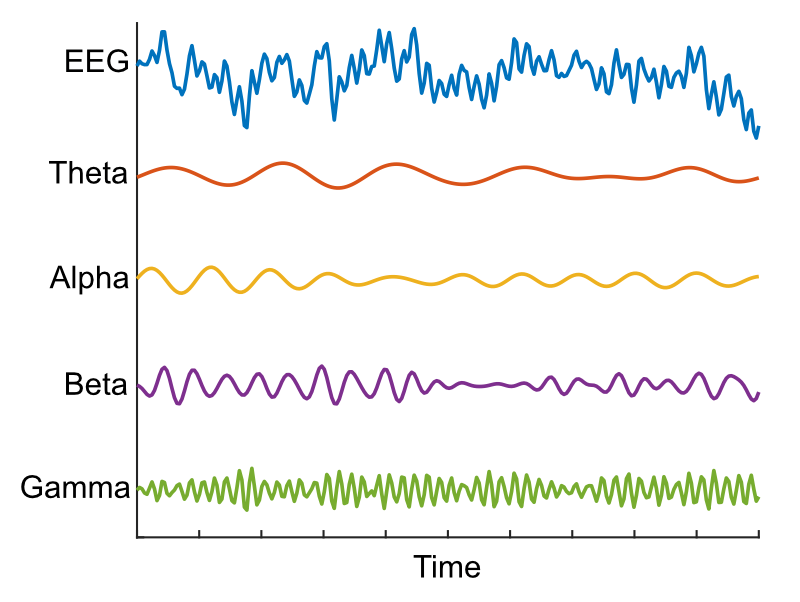
What goes up must come down: The science of brain rhythms | Donders Wonders 

Rhythm is a kind of constraint that is very natural to human beings, because they are a part of nature itself. 

Rhythms are a kind of pattern--a pattern that takes place in time. Waves breaking on the shore have rhythms. Bird songs have rhythms. Your heart beats to a rhythm. 

The brain, too, is full of rhythms--complex rhythms, brain waves, and so on. So, it should be no surprise that we humans are attracted to rhythms and make rhythms. Humans make music with rhythms. Birds are born with their songs, and we are now learning that many can learn new songs and modify old songs. Humans too, seem to be born with a musical sense, only we not only sing (some of us quite poorly), but externalize those rhythms into musical instruments we create. 

When you apply music to words, you get songs and rhythmic poetry. Good songs and poetry combine simple patterns, such as iambic, with more complex patterns, such as the occasional violation of the regular pattern, the subtle differences in lilt, word and syllable length, and stops and pauses due to punctuation and the presence of a cesura (a pause, either naturally placed there by the writer and reader as they read the line, or literally placed there with a space by the poet). 

The combination of regular rhythm and more complex rhythms prevent the poem from becoming too blandly repetitive, and it feels/sounds more beautiful. 

As mentioned above, the brain is rhythmic. It is why we are attracted to rhythms, and why we create rhythms--particularly when we make art. More, the rhythms of poetry and other rhythmic art coordinate the brain's rhythms, making the brain's rhythms match those of the poem, for example. Of course, those rhythms were made by another person, by another brain, so when your brain matches the work's rhythms, your brain is creating similar patterns as those of the artist when the artist was creating. 

Rhythms thus bring us together as people. Drums make us dance together in rhythms and rituals. We get together at concerts to unify in rhythms. A rhythmic speaker is more compelling and will get a group of people to act together. 

There is no mistaking the power of rhythms. Which is why it's a vital element for the most artistic of speech acts: poetry. 


Friday, July 8, 2022

What Is Missing--The Lipogram

Gadsby (novel) - Wikipedia

(Note: links with a star next to them will take you to Amazon pages where you can buy the books in question.)

A lipogram is a kind of rule-based writing in which the author does not use a particular letter. Most of the world's poetry is written using constraints--such as particular rhythms, rhyme schemes, etc.--and this is simply one of the poetic tools you can use. 

 Whenever I have taught writing, I have always given an assignment in which the students were to write a one-page essay without using any words that contain the letter E. This assignment was always met with disbelief that it could even be done. I assured them that it could.

Why would I assign my students to do a lipogram? 

One of the benefits of such an exercise is that it forces you to slow down and think about each and every word you're using. Many writing problems are simply a result of being fast and sloppy. We are used to our language, and too often we think because we have spoken it almost all our lives, that we are masters of it. In a sense, we are, but if that were transferable, we wouldn't have so many people writing so many ungrammatical sentences--sentences they would never speak, as they simply could not speak them, they are so unnatural. 

That may seem an odd situation, but that is perhaps a topic for another post. I'll simply say that while acquiring speech is automatic and natural, writing is a technology that must be actively taught. 

Trying to write an essay without using words containing the letter E is a fun exercise. But imagine trying to write a short story without them. Or try a novel. Impossible? Tell that to Ernest Vincent Wright, author of Gadsby*, and to George Perec, author of A Void (Versa Mundi)*. Me, I simply tried to do it with a poem:

I am a lion, a high-soaring bird,
I'm coiling and hissing a softly hot word.
I am a spirit with amorous wings,
A mouth that can only spill words if it sings.
I am light, not shadow or gravity –
I am a painful and dark black cavity.
Do you know what all I say? I’m smiling
And as I laugh, do you know who I’m styling
My soul against? An abyssal dragon
Has flown into dark clouds and sky – an agon,
War whipping my soul into strong and hard
Long-living spirit that will always stand guard
And bring a gift for all of mankind. Gift?
It’s in a box, a box brought up from a rift,
A box I carry down and carry up –
I cannot touch lunch or drink from a cool cup
Until my body and my blood turn warm
And I unfold again my old human form.
A monstrous animal or living light –
A spirit that in its good growth fashions flight
From fast-growing wings that lift us aloft –
Shall all of us grow hard, or stupid, soft?
I had to go down to climb mountaintops,
This light gift . . . I laugh, so that no laughing stops.

You may be wondering how my students did. Many wrote some pretty terrible pieces (I only graded their ability to not use words with the letter E, to be fair in regards to the assignment), but a few wrote some very beautiful mini-essays. And everyone's writing improved dramatically on their next assignment.

Now, go out and write your own lipogram! It will be fun!

Syllabics

 If you were to come across a ten-syllable lined poem, you would probably expect it to be iambic pentameter. And you would probably be right...