Showing posts with label formal verse. Show all posts

Monday, January 16, 2023

Bob and Wheel

Bardic Gawain: Sir Gawain and the Green Knight - YouTube

 Different languages have developed different poetic traditions because of the sound structures of those languages. For example, the Germanic languages had, early on, before the influence of Latin poetry and those of the Latinate languages (especially Italian and French), been dominated by alliterative forms. 

Alliteration is, of course, the repetition of initial sounds. The Old English poem, Beowulf, and those Norse Sagas written in verse are all alliterative. There are fewer words with end rhymes in the Germanic languages than in the Latinate languages, so as a consequence, other sound patterns emerged. Further, the languages are dominated by hard consonants, so it would be natural for hard consonants in particular to emerge as a rhythmic structuring device. 

In the Latinate languages, we find a lot of end rhymes. Thus, we should not be surprised to find that there is a lot of use of end rhymes in their poetry. Latin poetry was heavily influenced by Greek poetry, which emphasized rhythms such as iambic (which the Greeks considered to be a comic rhythm). As French and Latin entered into the English language, their styles of poetry did as well. Regular rhythms emerged, as did end rhyme. But of course, these things did not just happen overnight.

Thus, after the Norman conquest of England in the 11th Century, it's not surprising that we would find transitional poetry such as that of Sir Gawain and the Green Knight in the 14th century. While the main part of each stanza of The Green Knight is alliterative, each also ends with what is known as a "bob and wheel," in which regular rhythms and end rhyme come into play. 

All three translations I have of The Green Knight include the bob-and-wheel, but only two--Marie Borroff's and Brian Stone's translations--attempt to alliterate throughout the work, while W.S. Merwin's does not (nor do his bob-and-wheels rhyme correctly). The latter does, however, have the original on the facing page. We'll discuss issues of translation at a later date, so I will only note that in the tension between meaning and music, some translators tend toward one over the other. 

The stanza structure in The Green Knight is approximately 15-25 alliterative lines followed by a bob-and-wheel, which has the following structure:

rhythm    rhyme     structure

u/u/           a            bob
u/u/u/        b            wheel
u/u/u/        a            wheel
u/u/u/        b            wheel
u/u/u/        a            wheel

Here is an example of Stone's translation of stanza 30, the last two alliterative lines leading into the bob-and-wheel:

And there was none but said his nay, for never in their lives
Had they set eyes on someone of such hue
        As green.
    His way was wild and strange
    By dreary hill and dean.
    His mood would many times change
    Before that fane was seen. 

I would perhaps have made "many times" "often" in order to perfect the rhythm, but you get the idea of what this structure looks like. In any case, you will note that the bob is enjambed with the last line of the alliterative portion of the stanza. This ensures the continuity of the alliterative portion with the bob-and-wheel.

I've played with this structure myself, though I created a longer bob and a shorter wheel:

        Guide Light

        In the blue is the moon, a milk mass
        Whose place is purple dawn, a pregnant
        Betrayal of time and expectation
        When the sun is supposed to be set in the sapphire
        Alone to light our lives. Who's she
                Who'll be
                So free
            Beside the sun --
            Why won't she run?

        I thought the dark was destined to draw
        Me through my life, to thread and to threaten
        In ceaseless new moon nights that would nudge
        Me graveward and grant me a gravity that death
        Couldn't strangle out of me. Still the steel,
                Reveal
                The wheel
            That turned my life
            From death's blue knife.

        But the moon that is doubling the day will dip
        Into the night enough so that nothing
        Is encompassed by the dark that has come to claim
        My mind -- she will mend my heart and move
        Me to the dawn so the devils will dance
                The lance.
                Entrance
            Me to the day
            Where I can stay.

Certainly, there are other ways you can play with the bob-and-wheel structure, or you can simply use it as originally conceived. While alliteration has gotten a bad name in English poetry for a long time, I suspect that bad name has come about from a degree of Latin-based snobbery. I think there's probably a lot of potential still in alliterative verse, especially to the degree that it draws us into the Germanic origins of English through sound. More, I think there's something charming about the bob-and-wheel structure. It's something worth playing with. What can you create using this transitional structure? How might it become a transitional structure for you? 


Monday, November 28, 2022

Constrained and Unconstrained Poets

 The economic way of thinking begins with understanding that human choice is all walks of life is always exercised against a background of constraints.

The reality of choice within constraints implies that we face trade-offs in making decisions.

Peter Boettke, Living Economics, pg. 22


F. A. Hayek argues that there are two kinds of individualism, one which embraces the "constrained vision" and the other which embraces the "unconstrained vision." Those who believe humans are constrained believe we are naturally social and that there are evolved rules that restrict how humans can act and interact with each other. Those who believe human are unconstrained believe human beings are infinitely malleable, that we can be socially constructed into anything. The former Hayek identifies with the "tragic sense of life." The poet Frederick Turner identifies it with the development of a “culture of hope.” The latter is embraced by the avant-garde of the 20th and 21st centuries.

In poetry, the constrained vision is clearly accepted by the formalists. Of course, I have already argued elsewhere that all poetry—including free verse poetry—is built upon constraints, but formalist poets make those constraints more consciously-chosen. What we could call “unconstrained poets” would be those who write in free verse, but also in avant-garde styles such as dadaism, surrealis, and L=A=N=G=U=A=G=E poetry, among others. 

Free verse poets tend to believe constraints restrict their freedom. Free verse poetry and many of the experiments of literary modernism and postmodernism were attempts at shedding constraints—and were quite often attempts to deny the natural existence and validity of constraints. In their ideal of “automatic writing,” surrealism attempted to deny the validity of making a decision—or at least, conscious decisions—and therefore attempted to create an "act" without decision, direction/goal, or structure. The surrealist artists all considered themselves to be the artistic expression of Marxism, and Marxism is certainly a version of the unconstrained vision of man.

Formalist poets understand that constraints are not necessarily restricting, but rather that they are a necessary condition for freedom. The world is full of constraints, and interesting rules/constraints can create new possibilities you may not have thought of had you been writing a free verse poem. In a certain sense, then a sonnet thus makes one more entrepreneurial, because you have to be alert to new possibilities, because you have constraints in what you can say next (or, in revision, perhaps what you said before). In formalist poetry there are a number of constraints that can force you to make choices—many more choices than you would have to make in free verse, for example.

Of course, not all constraints are the same. There are natural and imposed constraints. There are internally-imposed and externally-imposed constraints. There are predictable and unpredictable constraints. Formalist poetry embraces a combination of natural (rhythms and rhymes) and imposed (this or that particular rhyme scheme or rhythm), internally imposed (by our choices) and externally imposed (by our traditions, within which we necessarily work), and predictable (in a heroic couplet the last word of the second line necessarily rhymes with the first) and unpredictable (having to rhyme may send the writer—and, subsequently, the reader—into a different direction than (s)he first thought the poem was going). But note that the formalist poet is making use of both simultaneously and is not using one at the expense of the other. 

Many of the modernist and postmodernist avant-garde writers insisted that they were rejecting the artificiality of formalism and embracing a more "natural" kind of poetry. The surrealists thought they were being natural, unpredictable, and internal, for example. There was an assumption that nature was chaotic/unpredictable—and that man imposed (and should impose) order from the outside. Self-organization theory helps us to see that a kind of predictable-unpredictable, internal-external natural order can exist, that no external orderer is necessary in nature, or in society. Thus, a good formalist poem is much more like a self-organizing natural system than is a surrealist poem. Neither is more natural than the other, but one could perhaps argue that the former embraces more aspects of reality than does the latter.

On the other hand, one can go in the other direction and have externally imposed, predictable art—but this is propaganda and/or is a product of censorship. In the visual arts, Futurism tried to embrace the completely "imposed"/non-natural. Language, being a spontaneous order itself, always necessarily embodies both elements, making a purely "unnatural" poetry all but impossible—except perhaps in various Dadaist experiments. 

This suggests, then, that the kinds of poetry flourishing at a given time are likely to reflect the way the poets understand the world—as being naturally constrained or naturally unconstrained. Does this mean there are more formalist poets with the tragic view of life? Does this mean that free verse poets are more optimistic about humans being able to design the world? Perhaps. One would expect to see this in the world views they express in their art. 


As we learn more and more about the world, we learn that the world is in fact full of constraints, that there is a power in limits, and that these elements of the world are what have led to ever-greater complexity and order in the cosmos. Does this mean the formalist poets are the one who “got it right”? Hardly. There are plenty of areas in our cultures and societies in which we can and do consciously structure our environments—not the least of which being businesses, legislation, and our organizations. And these are necessary. The free verse poets have their place, and the formalists have their place. Each contributes, and each finds their own kinds of freedoms. 


Each poet must find their voice, and each, I think, can only find their voice by experimenting across the different forms and various versions of free verse and avant-garde poetry. What you end up choosing, though, might say a great deal more about your world view than perhaps you realized.

Monday, October 3, 2022

Monday, September 26, 2022

The Sonnet

The Fountain of Vaucluse--a painting of Petrarch's villa in the south of France--by Thomas Cole (Dallas Museum of Art) 

One of the most famous forms of poetry is the sonnet. While most English speakers are most familiar with the Shakespearean sonnet--a form not invented by Shakespeare, though certainly mastered by him--the sonnet was originally created in Italy, where another famous form, the Petrarchan sonnet (similarly not invented by Petrarch, but mastered by him) emerged. 

The form is a fourteen line poem in iambic pentameter, with various rhyme schemes. Sonnets are divided into parts of different sizes. If you divide it into two parts of seven, you don't have a sonnet. 

The Italian/Sicilian forms are divided into two parts, first part of which is made of eight lines, with the second line having six, with a turn (or volta) that occurs in the second part. A turn is a reversal or shift in the theme, thought, or direction of the poem. As a consequence, the word "however" or "but" or some similar word is not uncommon at the turn. 

The Shakespearean sonnet is a little more complex. It is divided into four parts: an introduction of four lines, a thesis of four lines, an antithesis of four lines, and a synthesis in the final two lines. It can also simply have the turn with the final two lines.

The Petrarchan sonnet is made up of two Italian quatrains, abbaabba, which is known as an Italian octave. This is followed by an Italian sestet, cdecde, or a Sicilian sestet, cdcdcd.

The Sicilian sonnet is made up of a Sicilian octave, abababab, and a Sicilian or an Italian sestet.

The envelope sonnet rhymes abbacddc, followed by a Sicilian or an Italian sestet (rhymed, in this case, efgefg or efefef, respectively). 

The sonnetto rispetto has a ottava rima, abababcc, or a risotto, ababccdd, followed by either an Italian or a Sicilian sestet.

The Spencerian sonnet has three interlocking Sicilian quatrains, abab bcbc cdcd, followed by a volta and heroic couplet, ee. 

The terza rima sonnet contains a terza rima, aka bib cdc did, followed by a turn and a heroic couplet. A terza rima is, as you can see, made up of interlocking Sicilian triplet stanzas. 

The English or Shakespearean sonnet is the one most English readers are familiar with. It's made up of three Sicilian quatrains, abab cdcd efef, and a heroic couplet. 

The blues sonnet is made up of four blues stanzas and a couplet. The blues stanza is AAa, where AA are identical words, giving us the following form: AAa BBb Ccc Ddd ee.

Naturally, one could come up with a number of other rhyme schemes, and there have been poets who have abandoned rhyme altogether. And while sonnets have traditionally been in iambic pentameter, it's possible to have different line lengths and different rhythms as well. The main restrictions remain the requirement of fourteen lines, an uneven division, and a turn. 

Take, for example, the poem The Love Song of J. Alfred Prufrock by T.S. Eliot. It contains two full sonnets, both ending with the same couplet. I'll only discuss the first one, which opens the poem.

Let us go then, you and I,
When the evening is spread out against the sky
Like a patient etherized upon a table;
Let us go, through certain half-deserted streets,
The muttering retreats
Of restless nights in one-night cheap hotels
And sawdust restaurants with oyster-shells:
Streets that follow like a tedious argument
Of insidious intent
To lead you to an overwhelming question ...
Oh, do not ask, “What is it?”
Let us go and make our visit.

In the room the women come and go
Talking of Michelangelo.

First note that the lines are of different lengths: 7, 11, 12, 11, 6, 10, 10, 11, 7, 11, 7, 7, 9, and 8 syllables.

While many of the lines are iambic, including the 10-syllable, making them iambic pentameter, there is some variation in rhythms. And there is a rhyme scheme: aabccddeefgg hh. The scene seems to be a party, and the narrator is proposing to someone that they leave the party; however, in the turn, we have people at the party who are intending to stay. 

I'm not going to go into a full analysis. I just wanted to point to how one experienced, Modernist poet used the sonnet form within a longer poem, and did variations on the sonnet form itself. 

Finally, one can use sonnets in a series. 

The sonnet redoubled uses fifteen sonnets, with the first sonnet providing, line by line, the final line of each of the next fourteen sonnets. In other words, line one of the first sonnet will be the final line of the second sonnet, line two of the first sonnet will be the final line of the third sonnet, etc. To say this is difficult is an understatement, and it's very likely you'll have to go back and forth, massaging each sonnet until they all work and make sense. 

With my poem Time For Love and Art, I did my own kind of series of sonnets in which I used the couplet of each sonnet as lines 1 and 3 for the following sonnet, with the final sonnet having a couplet made of lines 1 and 3 of the first sonnet, making it the entire series circular and the sonnets themselves interlocking. I'm sure it's something someone else has probably done, but you never know. 

In the end, the sonnet remains a generative form. While Modernist and postmodernist poets complain about the restrictions of the form, I would argue that the restrictions make it highly generative. I certainly have used the sonnet--much more than any other form--and I do not feel restricted or that it's been remotely exhausted. I'm particularly attracted to the Shakespearean sonnet's dialectical movement, as I am myself a dialectical thinker. And while, traditionally, sonnets have been love poems, this has hardly been the case since Baudilaire, and you'll find a great many sonnets on a great many topics. 

Indeed, there are still many ways to use and challenge the sonnet form. One could take the forms divisible into four parts and write three quatrains and a couplet on a theme, as I do in my poem Four Displays, or you can even write those four sections as four unconnected poem and create a kind of surrealist or postmodernist juxtaposition that potentially pushes the reader into more complex ways of thinking and making connections. 

So, I encourage you to write sonnets. I have used the form too in my teaching, as I explain here. Again, the restrictions are precisely what are generative of good writing and interesting thoughts. And isn't that what we expect from poetry? 

Monday, September 5, 2022

Meter

*

Verse is metered language. What, though, is meter? 

"Meter" comes from the Ancient Greek "metron," meaning "measure." When we measure, or count, our lines, we are writing in meter. 

The simplest way to write meter is to simply count syllables. When we are writing poems with lines containing the same numbers of syllables, we are writing in what is called syllabics. In syllabics, we are not concerned about the placement of stressed and unstressed syllables or the length of syllables. These are common in languages which are not stressed, like Japanese, or tonal, like Chinese. However, in a language like English or German, our words are either stressed or unstressed. As a result, syllabics often sound stressed anyway.

Coincidentally, the Greek language, on which we have based most of our regular syllabic structures, wasn't stressed, but rather was made of long and short syllables. Such poetry is called quantitive verse. 

Most readers of poetry will be familiar with poetry with lines containing patterns of stressed and unstressed syllables, called feet. The best-known poetic foot in the English language is the iambic foot, which is a simple alternation of unstressed and stressed syllables. 

We mark stressed syllables with a "/" and unstressed syllables with a "˘", which sounds "da-DUM."

   ˘ / ˘ / ˘ / ˘ / ˘ /

Shall I compare thee to a summer's day?

  ˘ / ˘ / ˘ / ˘ / ˘ /

Thou art more lovely and more temperate!

Here, in Shakespeare's famous sonnet, we have lines of alternating iambic feet. Since there are five iambs, we call this a pentameter--"penta" for "five," meaning five-count. An iambic pentameter is thus a five-count of iambs. 

  • Dimeter: contains two metrical feet
  • Trimeter: contains three metrical feet
  • Tetrameter: contains four metrical feet
  • Pentameter: contains five metrical feet
  • Hexameter: contains six metrical feet

These are going to be the most typical meters. As Frederick Turner and Ernst Poppel argue in their essay The Neural Lyre (also found in Turner's book Natural Classicism, above), we're typically going to find the ten syllables of iambic or trochaic pentameter to be most "comfortable" in English because it fits into our auditory moment of about 3-4 seconds. If we're using anapest or spondee, then, a trimeter or tetrameter would fit that moment best. 

This, of course, gets us to the issue of regular rhythms. The most common regular rhythms in poetry are the following:

iamb:      ˘ / (ex: compare)

trochee: / ˘ (ex: summer)

spondee: / / (ex: Bang! Bang!)

anapest: ˘ ˘ / (ex: of unstressed)

dactyl: / ˘ ˘ (ex: beautiful)

There are, of course, others:

pyrrus: ˘ ˘

tribrach: ˘ ˘ ˘

amphibrach: ˘ / ˘

bacchius: ˘ / /

cretic: / ˘ /

antibacchus: / / ˘

molossus: / / /

The tribrach and the molossus are the most difficult to create because if there are three unstressed syllables in a row, we'll tend to hear one of the unstressed syllables as stressed; and equally, if there are three stressed syllables in a row, we'll tend to hear one of them as unstressed. To get your listener to hear a tribrach, you would likely have to have a very strongly stressed syllable on either side of it.

With most of these feet (excepting tribrach and molossus), you can use each of them to create a regular rhythm. With all of them, though, you can use them in combinations. For example, the Sapphic stanza is made up of three Sapphic lines and an adonic line. The Sapphic lines are two trochees, a dactyl, and two trochees, while the adonic line is a dactyl followed by a trochee. Thus, the Sapphic stanza is as follows:

/ ˘ / ˘ / ˘ ˘ / ˘ / ˘

/ ˘ / ˘ / ˘ ˘ / ˘ / ˘

/ ˘ / ˘ / ˘ ˘ / ˘ / ˘

/ ˘ ˘ / ˘

Note that the first three are 11-syllable lines (hendecasyllabics) in pentameters of mixed feet.

As one can imagine, there are a large number of potential combinations of syllabics, meters, and feet--an infinite variety if we ignore the requirement for the creation of line lengths that fit in the auditory moment. It's possible to create very complex meters and then repeat them in each line--or in alternating lines, or some other pattern. I would recommend that if you want to retain the word as a form of verse, though, that there be some kind of regularity--the simple and the complex have to be in balance--otherwise, you'll simply end up creating prose. And there's no need to figure out the meter and feet to write prose.

Another way meter is created is through the use of the caesura. A caesura is a pause in the middle of a line. The caesura helps to create a rhythm both within the lines and across the lines. If you use punctuation in the middle of your line, you'll create a natural caesura. But even without punctuation, the reader will create a natural (though weaker) pause in the middle of a long-enough line. While many English poems aren't built around caesuras, traditional Germanic (including Old English/Anglo-Saxon) verse was built around the caesura, with patterns of alliteration being determined by that internal pause.

Finally, in contradistinction to the caesura, where there's a pause in the middle of a line, there's enjambment, which means the syntax of a line isn't contained by that line, but is rather continued into the next line. Another way of putting it is that the line doesn't end with punctuation. The result is that a line that ends with punctuation is a harder pause than one without punctuation.

Regular number of syllables, feet, caesuras, and enjambment (and rhymes) are all ways to create meter, and to make for complex meters. It's important to both maintain regularity and disrupt that regularity simultaneously in order to prevent the reader from getting bored.

Remember, too, that changes in patterns are meaningful to the reader. Take advantage of that fact. If there's a change in feet (using a trochee instead of an iamb in a particular line, for example), then that word should probably be important. The same could be said of rhymes--your rhyming words should be more important than articles or prepositions, unless they're being used there for some kind of effect (meaning, they have meaning in being there).

Of course, there are also variations in stress--some syllables are more stressed than others, and this creates a more complex music over the regularity of the meter.

Things get even more complex if we read poems aloud, because then we add things like pitch, loudness, length, and timbre. Much of this will of course depend on how the reader chooses to read it, if the person has a high or low voice, if they think it would sound better loud or quiet, with longer or shorter time pronouncing given syllables, and personal, regional, or cultural speaking patterns.

All of this means that metered poetry is fundamentally musical. Encyclopedia Britannica's entry on rhythm even contains musical notation. This musicality brings both sides of the brain together--music and language--into a fuller, more complex art.

Verse is metered language. Meter is an artistic tool. It is what makes poetry a language art. The more we think about these kinds of rules, the more artistic our art will be.

Monday, August 8, 2022

Secular Free Verse vs. Religious Formal Verse

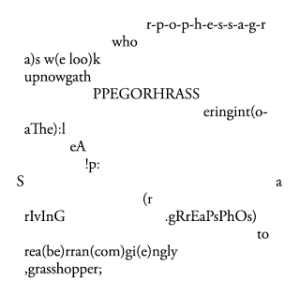
grasshopper[1]E.E. Cummings, "The Grasshopper"

 I think there are good reasons why formal poetry the world over preceded free verse and artistic prose. Those reasons are likely to be biological rather than directly connected to religion, but the ancient naturalness of both seem to be connected.

On the other hand, free verse and the non(anti)-formalist verse that followed seem to be distinctly secular in manmade-and-therefore-"unnatural" fashion. (There is nothing unnatural humans do, though there are choices which are more conscious and choices which are more instinctual, even if the latter, in poetry, follows manmade forms.) The anti-formalists often argued that formal verse was antidemocratic, indeed, elitist—while their verse was democratic and anti-elitist. Of course, the opposite was true. People prefer lyrical rock, country, and rap songs to surrealist, LANGUAGE, and postmodern poetry. It was the latter which the masses hated, loving formal verse. 

With the addition of music especially, formal verse seems to tap into a deep Dionysian element that much 20th century free verse and almost all postmodern anti-formalist poetry completely discards in favor of the Apollonian. Formal verse seems to tap into the very rhythms of the universe—including our mental/neural universe—which makes it deeply religious in its experience. This is something free verse, and especially anti-formalist verse, cannot typically create, whatever other interesting elements they may have. In this sense nonformalist poetry is deeply secular insofar as it cannot connect us to those deep rhythms which we describe as religious.

Poetry is likely to have its origins in song. Songs and poetry are the reunion of language and music, which bifurcated from an ancestral primate mating song (think gibbons). Indeed, we know that The Iliad and The Odyssey were sung, and these were religious texts. It seems likely that perhaps most initial songs were connected to religion as well. Of course, if you want to get right down to it, songs and dancing were both likely connected to mating calls and sexual demonstrations (as they still do). At the same time, I am convinced that the emergence of language gave rise to the simultaneous emergence of religion. Which may be why the earliest narratives are religious texts. This double origin of poetry—in sexual music and language-giving-rise-to-religion is probably why there is so much tension with religion and sex in poetry.

If the idea of formal/rhythmic verse being "religious" makes you uncomfortable, think rather of it being connected to the spirit, of being spiritual. There are many spiritual traditions, and they all had formalist kinds of verse associated with them. More than that, if you want your poetry to make a kind of spiritual connection with your audience—if you want a Dionysian element to your poetry—then formalist verse is truly the way to go.

This isn't to say that formalism is superior to non-formal verse. The Modernist non-formalists certainly made some major contributions in the creation of free verse and in surrealist poetry. However, I would argue that, for the most part, postmodern non-formal verse is primarily academic in nature, and the content of such poetry reflects that fact. The academic poets do have something to say, and they do have something to contribute to poetry as a form. What would perhaps be interesting, though, is the synthesis of what the non-formalists have discovered with the spiritualism of the formalists. It doesn't have to be either-or, after all. Both-and can crate some interesting works.

Monday, July 25, 2022

Rhyme Schemes


Rhyme is the repetition of sounds. As previously noted, alliteration is a form of rhyme. However, when most people think of rhyme, they think of end rhyme. While end rhyme has fallen out of favor in poetry, it's never fallen out of favor in songs, and it's an absolutely vital element of rap. In fact, a well-known term for rap battles and freestyle rapping is "dropping rhymes." 

If we're to be honest, the only place where rhyme has lost favor is among academics who study poetry. Your average person loves rhyme. That's why songs and rap continue to be full of rhymes. 

For a rhyme to be an end rhyme, it not only has to be found at the end of a line (which is, after all, why it's called an end rhyme), but it has to rhyme on the stressed syllable. If it only rhymes on the stressed syllable, it's called a masculine rhyme; if it rhymes using both the stressed and a following unstressed syllable, it's called a feminine rhyme. 

  • Masculine -- thick / quick
  • Feminine -- thickly / quickly

Of course, one can get really playful with one's rhyme and have three or even four syllables rhyming. 

However, there are a few "rhymes" that aren't actually rhymes. For example, stick and stick don't rhyme. They don't rhyme because they are the same word. A word rhymes only if it has part of the same sound(s), not if it is literally the same word in sound. Also, a stressed syllable doesn't rhyme with an unstressed syllable. The word three doesn't rhyme with quickly, for example. 

There are many kind of rhyming patterns (or schemes) you can use. We use letters to designate pattern. For example, if you have a ABAB rhyme pattern, the first line has to rhyme with the third line, and the second line has to rhyme with the fourth. 

Here are some popular rhyme schemes:

  • Couplets -- AA
  • Triplets -- AAA
  • Alternate rhyme -- ABAB
  • Enclosed rhyme -- ABBA
  • Simple four-lined rhyme -- ABCB

In addition to these would be the mono rhyme, where each line has the same rhyme.

Of course, there are also different forms that rely on very specific rhyme schemes, such as the Petrarchan sonnet, the Shakespearean sonnet, the villanelle, the terza rima, the ballade, the ruba'i, and the limerick, among others. 

While I'll be talking about both kinds of sonnets, the villanelle, the ballade, and the limerick later, because they have other features beyond rhyme, I will note that the terza rima and the ruba'i are primarily just particular rhyme schemes:

terza rima -- ABA BCB CDC DED EFE FGF

ruba'i -- AABA

Note that the terza rima is a particular rhyme scheme because it is interlocking. The central end word becomes the first and third rhymes of the next triplet. Thus, the poem is partly driven by the interlocking rhymes. 

The ruba'i can either stand as a single quatrain poem, be a series of similar quatrains, or be interlocking as well--AABA BBCB CCDC, etc. When it's a series, it's called a rubaiyat.

One of the interesting things about using end rhymes is that, because you are forced to fit the rhyme, you are oftentimes forced to find something more interesting than what we originally came up with. Sometimes, it can send the poem into unexpected directions. A lot of people don't like this, because they want to feel like they are in complete control over the work. But that's the wrong attitude to have when it comes to writing poetry. 

Rhyme allows you to both create the expected--the rhyme--with the unexpected in the question of what particular word will rhyme. And when it forces you, as a writer, to do somewhere other than where you thought you'd be going, it results in a combination of the expected and the unexpected in the very themes and topic of the poem. Anytime you can create a balance between the expected and the unexpected, you're going to be writing a better work than if it was all completely expected (boring) or completely unexpected (confusing). 

Rhyme is one of those constraints that can make your poem more interesting and artistic. 


Friday, July 15, 2022

Prosody

Todd Camplin

Everyone has a prosody, or theory of poetry composition. That theory can (and often is) a general theory of how one should "properly" write poetry, of how you yourself prefer to write poems, and/or of how any given particular poem will be written. 

In the latter case, I may decide that an idea I have for a poem will be best expressed as a sonnet. My theory of composition for that poem, then, will include making it only 14 lines, with the poem split up into  uneven parts (a 14-line poem divided into two balanced 7-line stanzas isn't a sonnet). There will then have to be a rhyme scheme that helps divide the poem into parts. The Patrarchan sonnet is divided into two parts, while the Shakespearean sonnet is divided into four, as we can see below.

Petrarchan rhyme scheme:

ABBAABBA CDECDE

Shakespearean rhyme scheme:

ABAB CDCD EFEF GG

There are other details about sonnets we will go through in another section, but we're just going to focus on a few things here.

Sonnets are typically composed using iambic pentameter, so that would be part of one's theory of composing one's sonnet. And so on.

Of course, we don't typically just write poems where we're changing our theory of poetry composition from poem to poem. We also have our own personal theory of composition. 

When I first started writing poetry, I wrote free verse poems. That is the most common form being written today, and most poetry-writing classes will not encourage you to write poems in any other way. I didn't at the time have any sort of conscious theory of poetry composition, but a few things did recur that kind of acted as a finger print on my poetry, and which basically constituted a tacit theory. If you have written a number of poems, you likely have such at tacit theory at the very least. This is likely also reflected in the kinds of poems you like to read. 

Later, I met the poet Frederick Turner, and because of his influence, I started writing formalist poetry. I started writing formalist poetry because I encountered Turner's general theory of poetry composition. He argued in favor of formalism on the basis of how our brains work, being rhythmic, pattern-detecting, pattern-making systems. I became persuaded, and this in turn affected my personal prosody. I became a formalist, and the prosody of each poem was then affected. 

I want you to think about your own prosody. What is your personal theory of poetry composition? What is your general prosody (how do you think poems ought to be written)? Why? Why do you think prosody can change from poem to poem? That is, why do you think one poem seems "right" as a sonnet, while another seems "right" as an ode, and another seems "right" as free verse?

Syllabics

 If you were to come across a ten-syllable lined poem, you would probably expect it to be iambic pentameter. And you would probably be right...