Showing posts with label rhythms. Show all posts

Monday, November 21, 2022

Making Meter

*

In a previous lesson, I discussed the nature of meter. However, knowing what meter is and knowing why using it in poetry is important, and writing meter are hardly the same thing. Since these lessons are intended to help you write poetry, theory has to meet practice. 

There's a degree to which the English language follows a simple iambic pattern, which results in many people writing mostly iambic verse unconsciously. But art is supposed to be purposeful--at least, to a great degree. As an artist, I want to make sure that I am using the words I want to use, the rhythm I want to create, and so on. To this end, we need to try to understand how the English language naturally falls into certain rhythmic patterns. 

Most people have difficulty learning to write in rhythm. Many fall into writing free verse because of this difficulty. However, nobody should be writing free verse because they cannot write in iambic pentameter, trochaics, or whatever rhythmic patterns you can imagine. That is like becoming an abstract expressionist artist because you cannot draw. You're not making a choice in the matter--the lack of skill is what's directing what you do--and if you're not making a choice, you're not an artist. That's why getting all the fundamentals down is important. 

There are many words and syllables which are naturally stressed or unstressed. However, there is variability of how stressed a given syllable may be, and context can certainly matter. A weakly unstressed syllable or word can be pressed into becoming stressed by being surrounded by more strongly unstressed syllables/words. The same is true of stressed words and syllables--if a weakly-stressed syllable is surrounded by more strongly stressed syllables/words, it will become unstressed. To practice, though, it's probably good to try to stick with simple, clear stressed-unstressed syllables.

There are several shortcuts to getting a rhythm down in your poem.

The first thing to note is that the articles--a, an, the--are all unstressed words. 

   ˘ /

The rock

It's hard to push an article into being stressed, but hardly impossible. 

A word like "of" is typically going to be unstressed, but it can be easily pushed into being stressed. For example:

   ˘ / ˘ /

The Book of Forms

   ˘ / ˘ / ˘ / ˘

The Making of a Poem

In the above book titles, the rhythm of the word "of" is different because of the words which surround it. In the first, "book" and "forms" are both strongly stressed, so there's no question about whether or not "of" should be unstressed. In the second, "making" is stressed-unstressed, and "a" is unstressed. "Of" is thus surrounded by strongly unstressed syllables, pushing it into being slightly stressed. 

This can also happen within words. For example, the word "able" is stressed-unstressed. However, notice what happens when you make it a suffix of "believe":

 ˘ / ˘ /

believable

The strong stress of the second syllable of "believe" pushes the "a" of "able" into becoming unstressed, and the "ble" into becoming stressed. You'll note that this is very common in words with the suffix "able."

Indeed, the stresses in "believe" are strong enough that they will even turn a prefix such as "un," which is typically unstressed, into being stressed:

/ ˘ / ˘ /

unbelievable

Here, we have another example of a natural unstressed syllable, which is the suffix. Much of the time, both prefixes and suffixes are unstressed. (Ironically, the words "prefix" and "suffix" violate this general pattern.)

As just noted, prefixes are typically unstressed.

  ˘ / ˘ / ˘ /

unkempt        unloved       unfair

  ˘ / ˘ / ˘ / ˘

before            behind          befuddled

Notice that, though the "b" sound is a strong sound and might typically be part of a stressed syllable, the "be" prefix is nevertheless unstressed.

In "befuddled," we also see that the "ed" ending, when fully pronounced, is unstressed. This is typical of suffixes. If we take the stressed word "love," and add the "ly" suffix, we get

  / ˘

lovely

Suffixes added to a stressed word will thus be unstressed:

  / ˘.  / ˘    / ˘

granted          truly         walking

Again, the presence of an unstressed syllable at the end of the root word can press the suffix into being stressed:

/ ˘ / / ˘ /

fidgeted          nervously

As you can see, then, this is more an art than a science (it is poetry, after all). However, the general rule that articles, prefixes, and suffixes are unstressed will generally help you create regular meters. As you practice using very strongly stressed and unstressed words, you will eventually hear the rhythm and internalize it more and more. Once that happens, you can then play around with less clearly stressed and unstressed words and syllables, and play around with metrical patterns to create meaning in violations of a regular meter. 

The greatest art, including the greatest poetry, is balanced between regularity and irregularity. The variations within stressed and unstressed syllables themselves help to create additional music/rhythms on top of the regular rhythms of iambic, anapestic, trochaic, etc. meters. As you learn to hear the regularities, you'll start to write good, solid meter. Once you hear the regularities, you'll then be more able to hear the irregularities as well. And then, you'll start to write more complex, more beautiful meter--and do so more intentionally as well. 


Monday, November 7, 2022

Acrostic Poetry

By Dearborn - American Broadsides and Ephemera, Series 1, Public Domain

 An acrostic poem is a poem in which the first letter of each line, read from top to bottom, makes a word, phrase or sentence. This can be a fun way to create a poem through yet another kind of restriction--in this case, a restriction on what the word beginning of each line must be. 

Let's say, for example, that I wanted to write a love poem to my wife, Anna. I could have an acrostic of

TROY LOVES ANNA

The weight within me has been borne by you,
Rewarding in this constant rain of sun
Over the clouds, the clouds that blanket through
Your warmth, your warmth which past this pain has run.

Low though I go, I can but go so low
Out in the wilderness where all the snakes,
Vipers have struck, but shed their skins--we know
Enough to know we'll be reborn. Cool lakes
Shall baptize us and, cleansed, we both shall grow.

A warmth has broken through--the stones will warm,
Now we shall settle in the sun together,
Naked to all the world in our new norm
Of love resisting venom, drowning, weather.

If we really wanted to challenge ourselves, we could even do an acrostic with a telestich (the last letters spell out the word), to do a double acrostic. Here, we could do 

TROY (first letters of the lines) and ANNA (last letters of the lines)

There's nothing in the lovely realm of flora
Rewarding to my eyes as what I've won
On that July where us truly'd begun--
You are my ever-shining, bright aurora. 

For my money, using acrostics in a free verse poem would "cheating" simply because that would make your task much easier. And where's the fun in that? The point of all constraints is precisely that it's supposed to make you wrack your brain, twist and turn your words and sentences, until you find something that fits. The more restrictions you have, the more twists and turns you'll have to make, and the more likely it will be that you'll have to find something you wouldn't have otherwise thought of on your own. And that's when your poetry truly gets interesting. 

Of course, with something like acrostic poetry, there are inevitably going to be those who object that you're simply engaging in word play, that it's not serious. Well, what else is poetry in general but word play? And what else is play than a nonserious thing done seriously? An acrostic poem is or can be as serious as any other form. More, you can add layers to the poem, having a serious sentence read down in an otherwise light poem, or vice versa. Especially if you don't point out that the poem is acrostic. Just let your reader discover it. 

Of course, there are any number of other things you could do to play around with the idea of acrostic. You could have the first letter of the last word of each line spell out a word. You could have a triple acrostic in which the first letters of the first word, the caesura, and the last word could each make a word. Or you could write a triple acrostic with the last letter of the last word spelling out the word. One could even invent a kind of alliterative "acrostic" in which the alliterating letters are what spell out the word(s) in question. 

I'm tempted to try, to tip-toe these terms
Round rhythms and rhymes that reel through the real,
On over through other orbiting orbs
Of yesterday's yearnings for yokes of yore.

Monday, September 5, 2022

Meter

*

Verse is metered language. What, though, is meter? 

"Meter" comes from the Ancient Greek "metron," meaning "measure." When we measure, or count, our lines, we are writing in meter. 

The simplest way to write meter is to simply count syllables. When we are writing poems with lines containing the same numbers of syllables, we are writing in what is called syllabics. In syllabics, we are not concerned about the placement of stressed and unstressed syllables or the length of syllables. These are common in languages which are not stressed, like Japanese, or tonal, like Chinese. However, in a language like English or German, our words are either stressed or unstressed. As a result, syllabics often sound stressed anyway.

Coincidentally, the Greek language, on which we have based most of our regular syllabic structures, wasn't stressed, but rather was made of long and short syllables. Such poetry is called quantitive verse. 

Most readers of poetry will be familiar with poetry with lines containing patterns of stressed and unstressed syllables, called feet. The best-known poetic foot in the English language is the iambic foot, which is a simple alternation of unstressed and stressed syllables. 

We mark stressed syllables with a "/" and unstressed syllables with a "˘", which sounds "da-DUM."

   ˘ / ˘ / ˘ / ˘ / ˘ /

Shall I compare thee to a summer's day?

  ˘ / ˘ / ˘ / ˘ / ˘ /

Thou art more lovely and more temperate!

Here, in Shakespeare's famous sonnet, we have lines of alternating iambic feet. Since there are five iambs, we call this a pentameter--"penta" for "five," meaning five-count. An iambic pentameter is thus a five-count of iambs. 

  • Dimeter: contains two metrical feet
  • Trimeter: contains three metrical feet
  • Tetrameter: contains four metrical feet
  • Pentameter: contains five metrical feet
  • Hexameter: contains six metrical feet

These are going to be the most typical meters. As Frederick Turner and Ernst Poppel argue in their essay The Neural Lyre (also found in Turner's book Natural Classicism, above), we're typically going to find the ten syllables of iambic or trochaic pentameter to be most "comfortable" in English because it fits into our auditory moment of about 3-4 seconds. If we're using anapest or spondee, then, a trimeter or tetrameter would fit that moment best. 

This, of course, gets us to the issue of regular rhythms. The most common regular rhythms in poetry are the following:

iamb:      ˘ / (ex: compare)

trochee: / ˘ (ex: summer)

spondee: / / (ex: Bang! Bang!)

anapest: ˘ ˘ / (ex: of unstressed)

dactyl: / ˘ ˘ (ex: beautiful)

There are, of course, others:

pyrrus: ˘ ˘

tribrach: ˘ ˘ ˘

amphibrach: ˘ / ˘

bacchius: ˘ / /

cretic: / ˘ /

antibacchus: / / ˘

molossus: / / /

The tribrach and the molossus are the most difficult to create because if there are three unstressed syllables in a row, we'll tend to hear one of the unstressed syllables as stressed; and equally, if there are three stressed syllables in a row, we'll tend to hear one of them as unstressed. To get your listener to hear a tribrach, you would likely have to have a very strongly stressed syllable on either side of it.

With most of these feet (excepting tribrach and molossus), you can use each of them to create a regular rhythm. With all of them, though, you can use them in combinations. For example, the Sapphic stanza is made up of three Sapphic lines and an adonic line. The Sapphic lines are two trochees, a dactyl, and two trochees, while the adonic line is a dactyl followed by a trochee. Thus, the Sapphic stanza is as follows:

/ ˘ / ˘ / ˘ ˘ / ˘ / ˘

/ ˘ / ˘ / ˘ ˘ / ˘ / ˘

/ ˘ / ˘ / ˘ ˘ / ˘ / ˘

/ ˘ ˘ / ˘

Note that the first three are 11-syllable lines (hendecasyllabics) in pentameters of mixed feet.

As one can imagine, there are a large number of potential combinations of syllabics, meters, and feet--an infinite variety if we ignore the requirement for the creation of line lengths that fit in the auditory moment. It's possible to create very complex meters and then repeat them in each line--or in alternating lines, or some other pattern. I would recommend that if you want to retain the word as a form of verse, though, that there be some kind of regularity--the simple and the complex have to be in balance--otherwise, you'll simply end up creating prose. And there's no need to figure out the meter and feet to write prose.

Another way meter is created is through the use of the caesura. A caesura is a pause in the middle of a line. The caesura helps to create a rhythm both within the lines and across the lines. If you use punctuation in the middle of your line, you'll create a natural caesura. But even without punctuation, the reader will create a natural (though weaker) pause in the middle of a long-enough line. While many English poems aren't built around caesuras, traditional Germanic (including Old English/Anglo-Saxon) verse was built around the caesura, with patterns of alliteration being determined by that internal pause.

Finally, in contradistinction to the caesura, where there's a pause in the middle of a line, there's enjambment, which means the syntax of a line isn't contained by that line, but is rather continued into the next line. Another way of putting it is that the line doesn't end with punctuation. The result is that a line that ends with punctuation is a harder pause than one without punctuation.

Regular number of syllables, feet, caesuras, and enjambment (and rhymes) are all ways to create meter, and to make for complex meters. It's important to both maintain regularity and disrupt that regularity simultaneously in order to prevent the reader from getting bored.

Remember, too, that changes in patterns are meaningful to the reader. Take advantage of that fact. If there's a change in feet (using a trochee instead of an iamb in a particular line, for example), then that word should probably be important. The same could be said of rhymes--your rhyming words should be more important than articles or prepositions, unless they're being used there for some kind of effect (meaning, they have meaning in being there).

Of course, there are also variations in stress--some syllables are more stressed than others, and this creates a more complex music over the regularity of the meter.

Things get even more complex if we read poems aloud, because then we add things like pitch, loudness, length, and timbre. Much of this will of course depend on how the reader chooses to read it, if the person has a high or low voice, if they think it would sound better loud or quiet, with longer or shorter time pronouncing given syllables, and personal, regional, or cultural speaking patterns.

All of this means that metered poetry is fundamentally musical. Encyclopedia Britannica's entry on rhythm even contains musical notation. This musicality brings both sides of the brain together--music and language--into a fuller, more complex art.

Verse is metered language. Meter is an artistic tool. It is what makes poetry a language art. The more we think about these kinds of rules, the more artistic our art will be.

Monday, August 29, 2022

Patterns and Poetry

*

"All art [is] cognitive play with pattern"--Brian Boyd, Why Lyrics Last, pg. 5

Rhythm and pattern are fundamental to understanding and finding meaning in the world. Rhythms and patterns are examples of a particular rule found at every scale of nature. Both involve repetitions of either objects (which would include grammatical structures and syntax) or sounds (such as rhymes and regular rhythms such as iambic). Poetry that has rhythms and patterns are thus participating in and adding to nature as nature itself expresses itself.

In Aeon Magazine there is a fascinating article on repetition and music. In it the author notes that people consider repeated sounds as more musical. More, repeated words become more like songs.  And by extension, more like poetry. 

What this implies, then, is that Fred Turner is right about poetry in, well, everything he has written about poetry. Poetry is repetition. It is repeated sounds, repeated rhythms, repeated words, repeated structures. This would also explain why some forms of poetry involve repeated lines. 

Sonnets, for example, have repeated sounds in the end rhymes and in the iambic pentameter rhythms.

With ghazals there is the repetition of the end phrase.

Then there is the villanelle, in which we have entire lines repeated. 

But if we take a poem like my poem In the Multiverse, one may wonder how it is any different from prose simply cut up into lines:

In the Multiverse

If there are really many universes,
As many physicists now claim, if there
Are infinite universes out there–
Then I exist an infinite number
Of times and places, and so do my wife
And baby daughter. In some, sadly, I
Do not exist; in some, my wife and I,
We never met. And that’s the tragedy.
But out there too my mother also lives
And, living, knows and loves my daughter who,
In my own universe, she’s never seen
–
And, knowing that, I think on it with joy.

Well, first, the poem is in iambic pentameter, so there is that level of repetition. But it is in blank verse, so sound repetition seems gone. But note that there are in fact several repetitions of sentence patterns:

"If there are..." is repeated. "In some," is repeated. "And, [progressive verb]," is repeated. As we've discussed before, parallelism such as this is a kind of repetition, and is not uncommon in poetry--see for example the Psalms. 

But is non-repetitive poetry even possible? If not, what do we make of the works out there called poetry but do not have repetition? Are they merely prose with line breaks? 

The writer who wants to successfully move his audience is one who will use repetition. If you want to make memorable works, you have to use repetition. If you want your work--poem, prose, play--to embed itself in the minds of your readers, you have to use repetition. With repetition, your reader, viewer, listener will go away with you forever in their minds. The more repetitions (without being overbearing), the more patterns and rhythms, the more memorable overall.

Patterns are spatially organized. They are arrangements of forms and/or colors, which is to say, they are designs. In literature, they create meaning and motif. They are imitations or copies, which comes from the etymology of “pattern,” derived from the Old French, patron, since a client would copy his patron, since the patron provided a model for the client to follow–the patron would act as the ideal, example, exemplar. Thus there a connection between patterns and ethics, and between beauty and ethics, since patterns are part of beauty. 

Rhythms, from the Greek rhein, to flow, are temporally organized. Rhythms are regular repetitions over time, typically of sound. Nonetheless, there is a connection to pattern: in a work of art, a rhythm holds the parts together to create a harmonious whole through the repetition of form and/or color. Since rhyme come from the Greek rhythmós, we see that rhyme is a kind of rhythm. There is also an ethical component to rhythm, since a rhythm in biology is a pattern of involuntary behavior or action that occurs regularly and periodically. 

In the realm of behavior, rhythms are involuntary actions, whereas patterns are consciously followed. A rhythm is meant to carry us along, to help our actions flow, while patterns help create meaning by making us more conscious. In this formulation, one could see rhythm as Dionysian, or (to use Milan Kundera’s terms) Demonic, while patterns would be Apollonian, or Angelic. A tragic work of art, using Nietzsche’s formulation, would be one that contains both rhythm and pattern.

Brian Boyd, in his book Why Lyrics Last, argued that we have an "innate attraction to information that we can see as patterned, since if we recognize patters we can process information rapidly, in real time" (5). He also argues that there is a "hyperconcentration of pattern in pure lyric" (5), by which he means the regular rhythms, rhymes, etc. typically found in formalist verse. However, there are other patterns which can emerge when we have stories. If the story is long enough, such as a novel, we can end up with very complex patterns--fractal patterns--of theme words, as I demonstrated in my dissertation (the relevant chapter of which you can find and read here). 

Stories make poems easier for the reader to engage with the poem because narrative structure is the pattern we live and think by. This isn't to say that lyric poems ought to have what we typically think of as a standard story structure, but certainly if you have some sort of story in mind, the reader will fill in the blanks and make the implied story their own. This also suggests that storytelling shouldn't be shunned in poetry--nor, I would argue, should poetry be shunned in storytelling. The patterns which storytelling create are complex, and they will complexify your poems, just as making stories poems (including plays, in verse) will also complexify and make more memorable your stories. 

Boyd, again, points out that patterns are vital elements to the arts, and that storytelling in particular provides complex patterns to the reader:

We incrementally fine-tune our neural wiring through our repeated and focused engagement in each of the arts. Fiction in particular, by harnessing the advanced power of human social cognition, our ability and inclination to track actions, intentions, and thoughts of others, also expands our imaginations so that we can make sustained forays into possibility space. (11)

In other words, "human art refines our performance in our key perceptual and cognitive modes, in sight (the visual arts), sound (music), and social cognition (story)" (11). 

Combining the patterns of rhythmic lines, rhymes, sound repetitions, word repetitions, and storytelling create a set of patterns within patterns The creation of patterns within patterns creates fractal depth, and unity among diversity, as found in nature. And as the brain is part of nature, in art too. Nature has fractal geometry–the repetitious repetition of repetitions. Great works of art have fractal geometry too, in the same way that nature is fractal, not in the repetition of the same fractals, but of the superposition of different fractal geometries on top of each other. Again, uniformity in variety. We again see the use of repetition, of patterns, and therefore, of rhythm, at the most basic levels of nature. And it goes all the way down. 

Light is made of waves – they are repetitious and have a steady rhythm. Quantum particles (including quantum strings) all vibrate–they have steady rhythms (this quality of vibrating at a steady rhythm is why we use Cesium–which vibrates at a known, constant rate–in our atomic clocks). Crystals all have patterns, planets all orbit in steady rhythms (as do stars in the galaxy). That is, nature is rhythmical, patterned, all the way down. It has fractal depth. So we should not be surprised to find the use of rhythm in the development of biological organisms, including humans–and our brains. 

Nor should we be surprised we find rhythms and patterns comforting–and beautiful. This suggests we would expect our art to be patterned, rhythmical, since both the creator and the audience finds patterned, rhythmic art beautiful. At the same time, one cannot have just regular patterns repeating over and over and over and over and over again. Violation of patterns is also important. It catches your attention. It is meaningful to the reader/viewer. It prevents the reader from getting board. 

Imagine a regular rhythm of grasses as a breeze blows across the savanna. It's calming, soothing. A little boring, but that's ok. Then, you notice a disruption in that regular pattern. Now you're paying attention, you're on alert. What could that be? What could it mean? Is there an enemy approaching? A lion? You focus on the disruption in the regular pattern, at the new pattern which is emerging. 

Regular patterns, then, have the danger of making the reader board. That's why it's important to introduce irregularities and complex patterns. It draws the attention. 

This same problem of boredom keeps artists innovating, creating new patterns, suggesting new rhythms that can potentially help us to see new things in the world, helping us to better adapt to and learn about the world. That is the true power of patterns. It's not just in their regularity, but in their irregularities as well. 

Friday, July 15, 2022

Prosody

Todd Camplin

Everyone has a prosody, or theory of poetry composition. That theory can (and often is) a general theory of how one should "properly" write poetry, of how you yourself prefer to write poems, and/or of how any given particular poem will be written. 

In the latter case, I may decide that an idea I have for a poem will be best expressed as a sonnet. My theory of composition for that poem, then, will include making it only 14 lines, with the poem split up into  uneven parts (a 14-line poem divided into two balanced 7-line stanzas isn't a sonnet). There will then have to be a rhyme scheme that helps divide the poem into parts. The Patrarchan sonnet is divided into two parts, while the Shakespearean sonnet is divided into four, as we can see below.

Petrarchan rhyme scheme:

ABBAABBA CDECDE

Shakespearean rhyme scheme:

ABAB CDCD EFEF GG

There are other details about sonnets we will go through in another section, but we're just going to focus on a few things here.

Sonnets are typically composed using iambic pentameter, so that would be part of one's theory of composing one's sonnet. And so on.

Of course, we don't typically just write poems where we're changing our theory of poetry composition from poem to poem. We also have our own personal theory of composition. 

When I first started writing poetry, I wrote free verse poems. That is the most common form being written today, and most poetry-writing classes will not encourage you to write poems in any other way. I didn't at the time have any sort of conscious theory of poetry composition, but a few things did recur that kind of acted as a finger print on my poetry, and which basically constituted a tacit theory. If you have written a number of poems, you likely have such at tacit theory at the very least. This is likely also reflected in the kinds of poems you like to read. 

Later, I met the poet Frederick Turner, and because of his influence, I started writing formalist poetry. I started writing formalist poetry because I encountered Turner's general theory of poetry composition. He argued in favor of formalism on the basis of how our brains work, being rhythmic, pattern-detecting, pattern-making systems. I became persuaded, and this in turn affected my personal prosody. I became a formalist, and the prosody of each poem was then affected. 

I want you to think about your own prosody. What is your personal theory of poetry composition? What is your general prosody (how do you think poems ought to be written)? Why? Why do you think prosody can change from poem to poem? That is, why do you think one poem seems "right" as a sonnet, while another seems "right" as an ode, and another seems "right" as free verse?

Monday, July 11, 2022

Rhythm and Alliteration

 Coca-Cola - Wikipedia

Alliteration has fallen out of favor among literary writers, including poets. If you use a lot of alliteration in your prose, you'll be accuse of writing "purple prose"--which is ironic, given that the term itself alliterates. 

Alliteration is the repetition of first sounds in words that are in close proximity to each other. It is a type of rhyme (not all rhyme comes at the end of lines, or at the end of words) that can help create rhythms in a work. "Purple prose," for example, repeats the P sound. "Coca-Cola" repeats the hard C sound. But that is not sufficient. In poetry, a word alliterates with another only if both sounds are on the stressed syllable. In this sense, it is indeed similar to how end-rhymes work. 

Alliteration was used in Old English poems to create the rhythms of the works rather than using regular alternations between stressed and unstressed syllables. Alliteration creates a kind of strong punctuation that can help emphasize a rhythm. It can be particularly effective in rhythmic styles that slightly deviate from the standard iambic pentameter.

Sapphic verse, for example, stresses two syllables after the first unstressed syllable, which is then followed by four iambs (there's slightly more to it than this, but let's leave it here for now and return to Sapphic verse later). Alliteration can help the reader really emphasize the repetition of the stressed syllables and thus notice that those syllables are there rather than the expected iamb. 

The power of alliteration can be seen by the fact that it's so often used in company names. 

Coca-Cola
Krispy Kream
Dunkin Donuts
Best Buy
PayPal

And think about the fact that people sometimes call Wal-Mart, "Wally-World."

The use of alliteration can thus create the rhythm itself, emphasize unusual rhythms (such as two stressed syllables next to each other), and even add another layer of pattern on top of a regular rhythm such as iambic. Alliteration may have "fallen out of favor" among "serious" poets, but all that attitude does is deprive you of a tool you can use to create more complex patterns and rhythms, affect the mood of the piece, and add to the style of your poetry. 

Saturday, July 9, 2022

Rhythm and the Brain

What goes up must come down: The science of brain rhythms | Donders Wonders 

Rhythm is a kind of constraint that is very natural to human beings, because they are a part of nature itself. 

Rhythms are a kind of pattern--a pattern that takes place in time. Waves breaking on the shore have rhythms. Bird songs have rhythms. Your heart beats to a rhythm. 

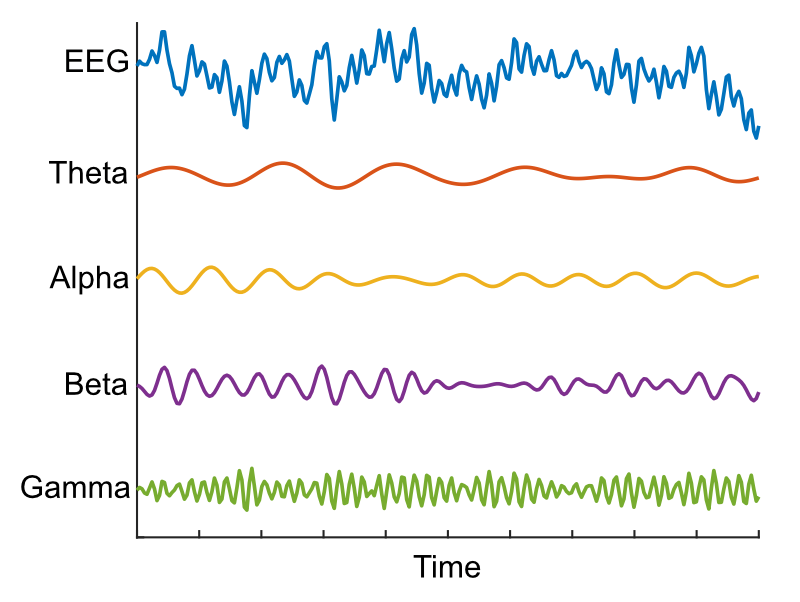
The brain, too, is full of rhythms--complex rhythms, brain waves, and so on. So, it should be no surprise that we humans are attracted to rhythms and make rhythms. Humans make music with rhythms. Birds are born with their songs, and we are now learning that many can learn new songs and modify old songs. Humans too, seem to be born with a musical sense, only we not only sing (some of us quite poorly), but externalize those rhythms into musical instruments we create. 

When you apply music to words, you get songs and rhythmic poetry. Good songs and poetry combine simple patterns, such as iambic, with more complex patterns, such as the occasional violation of the regular pattern, the subtle differences in lilt, word and syllable length, and stops and pauses due to punctuation and the presence of a cesura (a pause, either naturally placed there by the writer and reader as they read the line, or literally placed there with a space by the poet). 

The combination of regular rhythm and more complex rhythms prevent the poem from becoming too blandly repetitive, and it feels/sounds more beautiful. 

As mentioned above, the brain is rhythmic. It is why we are attracted to rhythms, and why we create rhythms--particularly when we make art. More, the rhythms of poetry and other rhythmic art coordinate the brain's rhythms, making the brain's rhythms match those of the poem, for example. Of course, those rhythms were made by another person, by another brain, so when your brain matches the work's rhythms, your brain is creating similar patterns as those of the artist when the artist was creating. 

Rhythms thus bring us together as people. Drums make us dance together in rhythms and rituals. We get together at concerts to unify in rhythms. A rhythmic speaker is more compelling and will get a group of people to act together. 

There is no mistaking the power of rhythms. Which is why it's a vital element for the most artistic of speech acts: poetry. 


Thursday, July 7, 2022

Prose and Verse

 Broadly understood, any literary writer--including those who write novels, short stories, and plays--is a poet. We tend to make a distinction, though. Poets write in verse; novelists and playwrights write in prose. And while when we typically think of poetry nowadays we think of lyric poetry, poetry also comes in the forms of epic poetry--and plays.

What is the difference between prose and verse? It's difficult to make the distinction with a majority of contemporary poems being written in free verse. While there are certainly free verse poems that are verse, there are also those that are really prose with line breaks. The existence or absence of line breaks is not what distinguishes prose from verse.

So what, then, does distinguish them?

What you are reading in this blog post is prose. You speak in prose. Prose is language walking. 

Verse is more rhythmic. It may have very regular rhythms--like Iambic--or is may have more irregular rhythms, or have rhythms created by alliteration or sentence structures or numbers of syllables. In all of these cases, though, the language isn't walking. It's dancing. 

Of course, one can dance one's walk, and walk one's dance. 

Novelists like William Faulkner definitely dance their walk. Hemingway's dance is more subtle. 

If you want to read truly prosaic prose, I recommend a good scientific article. 

Most formalist poetry is dancing language. Walt Whitman's poems are very much dancing, though he's introducing a new kind of rhythm. Postmodern poets like Bob Perelman make their poems walk to such a degree that one could call their works prose with line breaks. 

Poets like Perelman and Margaret Atwood have a strong tendency to write what I would call prose with line breaks. This creates other demands on their poems, meaning they have to find other ways to make their works "poems," but to me at least it's clear they're not writing in verse. The presence of line breaks doesn't make a work verse.

I do believe, though, that all literary works of art at least dance their walk. There has to be some kind of rhythm. How else could a work of literature be beautiful? 

Syllabics

 If you were to come across a ten-syllable lined poem, you would probably expect it to be iambic pentameter. And you would probably be right...