Showing posts with label inspiration. Show all posts

Monday, December 5, 2022

How a Poem is Produced

How does one write a poem? Or any work of literature, for that matter? Or, let us be less broad, still. How did I come to write this poem:

Shamanic Return


Where are the shamans that descend to bring

Up poetry from Hades—these new Huns

Cannot transform without the gift of art—

The world will desiccate in decadence.


A gold and emerald feathered serpent

To terrify us with its promises,

Convince us we must all at last repent

To gain his insights--shed, renew our souls.


One must descend in order to receive

The gift that will transform the pain and strife

We find ourselves in—we must now believe

In a new culture that believes in life. 


The shaman's poetry will heal the rift

That's poisoning our culture—that's his gift.

 
As you can see, in this poem, the form evolves from a blank verse quatrain to a ABAC rhyme scheme in the second, to a ABAB rhyme scheme in the third (yes, I’m ignoring the fact that I should be starting with the first end-word of the poem being A, but this is to make a broader point).The last six lines are thus structured as a Shakespearean sonnet, with the forst two quatrains showing an evolution toward that form, from blank verse to two rhymes, then the full four and the rhyming couplet. 


In other words, this poem is influenced by the form we call the Shakespearean sonnet. We call it this although the form was invented by Surrey. And Surrey modified Spencer, who modified the original Italian sonnet, which we call the Petrarchan sonnet, though it was actually invented by Giacomo di Lentini. So, the form of the sonnet I chose was due to the influence of Shakespeare on me, but we can see that there is a tradition of the sonnet as a form going back to di Lentini—and not just going back in time, but into another country, language, and culture.

Further, the Shakespearean sonnet is somewhat different from the other sonnet forms. While the Petrarchan sonnet's form creates a tension in the two quatrains that is released in the sextet, the Spencerian sonnet's form creates a tension between the emotional and the analytic,  and the Shakespearean sonnet's form creates a tension between thesis and antithesis that gets resolved in the couplet and is thus more analytical/intellectual. Form informs theme, and vice versa. Thus did the form of the Shakespearean sonnet suggest itself in the writing of the poem. In this case, there was an evolution in the poem from “chaos”—no rhyme—to increasing rhyming order. All of this reflects the theme of the poem itself. (Note: the topic chose the form; I did not, in any conscious way, choose the form before the topic.)

As I am sure with practically everyone else, I became exposed to the sonnets of Shakespeare—and any number of more recent sonneteers of more recent vintage—in high school and college. Even though I only started writing poems in the last of my undergraduate years, and although I only started writing formal verse on any sort of regular basis after meeting Frederick Turner while working on my Ph.D., I was certainly not unaware of the existence of sonnets, and there is little doubt that there was influence from those sonnets even before I wrote my first sonnet—or began writing them regularly.

Of course, all of the poems I have read over the years have helped to direct my general poetic tastes and tendencies—toward and away from particular styles, topics, etc. And not just poems. My interests have developed in fictional prose, epics, essays, nonfiction books, etc. My interests in social issues, in complexity, in economics and governance, in human nature, in neuroscience and psychology, in philosophy, etc. have all contributed to the content which appears in any number of my poems. One would have to trace the genealogies of each of those interests to me to understand the context in which I write.

And not just that. There are contexts not only of what I have read, but of my experiences and of my culture. My frustration at the degree to which the literary arts in general, and poetry in particular, are not considered to have much value in this culture, for example, is expressed in the poem. A recognition that there is a belief that poetry doesn't "do anything" by people in this culture—meaning, since they don't think it does anything, it doesn't and cannot do anything—is also there. 


If we take a look at another poem—this one a full Shakespearean sonnet, as it turns out—we will see that these concerns recur in my poetry:

On Censorship


Is poetry important? Yours is not

If no one wants to censor you or burn

Your manuscripts. If no one wants them hot

Off the presses and no one will spurn


Your verse, then it is unimportant. Death

Comes early to the dangerous who dare

To challenge worlds. Your long life and your breath

Condemn your frivolous words. We don't care.


But if you say the meaningful and break

The colored glasses that we wear, you'll see

Your words for their importance. When a lake

Of blood is spilled for words, then you'll agree


That arts' and humanities' import

Is such that only fools would dare abort.


Further, I suggest in this poem that there are obviously cultures that encourage people to think the arts do in fact do something. Why else would they have censorship laws? From this, there is a question of whether it is our long history of freedom of speech which has thoroughly defanged literature. (Which could further raise the question in a discussion of this poem of whether it’s worth losing poetry to gain freedom—which it would hard to argue against.)

In my poem, I essentially argue that our literature has become thoroughly defanged. Poetry is dominated by kitsch—it is primarily self-congratulatory in nature, demonstrating how wonderfully anti-racist, -sexist, -etc. one is to others who are very proud of their own PC credentials. It’s just preaching to the choir (yes, sometimes we in the choir do need to hear the message that we’re the chosen ones going to heaven and that our enemies are all hell-bound, but it's no way to get converts). There is nothing truly shocking or edgy—everything is only mock-shock. "Look, I have the word 'penis' in my poem!"—knowing looks all around. Blah-blah-blah-boring.

You know that today’s poetry isn't shocking because everyone who writes it is sitting around, as cool and comfortable as cucumbers in their plush offices, not in the least bit concerned that someone might read it who could threaten that comfort in the least.

If you write something that truly matters, you'll truly rile people up. But who is writing that poetry?

These are the thoughts—the contemporary thoughts, embedded in our contemporary American culture, in light of the fact that there are other cultures in which poets live truly dangerous lives—that underlie this poem. So, we not only need a cultural context, but a comparative culture context, a global context. We have to understand my interests and concerns. We have to understand my world view and understanding of human nature. We have to know my poetic genealogy. All of which I have, quite frankly, dealt with superficially here. To truly write about the context necessary for the poem in question to have been created, one would need to write a book. And one would have to not rely on me for the full meaning of each of these poems. 

And that gets us to the true complexity of a work of art like a poem. To understand a poem, you have to not only understand the person in question—at the time of the writing of the poem—but also the social context that helped to create that mind. That is, we have to understand the mind as extended beyond the emergent processes of the embodied brain in action. We have to understand all of the spontaneous orders involved, and the particular subnetworks within each that lead to the emergence of the poem from the poet. And we have to understand it not only in the social context in which it was written, but in the social context in which it’s presently being read, and based on the responses of numerous other readers across time and cultures. 


And this, too, is how one writes a poem. It is an emergent property of the poet’s influences, knowledge, wisdom, ignorance, foolishness, seriousness, world view, sense of humor, etc., combined with one’s skills in writing. Of course, the last thing you should be doing is thinking about any of these things as you write—other than, of course, writing skills, sounds, patterns, rhythms, and all the other things that contribute to the art of poetry. 

Monday, October 31, 2022

Against Self-Expression

If you search for images of "self-expression" on Google, you'll get a collage of photos that are going to look like this. I could think of no better way of showing exactly what I mean when I talk about--and criticize--self-expression. 

The irony here is that in all of this so-called self-expression, the results are almost universally identical. It's all a miss-mash, with lots of color. What this suggests is that everyone's self-expression is like everyone else's self-expression. And what does that mean for either the self or it's expression? It means you're just like everyone else if this is what self-expression looks like. And that's precisely the problem with self-expression as art. It isn't art. It isn't even, as one of the pictures suggests, self-love. Love is always of a particular thing or person, and if there's anything this example of self-expression is not, it's particular. 

 With that kind of introduction, it's probably not surprising that I would say that perhaps the worst thing that ever happened to poetry was the emergence of the cult of self-expression. Although one can find this cult at play in the other arts, it seems to have hit poetry the hardest, and ruined several generations of poets. 

Of course, the opposite end of this is the kind of academic poetry that is only produced in university English departments, only read by other academic poets, and only commented upon by academics trying to get scholarly papers published--a task made easier when one is dealing with "difficult" poetry. 

Karl Popper once defined true artists as those who are attempting to work out artistic ideas and problems--which is to say, those related to myth, structures, traditions, etc., in light of changing social conditions in which the artists are working. It is an evolutionary process, and it always is in touch with what came before it. 

Certainly, one could argue that contemporary academic poetry is doing precisely that. However, the avant-garde, as the academic poets fancy themselves to be, pride themselves in making radical breaks with the past. This is, of course, unlikely to be literally true, in much the same way that the surrealists never really allowed their "automatic writing" to go unaltered (a simple example: what are "automatic" line-breaks?). 

The real problem with what I'm calling academic poetry is that it, much like academic art in general, is created after the "artist's statement" is created--even if it's created only in the artist's head. This is in part the fault of most of our artists having become academic artists because they first passed through university classes. 

The funny thing, though, is that the undergrad poetry writing classes all tend to encourage "self-expression." The professors don't want you to stifle your self-expression by using form or any kind of constraint. In the meantime, many of them are writing poetry most of their students wouldn't understand. As the creative writers move into grad school, those who are writing more academic poetry tend to get more encouragement while the self-expression poets get left by the wayside. 

One of the main problems with self-expression poetry--and the reason it gets left by the wayside, and why most such poets eventually stop writing--is that there is really only so much self to express. Most people are like most other people. And really, almost nobody has anything particularly interesting to say--and if you do have something interesting to say, it's likely going to be said in a few poems, a few short stories. And then, you'll be done. 

While the academic poets do seemingly at least try to work out some kind of artistic problem, the problem they have is that they don't produce anything anyone wants to read. Not even the academics writing scholarly papers on today's academic art aren't interested in it. They just need to publish, and it's easier to publish something on a work that is contemporary and difficult and, therefore, hasn't been touched by anyone else, than it is to try to say something new about Shakespeare's sonnets, for example. 

This would seem to put us in a quandary. If self-expression doesn't create lasting art or artists, and academic poetry isn't going to be read by anyone, when where does that leave us? 

Fortunately, these are not the only options.

Another way forward is to first abandon self-expression as self-centered, narcissistic, and indulgent; then, we need to familiarize ourselves with the global traditions, become global classicists, and familiarize ourselves with the world's myths, poetic structures, and forms. We must keep in mind, though, that postmodern academic art is now part of that tradition. It was at least participating in the art of poetry in the Popperian sense, even if it sent itself into abject unpopularity due to the direction the poets went with it. However, to move forward, we have to bring things back to foundations, writing works that people would actually want to read, because they tap into the brain's love or rhythms, sounds/music, and archetypal imagery. Challenge, yes--but do so from a place of familiarity. 

None of this is to say that you will no longer appear in your poetry. How is that even possible? Your poetry is necessarily going to reflect your world view, your attitudes, your fundamental beliefs, your passions, and so on. How can they not? Just don't make the mistake of either thinking that your art is all about you, and do not think your poetry is going to change the world because you're undermining capitalism by subverting grammar or some such nonsense. You're not. That's not how poetry works. Its power is elsewhere. 

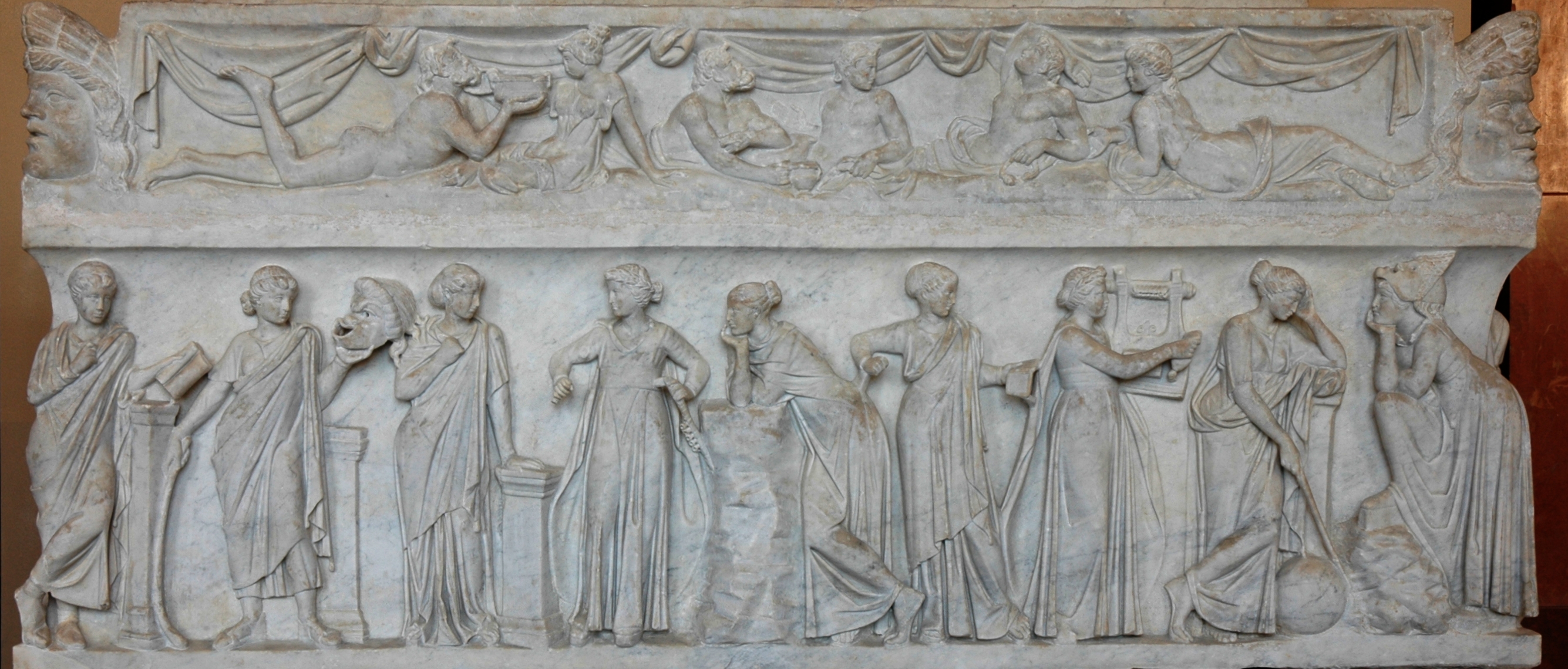
Remember, the Muses are the daughters of memory and inspiration, of what your brain retained of external knowledge, and the way your brain unconsciously processed that knowledge through your emotions. The "you," the "self" that is being expressed is in that unconscious processing leading to inspiration. It's not vomiting your emotions onto the page. Indeed, self-expression is the subversion of poetry to your emotions, ideas, and thoughts rather than entering into a dialogue with the world's other poets, and your audience. You have  to love the art enough that you want to serve it rather than make it serve you. And that means entering into the global history of poetry, bringing not just yourself, but your contemporary society, culture, and knowledge with you.

Monday, October 3, 2022

Monday, August 15, 2022

Inspiration and Knowledge

Muses in popular culture - Wikipedia

 The Greeks believed that the Muses were the offspring of Zeus (God) and Memneke (Memory). One way of understanding this insight is that poets produce their art due to a combination of inspiration and memory. 

In other words, we have to have some kind of knowledge in order to create good poems. You cannot be an ignorant poet. Indeed, one could argue that there is no such thing as a great poet who is ignorant. Think about the great poets. Goethe was a scientist who studied the physics of light and biology, a bureaucrat who helped manage a princedom, a well-read writer, and a traveler. He studied languages and history, read philosophers and ancient writers. Shakespeare demonstrated his knowledge of the Trivium, of history, of philosophy, and of the literatures of other cultures in his works. Keats was a doctor, as was Chekov. The point is that these were educated people. 

The poet must be an educated person. Not just educated in a narrow sense--having a B.A. in English, a M.A. in English, and a Ph.D. in English is being educated in a narrow sense--but in as broad and universal a sense as possible. There are English-major Marxists, English-major Freudians and Jungians, and English-major theorists; unfortunately, actual economists, psychologists, and philosophers barely recognize the English-major versions of their fields. 

This is not to denigrate English as a degree. I do, after all, have a major in English, a Master's in English, and a Ph.D. in the Humanities that focused on creative writing and literary studies, and I learned a great deal from my literary theory classes--and I took as many literary theory classes as I could, because I enjoyed them so much. However, I did also major in biology and minor in chemistry, I do have two years of graduate classes in molecular biology, and I taught myself enough economics, psychology, and sociology to have peer-reviewed publications in those fields. I have studied mythology on my own and to get my Humanities degree. I truly believe in the synthesis of science and the humanities, that there shouldn't be "two cultures." I don't know if any of this makes me a great poet, but it certainly means I have a great many things in memory. 

This knowledge of course has to include thousands of poems, as well as novels, short stories, and plays. There is no such thing--anywhere at any time--as a poet who is anything less than mediocre who isn't well-read. This "reading" includes oral traditions, including songwriters who are inspired/influenced by other songwriters. There's no such thing as a writer who wasn't a prolific reader. The two go hand-in-hand. 

But knowledge and ideas are not enough. We also need inspiration. 

The word "inspiration" literally means "breathe in." However, in many languages, the word for soul or spirit is "breath." To have inspiration is thus to have a spirit within you. You may call that spirit God, or you may call it, along with Socrates, a "daimon," but whatever it may be, it feels like it's coming from somewhere other than yourself. It's certainly coming from somewhere other than your conscious self. If you feel inspired, there is a kind of sudden insight that makes you want to write (or paint, or make music, etc.). 

If you prefer a less mythical/mystical version of inspiration, there's also a psychological one. Our minds are often working on problems in the background, then feed the finished solution to our conscious minds all at once, in what we call "a flash of insight." This can happen with scientists--Einstein being a famous case, with his insight about relativity coming to him in a dream--and it can certainly happen with poets. 

With poets, though, inspiration is more of a learning something that is of personal importance to us. That is, it's a kind of subjective knowledge. When we communicate what we have learned in verse, we express poetic truth. How well we communicate that truth depends upon our skills as poets. 

When you communicate your subjective understanding, you add to the wealth of human knowledge. We need your insight, your understanding, your interpretation of things--and we need you to write so well someone will read it, so it actually becomes part of human knowledge by becoming a part of your reader and how your reader ever after thinks. And that means writing something people can and will remember.

At the same time, if you are only relying on inspiration, you may write a few dozen poems in your life, none of them any good. As we've already seen, there's more to writing poetry. 


Syllabics

 If you were to come across a ten-syllable lined poem, you would probably expect it to be iambic pentameter. And you would probably be right...