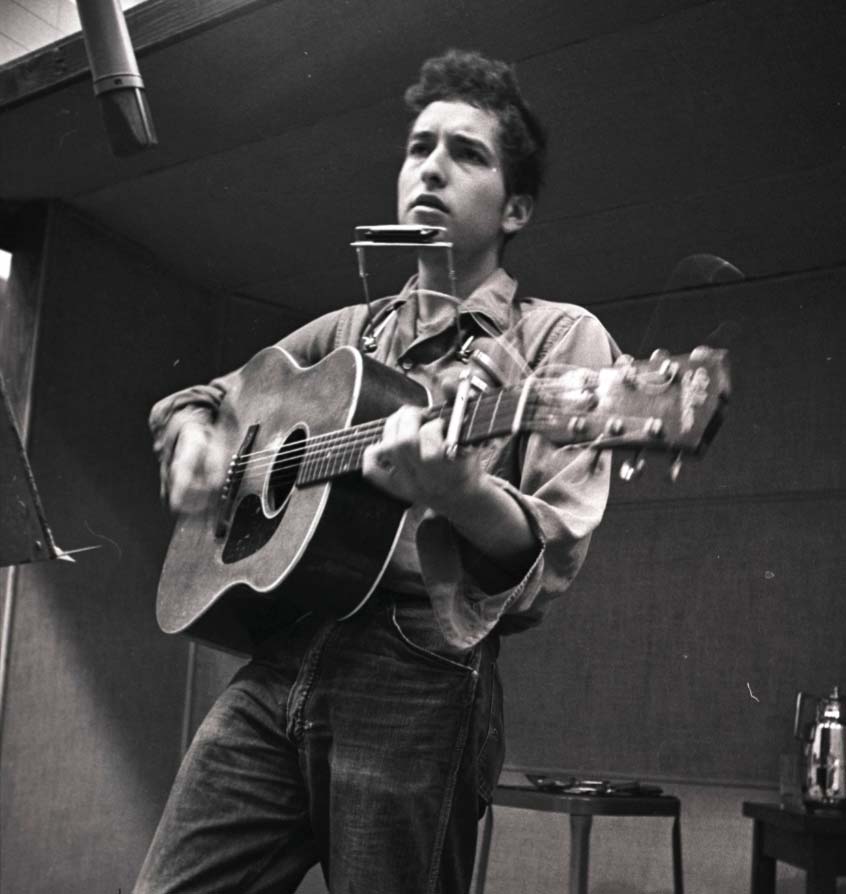
We forget that poetry had its origin in song. The Iliad and The Odyssey were sung (can you imagine memorizing those songs?). The Greek tragedies were sung. So rock music, blues, etc. are much more originary in their poetry than what we now consider to be poetry is.
Unless you understand what poetry is and its history, nobody should take you seriously as a poet -- least of all yourself. In the same way that if you can't draw a picture of something someone could clearly and obviously recognize, you're not an artist no matter how much paint you fling around, if you can't write a sonnet or some Sapphic verse, you're not a poet. Artists have to know the history of their art if they're ever going to be worth anything. Even such Modern poets like Ezra Pound, who famously said, "make it new," understood that. So has any poet that has ever lasted. Walt Whitman didn't write free verse because he couldn't write a sonnet (which seems to be the case with too many poets these days), but rather he wrote in free verse because, having mastered the forms, he wanted to push poetry into new territory. As an artist, if you don't know where you came from, you are lost. The fact that poetry has its origin in song is vital to understanding poetry at all and thus to making poetry worth reading. In the same way, it's important to understand that your egg came from a chicken if your plan is to make more chickens. But it doesn't matter what animal an egg comes from if you're going to mess it up, break it down, and chew it up -- the end result is crap. I still prefer chicken eggs, though.
So, what is poetry? How can we identify it? Can we talk about its essence? You should at least have read a sufficient amount of what has been identified as poetry -- both past and present -- to have created some sort of concept, even if you can't create a scientifically acceptable definition of poetry. How else will you be able to tell the difference between poetry and prose? I've read poetic prose and read prose broken up into lines. If you can't sing it or dance to it, it's probably not poetry. A lot of prose has been mistakenly called poetry -- but if we call everything poetry, then poetry indeed has no meaning or definition.
The issue of definitions goes back to Socrates (and likely before). Remember that Socrates was always asking experts to define the thing they were expert in. Every time he would do so, he would find them giving him examples of, say, justice or piety or love, but they could never define the thing itself, which Plato developed into a theory that such Ideas or Forms were external to the world, which was just a poor set of shadows of the real. Nietzsche observed that we create ideas or concepts by looking at a set of unidentical similar objects and subtracting away the dissimilarities. Wittgenstein observed that this results in objects being able to be conceived and reconceived due to "family resemblances." A shoe is not a hammer, but it can be used as a hammer, so when you reconceive of a shoe as a hammer, you are saying it has a family resemblance to hammers.
All of this is to say that if we are trying to come up with the Platonic Form of poetry, we will never succeed, since such a form does not exist. However, we should be able to look at a sufficient number of poems and be able to work out their family resemblances. Along those lines, whatever your definition of poetry is is going to be a good start. Can we add to it? Subtract from it? The use of tradition as a criteria (I think one should have that as a criteria in the arts) suggests that we should put quite a bit of weight on past "verbal happenings." If we look at poetry around the world, such works have repeated structures (whether rhythm, rhymes, parallelism, etc.) and are broken up into lines that take optimally 3 seconds to speak -- not coincidentally, our short term memory works best in 3 second chunks. These are typical, but are they necessary?
Let's also return to the issue of song and poetry. There is no question that poetry began as song -- but there is equally no question that there was a bifurcation, resulting in the two traveling down somewhat different (though periodically intersecting) paths. Where does one draw the line? Many poems can be sung -- does that make them songs? I have sung my daughter's Dr. Seuss books to her (had to throw some variety in, since I read her the same books every single day), but I don't think Dr. Seuss intended his books to be sung. I suppose we could look at songs as "low art" vs. the "high art" of poetry -- especially modernist and postmodernist poetry, which is read (and sometimes enjoyed) almost exclusively by overeducated people like me -- but I don't like such distinctions, as it creates an unnecessary bifurcation in the art. A great work of art is one where anyone can enjoy it, but the more you know, the more you appreciate the work, one where repeated readings/viewings/listenings result in your coming to understand the work more and more. Perhaps by reconsidering song as poetry and consciously including it in the tradition, we will come to a better understanding of what poetry is, and become better poets ourselves.

 E.E. Cummings, "The Grasshopper"

