Showing posts with label free verse. Show all posts

Monday, November 28, 2022

Constrained and Unconstrained Poets

 The economic way of thinking begins with understanding that human choice is all walks of life is always exercised against a background of constraints.

The reality of choice within constraints implies that we face trade-offs in making decisions.

Peter Boettke, Living Economics, pg. 22


F. A. Hayek argues that there are two kinds of individualism, one which embraces the "constrained vision" and the other which embraces the "unconstrained vision." Those who believe humans are constrained believe we are naturally social and that there are evolved rules that restrict how humans can act and interact with each other. Those who believe human are unconstrained believe human beings are infinitely malleable, that we can be socially constructed into anything. The former Hayek identifies with the "tragic sense of life." The poet Frederick Turner identifies it with the development of a “culture of hope.” The latter is embraced by the avant-garde of the 20th and 21st centuries.

In poetry, the constrained vision is clearly accepted by the formalists. Of course, I have already argued elsewhere that all poetry—including free verse poetry—is built upon constraints, but formalist poets make those constraints more consciously-chosen. What we could call “unconstrained poets” would be those who write in free verse, but also in avant-garde styles such as dadaism, surrealis, and L=A=N=G=U=A=G=E poetry, among others. 

Free verse poets tend to believe constraints restrict their freedom. Free verse poetry and many of the experiments of literary modernism and postmodernism were attempts at shedding constraints—and were quite often attempts to deny the natural existence and validity of constraints. In their ideal of “automatic writing,” surrealism attempted to deny the validity of making a decision—or at least, conscious decisions—and therefore attempted to create an "act" without decision, direction/goal, or structure. The surrealist artists all considered themselves to be the artistic expression of Marxism, and Marxism is certainly a version of the unconstrained vision of man.

Formalist poets understand that constraints are not necessarily restricting, but rather that they are a necessary condition for freedom. The world is full of constraints, and interesting rules/constraints can create new possibilities you may not have thought of had you been writing a free verse poem. In a certain sense, then a sonnet thus makes one more entrepreneurial, because you have to be alert to new possibilities, because you have constraints in what you can say next (or, in revision, perhaps what you said before). In formalist poetry there are a number of constraints that can force you to make choices—many more choices than you would have to make in free verse, for example.

Of course, not all constraints are the same. There are natural and imposed constraints. There are internally-imposed and externally-imposed constraints. There are predictable and unpredictable constraints. Formalist poetry embraces a combination of natural (rhythms and rhymes) and imposed (this or that particular rhyme scheme or rhythm), internally imposed (by our choices) and externally imposed (by our traditions, within which we necessarily work), and predictable (in a heroic couplet the last word of the second line necessarily rhymes with the first) and unpredictable (having to rhyme may send the writer—and, subsequently, the reader—into a different direction than (s)he first thought the poem was going). But note that the formalist poet is making use of both simultaneously and is not using one at the expense of the other. 

Many of the modernist and postmodernist avant-garde writers insisted that they were rejecting the artificiality of formalism and embracing a more "natural" kind of poetry. The surrealists thought they were being natural, unpredictable, and internal, for example. There was an assumption that nature was chaotic/unpredictable—and that man imposed (and should impose) order from the outside. Self-organization theory helps us to see that a kind of predictable-unpredictable, internal-external natural order can exist, that no external orderer is necessary in nature, or in society. Thus, a good formalist poem is much more like a self-organizing natural system than is a surrealist poem. Neither is more natural than the other, but one could perhaps argue that the former embraces more aspects of reality than does the latter.

On the other hand, one can go in the other direction and have externally imposed, predictable art—but this is propaganda and/or is a product of censorship. In the visual arts, Futurism tried to embrace the completely "imposed"/non-natural. Language, being a spontaneous order itself, always necessarily embodies both elements, making a purely "unnatural" poetry all but impossible—except perhaps in various Dadaist experiments. 

This suggests, then, that the kinds of poetry flourishing at a given time are likely to reflect the way the poets understand the world—as being naturally constrained or naturally unconstrained. Does this mean there are more formalist poets with the tragic view of life? Does this mean that free verse poets are more optimistic about humans being able to design the world? Perhaps. One would expect to see this in the world views they express in their art. 


As we learn more and more about the world, we learn that the world is in fact full of constraints, that there is a power in limits, and that these elements of the world are what have led to ever-greater complexity and order in the cosmos. Does this mean the formalist poets are the one who “got it right”? Hardly. There are plenty of areas in our cultures and societies in which we can and do consciously structure our environments—not the least of which being businesses, legislation, and our organizations. And these are necessary. The free verse poets have their place, and the formalists have their place. Each contributes, and each finds their own kinds of freedoms. 


Each poet must find their voice, and each, I think, can only find their voice by experimenting across the different forms and various versions of free verse and avant-garde poetry. What you end up choosing, though, might say a great deal more about your world view than perhaps you realized.

Monday, November 21, 2022

Making Meter

*

In a previous lesson, I discussed the nature of meter. However, knowing what meter is and knowing why using it in poetry is important, and writing meter are hardly the same thing. Since these lessons are intended to help you write poetry, theory has to meet practice. 

There's a degree to which the English language follows a simple iambic pattern, which results in many people writing mostly iambic verse unconsciously. But art is supposed to be purposeful--at least, to a great degree. As an artist, I want to make sure that I am using the words I want to use, the rhythm I want to create, and so on. To this end, we need to try to understand how the English language naturally falls into certain rhythmic patterns. 

Most people have difficulty learning to write in rhythm. Many fall into writing free verse because of this difficulty. However, nobody should be writing free verse because they cannot write in iambic pentameter, trochaics, or whatever rhythmic patterns you can imagine. That is like becoming an abstract expressionist artist because you cannot draw. You're not making a choice in the matter--the lack of skill is what's directing what you do--and if you're not making a choice, you're not an artist. That's why getting all the fundamentals down is important. 

There are many words and syllables which are naturally stressed or unstressed. However, there is variability of how stressed a given syllable may be, and context can certainly matter. A weakly unstressed syllable or word can be pressed into becoming stressed by being surrounded by more strongly unstressed syllables/words. The same is true of stressed words and syllables--if a weakly-stressed syllable is surrounded by more strongly stressed syllables/words, it will become unstressed. To practice, though, it's probably good to try to stick with simple, clear stressed-unstressed syllables.

There are several shortcuts to getting a rhythm down in your poem.

The first thing to note is that the articles--a, an, the--are all unstressed words. 

   ˘ /

The rock

It's hard to push an article into being stressed, but hardly impossible. 

A word like "of" is typically going to be unstressed, but it can be easily pushed into being stressed. For example:

   ˘ / ˘ /

The Book of Forms

   ˘ / ˘ / ˘ / ˘

The Making of a Poem

In the above book titles, the rhythm of the word "of" is different because of the words which surround it. In the first, "book" and "forms" are both strongly stressed, so there's no question about whether or not "of" should be unstressed. In the second, "making" is stressed-unstressed, and "a" is unstressed. "Of" is thus surrounded by strongly unstressed syllables, pushing it into being slightly stressed. 

This can also happen within words. For example, the word "able" is stressed-unstressed. However, notice what happens when you make it a suffix of "believe":

 ˘ / ˘ /

believable

The strong stress of the second syllable of "believe" pushes the "a" of "able" into becoming unstressed, and the "ble" into becoming stressed. You'll note that this is very common in words with the suffix "able."

Indeed, the stresses in "believe" are strong enough that they will even turn a prefix such as "un," which is typically unstressed, into being stressed:

/ ˘ / ˘ /

unbelievable

Here, we have another example of a natural unstressed syllable, which is the suffix. Much of the time, both prefixes and suffixes are unstressed. (Ironically, the words "prefix" and "suffix" violate this general pattern.)

As just noted, prefixes are typically unstressed.

  ˘ / ˘ / ˘ /

unkempt        unloved       unfair

  ˘ / ˘ / ˘ / ˘

before            behind          befuddled

Notice that, though the "b" sound is a strong sound and might typically be part of a stressed syllable, the "be" prefix is nevertheless unstressed.

In "befuddled," we also see that the "ed" ending, when fully pronounced, is unstressed. This is typical of suffixes. If we take the stressed word "love," and add the "ly" suffix, we get

  / ˘

lovely

Suffixes added to a stressed word will thus be unstressed:

  / ˘.  / ˘    / ˘

granted          truly         walking

Again, the presence of an unstressed syllable at the end of the root word can press the suffix into being stressed:

/ ˘ / / ˘ /

fidgeted          nervously

As you can see, then, this is more an art than a science (it is poetry, after all). However, the general rule that articles, prefixes, and suffixes are unstressed will generally help you create regular meters. As you practice using very strongly stressed and unstressed words, you will eventually hear the rhythm and internalize it more and more. Once that happens, you can then play around with less clearly stressed and unstressed words and syllables, and play around with metrical patterns to create meaning in violations of a regular meter. 

The greatest art, including the greatest poetry, is balanced between regularity and irregularity. The variations within stressed and unstressed syllables themselves help to create additional music/rhythms on top of the regular rhythms of iambic, anapestic, trochaic, etc. meters. As you learn to hear the regularities, you'll start to write good, solid meter. Once you hear the regularities, you'll then be more able to hear the irregularities as well. And then, you'll start to write more complex, more beautiful meter--and do so more intentionally as well. 


Monday, October 3, 2022

Monday, September 5, 2022

Meter

*

Verse is metered language. What, though, is meter? 

"Meter" comes from the Ancient Greek "metron," meaning "measure." When we measure, or count, our lines, we are writing in meter. 

The simplest way to write meter is to simply count syllables. When we are writing poems with lines containing the same numbers of syllables, we are writing in what is called syllabics. In syllabics, we are not concerned about the placement of stressed and unstressed syllables or the length of syllables. These are common in languages which are not stressed, like Japanese, or tonal, like Chinese. However, in a language like English or German, our words are either stressed or unstressed. As a result, syllabics often sound stressed anyway.

Coincidentally, the Greek language, on which we have based most of our regular syllabic structures, wasn't stressed, but rather was made of long and short syllables. Such poetry is called quantitive verse. 

Most readers of poetry will be familiar with poetry with lines containing patterns of stressed and unstressed syllables, called feet. The best-known poetic foot in the English language is the iambic foot, which is a simple alternation of unstressed and stressed syllables. 

We mark stressed syllables with a "/" and unstressed syllables with a "˘", which sounds "da-DUM."

   ˘ / ˘ / ˘ / ˘ / ˘ /

Shall I compare thee to a summer's day?

  ˘ / ˘ / ˘ / ˘ / ˘ /

Thou art more lovely and more temperate!

Here, in Shakespeare's famous sonnet, we have lines of alternating iambic feet. Since there are five iambs, we call this a pentameter--"penta" for "five," meaning five-count. An iambic pentameter is thus a five-count of iambs. 

  • Dimeter: contains two metrical feet
  • Trimeter: contains three metrical feet
  • Tetrameter: contains four metrical feet
  • Pentameter: contains five metrical feet
  • Hexameter: contains six metrical feet

These are going to be the most typical meters. As Frederick Turner and Ernst Poppel argue in their essay The Neural Lyre (also found in Turner's book Natural Classicism, above), we're typically going to find the ten syllables of iambic or trochaic pentameter to be most "comfortable" in English because it fits into our auditory moment of about 3-4 seconds. If we're using anapest or spondee, then, a trimeter or tetrameter would fit that moment best. 

This, of course, gets us to the issue of regular rhythms. The most common regular rhythms in poetry are the following:

iamb:      ˘ / (ex: compare)

trochee: / ˘ (ex: summer)

spondee: / / (ex: Bang! Bang!)

anapest: ˘ ˘ / (ex: of unstressed)

dactyl: / ˘ ˘ (ex: beautiful)

There are, of course, others:

pyrrus: ˘ ˘

tribrach: ˘ ˘ ˘

amphibrach: ˘ / ˘

bacchius: ˘ / /

cretic: / ˘ /

antibacchus: / / ˘

molossus: / / /

The tribrach and the molossus are the most difficult to create because if there are three unstressed syllables in a row, we'll tend to hear one of the unstressed syllables as stressed; and equally, if there are three stressed syllables in a row, we'll tend to hear one of them as unstressed. To get your listener to hear a tribrach, you would likely have to have a very strongly stressed syllable on either side of it.

With most of these feet (excepting tribrach and molossus), you can use each of them to create a regular rhythm. With all of them, though, you can use them in combinations. For example, the Sapphic stanza is made up of three Sapphic lines and an adonic line. The Sapphic lines are two trochees, a dactyl, and two trochees, while the adonic line is a dactyl followed by a trochee. Thus, the Sapphic stanza is as follows:

/ ˘ / ˘ / ˘ ˘ / ˘ / ˘

/ ˘ / ˘ / ˘ ˘ / ˘ / ˘

/ ˘ / ˘ / ˘ ˘ / ˘ / ˘

/ ˘ ˘ / ˘

Note that the first three are 11-syllable lines (hendecasyllabics) in pentameters of mixed feet.

As one can imagine, there are a large number of potential combinations of syllabics, meters, and feet--an infinite variety if we ignore the requirement for the creation of line lengths that fit in the auditory moment. It's possible to create very complex meters and then repeat them in each line--or in alternating lines, or some other pattern. I would recommend that if you want to retain the word as a form of verse, though, that there be some kind of regularity--the simple and the complex have to be in balance--otherwise, you'll simply end up creating prose. And there's no need to figure out the meter and feet to write prose.

Another way meter is created is through the use of the caesura. A caesura is a pause in the middle of a line. The caesura helps to create a rhythm both within the lines and across the lines. If you use punctuation in the middle of your line, you'll create a natural caesura. But even without punctuation, the reader will create a natural (though weaker) pause in the middle of a long-enough line. While many English poems aren't built around caesuras, traditional Germanic (including Old English/Anglo-Saxon) verse was built around the caesura, with patterns of alliteration being determined by that internal pause.

Finally, in contradistinction to the caesura, where there's a pause in the middle of a line, there's enjambment, which means the syntax of a line isn't contained by that line, but is rather continued into the next line. Another way of putting it is that the line doesn't end with punctuation. The result is that a line that ends with punctuation is a harder pause than one without punctuation.

Regular number of syllables, feet, caesuras, and enjambment (and rhymes) are all ways to create meter, and to make for complex meters. It's important to both maintain regularity and disrupt that regularity simultaneously in order to prevent the reader from getting bored.

Remember, too, that changes in patterns are meaningful to the reader. Take advantage of that fact. If there's a change in feet (using a trochee instead of an iamb in a particular line, for example), then that word should probably be important. The same could be said of rhymes--your rhyming words should be more important than articles or prepositions, unless they're being used there for some kind of effect (meaning, they have meaning in being there).

Of course, there are also variations in stress--some syllables are more stressed than others, and this creates a more complex music over the regularity of the meter.

Things get even more complex if we read poems aloud, because then we add things like pitch, loudness, length, and timbre. Much of this will of course depend on how the reader chooses to read it, if the person has a high or low voice, if they think it would sound better loud or quiet, with longer or shorter time pronouncing given syllables, and personal, regional, or cultural speaking patterns.

All of this means that metered poetry is fundamentally musical. Encyclopedia Britannica's entry on rhythm even contains musical notation. This musicality brings both sides of the brain together--music and language--into a fuller, more complex art.

Verse is metered language. Meter is an artistic tool. It is what makes poetry a language art. The more we think about these kinds of rules, the more artistic our art will be.

Monday, August 8, 2022

Secular Free Verse vs. Religious Formal Verse

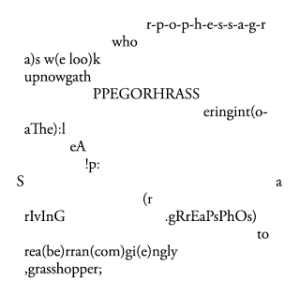
grasshopper[1]E.E. Cummings, "The Grasshopper"

 I think there are good reasons why formal poetry the world over preceded free verse and artistic prose. Those reasons are likely to be biological rather than directly connected to religion, but the ancient naturalness of both seem to be connected.

On the other hand, free verse and the non(anti)-formalist verse that followed seem to be distinctly secular in manmade-and-therefore-"unnatural" fashion. (There is nothing unnatural humans do, though there are choices which are more conscious and choices which are more instinctual, even if the latter, in poetry, follows manmade forms.) The anti-formalists often argued that formal verse was antidemocratic, indeed, elitist—while their verse was democratic and anti-elitist. Of course, the opposite was true. People prefer lyrical rock, country, and rap songs to surrealist, LANGUAGE, and postmodern poetry. It was the latter which the masses hated, loving formal verse. 

With the addition of music especially, formal verse seems to tap into a deep Dionysian element that much 20th century free verse and almost all postmodern anti-formalist poetry completely discards in favor of the Apollonian. Formal verse seems to tap into the very rhythms of the universe—including our mental/neural universe—which makes it deeply religious in its experience. This is something free verse, and especially anti-formalist verse, cannot typically create, whatever other interesting elements they may have. In this sense nonformalist poetry is deeply secular insofar as it cannot connect us to those deep rhythms which we describe as religious.

Poetry is likely to have its origins in song. Songs and poetry are the reunion of language and music, which bifurcated from an ancestral primate mating song (think gibbons). Indeed, we know that The Iliad and The Odyssey were sung, and these were religious texts. It seems likely that perhaps most initial songs were connected to religion as well. Of course, if you want to get right down to it, songs and dancing were both likely connected to mating calls and sexual demonstrations (as they still do). At the same time, I am convinced that the emergence of language gave rise to the simultaneous emergence of religion. Which may be why the earliest narratives are religious texts. This double origin of poetry—in sexual music and language-giving-rise-to-religion is probably why there is so much tension with religion and sex in poetry.

If the idea of formal/rhythmic verse being "religious" makes you uncomfortable, think rather of it being connected to the spirit, of being spiritual. There are many spiritual traditions, and they all had formalist kinds of verse associated with them. More than that, if you want your poetry to make a kind of spiritual connection with your audience—if you want a Dionysian element to your poetry—then formalist verse is truly the way to go.

This isn't to say that formalism is superior to non-formal verse. The Modernist non-formalists certainly made some major contributions in the creation of free verse and in surrealist poetry. However, I would argue that, for the most part, postmodern non-formal verse is primarily academic in nature, and the content of such poetry reflects that fact. The academic poets do have something to say, and they do have something to contribute to poetry as a form. What would perhaps be interesting, though, is the synthesis of what the non-formalists have discovered with the spiritualism of the formalists. It doesn't have to be either-or, after all. Both-and can crate some interesting works.

Friday, July 15, 2022

Prosody

Todd Camplin

Everyone has a prosody, or theory of poetry composition. That theory can (and often is) a general theory of how one should "properly" write poetry, of how you yourself prefer to write poems, and/or of how any given particular poem will be written. 

In the latter case, I may decide that an idea I have for a poem will be best expressed as a sonnet. My theory of composition for that poem, then, will include making it only 14 lines, with the poem split up into  uneven parts (a 14-line poem divided into two balanced 7-line stanzas isn't a sonnet). There will then have to be a rhyme scheme that helps divide the poem into parts. The Patrarchan sonnet is divided into two parts, while the Shakespearean sonnet is divided into four, as we can see below.

Petrarchan rhyme scheme:

ABBAABBA CDECDE

Shakespearean rhyme scheme:

ABAB CDCD EFEF GG

There are other details about sonnets we will go through in another section, but we're just going to focus on a few things here.

Sonnets are typically composed using iambic pentameter, so that would be part of one's theory of composing one's sonnet. And so on.

Of course, we don't typically just write poems where we're changing our theory of poetry composition from poem to poem. We also have our own personal theory of composition. 

When I first started writing poetry, I wrote free verse poems. That is the most common form being written today, and most poetry-writing classes will not encourage you to write poems in any other way. I didn't at the time have any sort of conscious theory of poetry composition, but a few things did recur that kind of acted as a finger print on my poetry, and which basically constituted a tacit theory. If you have written a number of poems, you likely have such at tacit theory at the very least. This is likely also reflected in the kinds of poems you like to read. 

Later, I met the poet Frederick Turner, and because of his influence, I started writing formalist poetry. I started writing formalist poetry because I encountered Turner's general theory of poetry composition. He argued in favor of formalism on the basis of how our brains work, being rhythmic, pattern-detecting, pattern-making systems. I became persuaded, and this in turn affected my personal prosody. I became a formalist, and the prosody of each poem was then affected. 

I want you to think about your own prosody. What is your personal theory of poetry composition? What is your general prosody (how do you think poems ought to be written)? Why? Why do you think prosody can change from poem to poem? That is, why do you think one poem seems "right" as a sonnet, while another seems "right" as an ode, and another seems "right" as free verse?

Syllabics

 If you were to come across a ten-syllable lined poem, you would probably expect it to be iambic pentameter. And you would probably be right...