In this interview, I discuss my book, Diaphysics*. While it's a work of philosophy, it's wide-ranging, and there is an extensive discussion of language. Since this blog is titled The Metamodern Poet, there will be a few discussions of that world view. After viewing this video, think about what these ideas might mean for poetry. How might different ways of thinking, different values, affect your poetry? My philosophical ideas may simply be a bunch of nonsense to you, and that's fine. I only hope it will stimulate thought, and if it gets a reaction of any kind, and if it stimulates the creation of poetry, then it will have done its job.
Showing posts with label ethics. Show all posts
Showing posts with label ethics. Show all posts
Monday, January 2, 2023

Monday, December 12, 2022
Against Authenticity
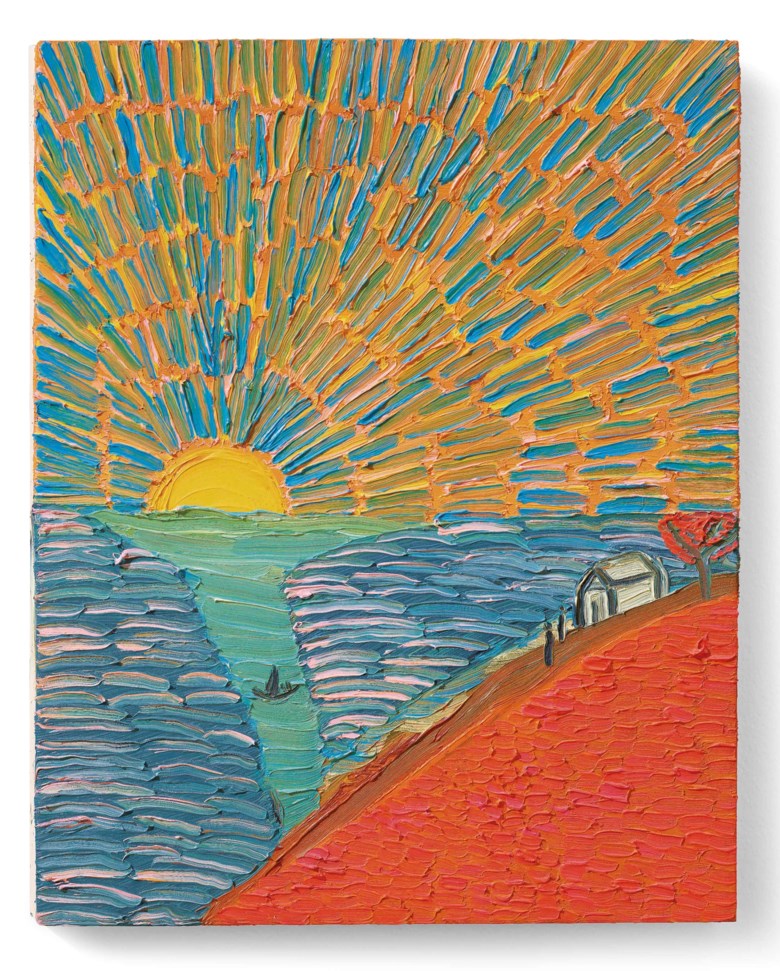
The Journey Home by Matthew Wong
Becoming a good poet is a process. It’s a learning process. It’s a developmental process. If you are the same poet today as you were ten years ago, you haven’t grown as a human being, let alone a poet. We of course learn from our experiences, but we also learn from reading poetry (or listening to music, or viewing paintings, etc., depending on your art).
I’ve already talked about what I call the “cult of self-expression,” but here I want to talk about the related “cult of authenticity.”
In the most recent Disney version of Pinocchio, Pinocchio decides he wants to remain a marionette rather than to become a real boy, as happened in the first Disney film. This is a significant change in the story. In the first version, Pinocchio is tested and tempted (by real temptations, like alcohol and tobacco, vs. the new version), and as a result he grows and develops. Part of that development is that he becomes a real boy. It’s a justified transformation, as he has earned it. However, in the newer version, Pinocchio decides to remain his “authentic self.” Meaning, he rejects growth and development and transformation.
This, in the end, is what is meant by “authenticity.” To remain “authentic” means to reject learning anything because it endangers your authentic self. It rejects moral development just as much as artistic development. You have to develop your morals and your values. Yes, we have genetic proclivities to certain moral actions and values, but that doesn't mean we're stuck with them.
This rejection of development is at the root of the authenticity cult and the self-expression cult. You don’t have to mature, change, learn, develop, etc., because all of those will get in the way of you being authentic and engaging in self-expression. But if you have children, you know you don’t really want them to be their “authentic selves.” You want them to become better selves.
Our aim should, rather, be excellence. Now, excellence isn’t perfection. Perfection isn’t an option. Excellence is continual improvement of your craft (or your moral self, or your learning, or any other aspect of yourself).
Nobody wants to read poetry from your “authentic self.” Your authentic self isn’t all that interesting. Nobody wants to listen to you play “authentic” guitar, uninfluenced by anyone. That would just be a mess, chaos, noise. And that’s really what your authentic self is. Rather, you need to develop style. Your style is developed by emulating others, finding those whose style impresses you, and transforming those styles into your own through combination. This is true of all the arts, and it’s true of poetry.
Authentic talent always develops within a tradition. Your tradition is not likely to be the same as another’s tradition. Someone who loves Romantic poetry is going to write quite different poems than someone who loves the Modernists, like T.S. Eliot, Wallace Stevens, and Eluard; and they will write different poems from someone who works within the postmodern tradition. As a Metamodernist poet, I work within not just these traditions, but am influenced by Japanese and Chinese poetry, Renaissance and Medieval and Ancient poetry, and various African and Latin American traditions. Obviously, then, my poetry will be different still.
All of this is true of all the arts. My 10-year-old somehow understands this quite well. He is teaching himself guitar, and his musical influences are The Beatles, Nirvana, and Gorillaz. He also has tried to learn AC/DC, Queen, and Bob Dylan. He performed “We Don’t Talk About Bruno” for a school talent show. It will be interesting to see how these converse and converge to become his own style. In fact, he already plays around with creating his own compositions, and they are often quite upbeat. He will also, though, find other bands he wants to emulate, and they will provide further foundation for his style. Thus, it will evolve over time. His artistic self will develop over time, and that’s as it should be.
This is what each of us should do as poets as well. I strongly encourage each and every one of you to become as broadly influenced as possible, across time and cultures. Poetry needs a renewal, and the way to do it is to embrace the entirety of the past, to embrace every tradition from the most ancient to postmodernism, and to create new things within that global frame. Each of us will find their own style, from a combination of our own personal experiences and the peculiarities of what you read, hear, and see. This is how you become part of the poetic tradition.
Monday, September 12, 2022
Poetry, the Quadrivium, and the Trivium

The Trivium is part of a Medieval educational system that was designed to provide the student with a complete education. The Trivium is made up of grammar, rhetoric, and logic. The other part of that educational system was called the Quadrivium--arithmetic (number), geometry, astronomy, and music.
You may be wondering what the Quadrivium could possibly do with poetry. Well, one can view geometry as number in space (patterns), music as number in time (rhythms), and astronomy as number in space and time. Using this formula, one could easily argue that well-written poetry is akin to astronomy, especially those poems that use things like iambic pentameter (note the use of number--"penta" means "five," which is the number of iambic syllable patterns in a line). As John Steinbeck once wrote, "Poetry is the mathematics of writing and closely kin to music."
We have already spent a great deal of time discussing several aspects of the Quadrivium within poetry, even if we haven't exactly been calling it that, and we will spend even more on the issue of number in the future. However, for this lesson, I want us to focus on the Trivium.
Poets, perhaps more than anyone else (excepting lawyers), must master the Trivium.
Mastery of grammar should be obvious: how can you be said to be a language artist if you have not mastered the language itself? Only if you fully know and understand why your language works the way it does can you properly use it, beautifully use it, twist and bend it. Thus, it is important that one understand how the different parts of speech work, what kinds of sentences there are, and how to diagram sentences. To be a poet, one must love language enough to want to know how the words and the sentences work.
I'm not going to be spending time on grammar lessons. That's not the point of this blog. I'm assuming you have mastered grammar and that you are here to learn about the tools you need to write poetry, and to give you some ideas about poetry writing, challenge the way you think about poetry, and provide you with my own ideas about poetry. However, there is much that can be said about the other elements--logic and rhetoric--and their importance to poetry.
First, logic. You may think that logic has nothing to do with poetry. You may even have some romantic idea that poetry transcends logic and reason. And you are, perhaps, right about the latter statement. But, in order to transcend something, you have to include it. But there is, as I have argued, a rationality in poetic verse.
Poetry both infers and, in complex ways, demonstrates. Logic shows when inference and demonstrations are valid. We have to keep in mind that the word "logic" comes from the Greek "logos," which can be translated as word, account, thought, reason, idea, or principle. A dialogue thus occurs "through logos"--meaning there is necessarily a logic to dialogue, and thus to plays, which combine action with dialogue. Insofar as poetry is made up of words and ideas, and are products of our thoughts, it should be clear that we cannot avoid logic. Logic just clarifies our thinking.
You have perhaps heard complaints about "logocentrism" and about logic itself. However, those who oppose "logocentrism" have to use logic to make their arguments. Those arguments can only be better or worse, and use good or bad logic, but logic is inescapable. Given this fact, I would argue that you should master logic--certainly before you can criticize it. And at least a familiarity with formal logic should benefit your thinking and, thus, your poetry. (Symbolic logic is another thing altogether--we'll leave that to the logicians over in the philosophy department.)
Rhetoric is the art of making an argument, the art of persuasion. Each work of art is trying to make some sort of argument, and the language arts perhaps more clearly and obviously. After all, we make most arguments using language. Thus, rhetoric is central to all forms of poetry.
Aristotle argued that good rhetoric requires the use of logos, ethos, and pathos.
Logos we have just covered.
Ethos, from which we derive the word "ethics," has to do with the reader trusting the writer or speaker. Part of persuasion comes from your reader trusting you, and you can only create true trust by being a trustworthy person. How that can be demonstrated in a poem will certainly vary form poem to poem, from topic to topic, and is perhaps less tangible in poetry than in a scholarly paper or a speech.
Pathos is emotion, how we create emotion in our writing or in a speech. We do not create true pathos by being melodramatic or sentimental. It has been said that sentimentality occurs when there's a lack of sentiment. Sentimentality if felt by the reader when the writer fails to communicate emotion well. One could perhaps say that sentimentality is pathos without ethos.
It should be obvious that pathos is central to poetry. It's perhaps the one thing most early poets focus on--sometimes to the exclusion of all else. Which is why there is so much sentimental poetry out there. The way to create true pathos is through the use of appropriate imagery and through the use of story. But in the end, like most aspect of poetry, it takes practice to communicate emotions well, and you are bound to miss the mark on either side, by being either too sentimental or too cold. More, what works for one reader won't work for another. You just have to play the numbers--if you find a large-enough number of your readers get the emotion in the poem, you can consider it a success in its pathos.
To be persuasive, you have to have good style. Of course, good style means different things for different kinds of writing. "A good style must, first of all, be clear. It must not be mean or above the dignity of the subject. It must be appropriate" (Aristotle). The style of an article intended for a mass audience is necessarily going to be different from that intended for scientists with advanced degrees, and both should be different for different kinds of novels, whether romance or literary, and everything in-between. And of course, poetry should itself have its own, and each poem should have its own, style.
Style is more than just decoration. "Style ought to prove that one believes in an idea; not only that one thinks it but also feels it" (Nietzsche). The reader ought to be able to feel your conviction. Style, then, is part of the ethos of rhetoric.
It is important for poets to master the Trivium. The Trivium must be mastered before you can challenge any part of it--if you decide to challenge any part of it. To paraphrase Don Barthelme, you have to be able to write masterfully well-written sentences before you can write bad sentences in your poetry or prose. Thus, it is important to know the rules of the language before one can challenge them. And challenge them we must for, as Octavio Paz once wrote, "Social criticism begins with grammar and the re-establishing of meanings." The greatest poets have always challenged the rules of grammar, logic, and rhetoric--and of ethos and pathos. But they have also always been their masters as well.
Subscribe to:
Posts (Atom)
-
If you were to come across a ten-syllable lined poem, you would probably expect it to be iambic pentameter. And you would probably be right...
-
Abduction, by Jesse Mockrin Here, at last, is the promised post on metamodern poetry --or, at least, what I think metamodern poetry is and ...
-
* Verse is metered language. What, though, is meter? "Meter" comes from the Ancient Greek "metron," meaning "measu...

