Monday, November 21, 2022

Making Meter

*

In a previous lesson, I discussed the nature of meter. However, knowing what meter is and knowing why using it in poetry is important, and writing meter are hardly the same thing. Since these lessons are intended to help you write poetry, theory has to meet practice. 

There's a degree to which the English language follows a simple iambic pattern, which results in many people writing mostly iambic verse unconsciously. But art is supposed to be purposeful--at least, to a great degree. As an artist, I want to make sure that I am using the words I want to use, the rhythm I want to create, and so on. To this end, we need to try to understand how the English language naturally falls into certain rhythmic patterns. 

Most people have difficulty learning to write in rhythm. Many fall into writing free verse because of this difficulty. However, nobody should be writing free verse because they cannot write in iambic pentameter, trochaics, or whatever rhythmic patterns you can imagine. That is like becoming an abstract expressionist artist because you cannot draw. You're not making a choice in the matter--the lack of skill is what's directing what you do--and if you're not making a choice, you're not an artist. That's why getting all the fundamentals down is important. 

There are many words and syllables which are naturally stressed or unstressed. However, there is variability of how stressed a given syllable may be, and context can certainly matter. A weakly unstressed syllable or word can be pressed into becoming stressed by being surrounded by more strongly unstressed syllables/words. The same is true of stressed words and syllables--if a weakly-stressed syllable is surrounded by more strongly stressed syllables/words, it will become unstressed. To practice, though, it's probably good to try to stick with simple, clear stressed-unstressed syllables.

There are several shortcuts to getting a rhythm down in your poem.

The first thing to note is that the articles--a, an, the--are all unstressed words. 

   ˘ /

The rock

It's hard to push an article into being stressed, but hardly impossible. 

A word like "of" is typically going to be unstressed, but it can be easily pushed into being stressed. For example:

   ˘ / ˘ /

The Book of Forms

   ˘ / ˘ / ˘ / ˘

The Making of a Poem

In the above book titles, the rhythm of the word "of" is different because of the words which surround it. In the first, "book" and "forms" are both strongly stressed, so there's no question about whether or not "of" should be unstressed. In the second, "making" is stressed-unstressed, and "a" is unstressed. "Of" is thus surrounded by strongly unstressed syllables, pushing it into being slightly stressed. 

This can also happen within words. For example, the word "able" is stressed-unstressed. However, notice what happens when you make it a suffix of "believe":

 ˘ / ˘ /

believable

The strong stress of the second syllable of "believe" pushes the "a" of "able" into becoming unstressed, and the "ble" into becoming stressed. You'll note that this is very common in words with the suffix "able."

Indeed, the stresses in "believe" are strong enough that they will even turn a prefix such as "un," which is typically unstressed, into being stressed:

/ ˘ / ˘ /

unbelievable

Here, we have another example of a natural unstressed syllable, which is the suffix. Much of the time, both prefixes and suffixes are unstressed. (Ironically, the words "prefix" and "suffix" violate this general pattern.)

As just noted, prefixes are typically unstressed.

  ˘ / ˘ / ˘ /

unkempt        unloved       unfair

  ˘ / ˘ / ˘ / ˘

before            behind          befuddled

Notice that, though the "b" sound is a strong sound and might typically be part of a stressed syllable, the "be" prefix is nevertheless unstressed.

In "befuddled," we also see that the "ed" ending, when fully pronounced, is unstressed. This is typical of suffixes. If we take the stressed word "love," and add the "ly" suffix, we get

  / ˘

lovely

Suffixes added to a stressed word will thus be unstressed:

  / ˘.  / ˘    / ˘

granted          truly         walking

Again, the presence of an unstressed syllable at the end of the root word can press the suffix into being stressed:

/ ˘ / / ˘ /

fidgeted          nervously

As you can see, then, this is more an art than a science (it is poetry, after all). However, the general rule that articles, prefixes, and suffixes are unstressed will generally help you create regular meters. As you practice using very strongly stressed and unstressed words, you will eventually hear the rhythm and internalize it more and more. Once that happens, you can then play around with less clearly stressed and unstressed words and syllables, and play around with metrical patterns to create meaning in violations of a regular meter. 

The greatest art, including the greatest poetry, is balanced between regularity and irregularity. The variations within stressed and unstressed syllables themselves help to create additional music/rhythms on top of the regular rhythms of iambic, anapestic, trochaic, etc. meters. As you learn to hear the regularities, you'll start to write good, solid meter. Once you hear the regularities, you'll then be more able to hear the irregularities as well. And then, you'll start to write more complex, more beautiful meter--and do so more intentionally as well. 


Monday, November 14, 2022

A Mirror or a Lamp?

853 Infinity Mirror Stock Photos, Pictures & Royalty-Free Images - iStock

Is poetry a mirror or a lamp on the world? 

If poetry is a mirror on the world, reflecting what is there, then it is surely a funhouse mirror, distorting what is there. Everything is bent, fragmented, stretched, and/or widened.  Many free verse poets argued precisely this, that it would be their free verse poetry that would finally provide this mirror on the world, no longer distorted by rhythm and rhyme. The surrealists also made this claim. Who, now, would agree that the surrealists provided any kind of mirror?

If poetry is a lamp, lighting up the darkness in the world, then it is surely more a moon than a sun. (Ah, but the moon itself is reflective!--a kind of mirror of the sun, imperfect and dimmer.) While the Greeks considered Apollo, the sun god, to be the leader of the Muses, practically every other polytheistic mythological tradition considers the moon goddess to be the source of poetry. Poetry is thus considered to be a product of the moon--a dim light within the darkness, playing with the shadows, perhaps part of the shadows themselves, with the shadows moving, undulating, as the poem's light crosses the darkness, faintly uncovering what lies where people fear to look. 

Orpheus descends into the underworld to retrieve his wife from death, but can only return with his poetry. There are many traditions of men descending into the underworld to retrieve something but are only able to return with the gift of poetry. 

Plato, in the Allegory of the Cave, instead shows a man ascending out of the cave and into the sun, where he is enlightened. He then returns to the cave to bring the people knowledge of what he saw. He argues that most would reject the philosopher bringing the good news of the sunlight outside the cave. The philosopher thus comes closest to bringing a lamp--but in reality, he's attempting to bring the people to the lamp/sun, which requires persuasion. If you live in dimness and only view shadows, how could you believe in the light?

The poet, on the other hand, can bring the same information to the public without rejection. Why? Because the message is hidden under imagery, metaphor, and sound. The reader is first enchanted by these things, which creates the conditions for acceptance. Of course, this is hardly perfect. There have been plenty of persecuted poets in the world--burned at the stake, in its various metaphorical forms. 

Plato wrote in dialogues in an attempt to bring the light of philosophy to the people in poetry. He felt the best poetry was that which was true, and which was trying to get people to see the truth. If this is your goal, remember that you have to do it under a veil.

Too many attempt to make their poetry either a lamp or a mirror. Didactic poetry, ham-handed political poetry--propaganda for a party and an ideology--are almost universally failures. The existence of the brilliant Langston Hughes hardly proves the opposite. Neither you nor I are Langston Hughes. And he had enough sense to write his poems by moonlight. 

Having the right understanding of poetry will help you write better poems. For many of you, I am sure that you are already in this kind of lunar headspace and are thus proper lunatics. Some of you are perhaps a little (or a lot) prone to wanting to shine the sun on the world. Alas, such poetry doesn't last, as it mostly annoys readers, preaches to the choir for those who do like it, and really doesn't last. Instead, bring your truths to the world in imagery, metaphor, sound, fable, parables, mythology, and other forms of narrative. Afraid there will be many interpretations of your work? Then write essays. Everyone will bring their own perspectives to your poetry, when it's good, and if you're particularly good (and if you're particularly metamodern), you'll bring multiple perspectives to your reader within your poems themselves. 

Monday, November 7, 2022

Acrostic Poetry

By Dearborn - American Broadsides and Ephemera, Series 1, Public Domain

 An acrostic poem is a poem in which the first letter of each line, read from top to bottom, makes a word, phrase or sentence. This can be a fun way to create a poem through yet another kind of restriction--in this case, a restriction on what the word beginning of each line must be. 

Let's say, for example, that I wanted to write a love poem to my wife, Anna. I could have an acrostic of

TROY LOVES ANNA

The weight within me has been borne by you,
Rewarding in this constant rain of sun
Over the clouds, the clouds that blanket through
Your warmth, your warmth which past this pain has run.

Low though I go, I can but go so low
Out in the wilderness where all the snakes,
Vipers have struck, but shed their skins--we know
Enough to know we'll be reborn. Cool lakes
Shall baptize us and, cleansed, we both shall grow.

A warmth has broken through--the stones will warm,
Now we shall settle in the sun together,
Naked to all the world in our new norm
Of love resisting venom, drowning, weather.

If we really wanted to challenge ourselves, we could even do an acrostic with a telestich (the last letters spell out the word), to do a double acrostic. Here, we could do 

TROY (first letters of the lines) and ANNA (last letters of the lines)

There's nothing in the lovely realm of flora
Rewarding to my eyes as what I've won
On that July where us truly'd begun--
You are my ever-shining, bright aurora. 

For my money, using acrostics in a free verse poem would "cheating" simply because that would make your task much easier. And where's the fun in that? The point of all constraints is precisely that it's supposed to make you wrack your brain, twist and turn your words and sentences, until you find something that fits. The more restrictions you have, the more twists and turns you'll have to make, and the more likely it will be that you'll have to find something you wouldn't have otherwise thought of on your own. And that's when your poetry truly gets interesting. 

Of course, with something like acrostic poetry, there are inevitably going to be those who object that you're simply engaging in word play, that it's not serious. Well, what else is poetry in general but word play? And what else is play than a nonserious thing done seriously? An acrostic poem is or can be as serious as any other form. More, you can add layers to the poem, having a serious sentence read down in an otherwise light poem, or vice versa. Especially if you don't point out that the poem is acrostic. Just let your reader discover it. 

Of course, there are any number of other things you could do to play around with the idea of acrostic. You could have the first letter of the last word of each line spell out a word. You could have a triple acrostic in which the first letters of the first word, the caesura, and the last word could each make a word. Or you could write a triple acrostic with the last letter of the last word spelling out the word. One could even invent a kind of alliterative "acrostic" in which the alliterating letters are what spell out the word(s) in question. 

I'm tempted to try, to tip-toe these terms
Round rhythms and rhymes that reel through the real,
On over through other orbiting orbs
Of yesterday's yearnings for yokes of yore.

Monday, October 31, 2022

Against Self-Expression

If you search for images of "self-expression" on Google, you'll get a collage of photos that are going to look like this. I could think of no better way of showing exactly what I mean when I talk about--and criticize--self-expression. 

The irony here is that in all of this so-called self-expression, the results are almost universally identical. It's all a miss-mash, with lots of color. What this suggests is that everyone's self-expression is like everyone else's self-expression. And what does that mean for either the self or it's expression? It means you're just like everyone else if this is what self-expression looks like. And that's precisely the problem with self-expression as art. It isn't art. It isn't even, as one of the pictures suggests, self-love. Love is always of a particular thing or person, and if there's anything this example of self-expression is not, it's particular. 

 With that kind of introduction, it's probably not surprising that I would say that perhaps the worst thing that ever happened to poetry was the emergence of the cult of self-expression. Although one can find this cult at play in the other arts, it seems to have hit poetry the hardest, and ruined several generations of poets. 

Of course, the opposite end of this is the kind of academic poetry that is only produced in university English departments, only read by other academic poets, and only commented upon by academics trying to get scholarly papers published--a task made easier when one is dealing with "difficult" poetry. 

Karl Popper once defined true artists as those who are attempting to work out artistic ideas and problems--which is to say, those related to myth, structures, traditions, etc., in light of changing social conditions in which the artists are working. It is an evolutionary process, and it always is in touch with what came before it. 

Certainly, one could argue that contemporary academic poetry is doing precisely that. However, the avant-garde, as the academic poets fancy themselves to be, pride themselves in making radical breaks with the past. This is, of course, unlikely to be literally true, in much the same way that the surrealists never really allowed their "automatic writing" to go unaltered (a simple example: what are "automatic" line-breaks?). 

The real problem with what I'm calling academic poetry is that it, much like academic art in general, is created after the "artist's statement" is created--even if it's created only in the artist's head. This is in part the fault of most of our artists having become academic artists because they first passed through university classes. 

The funny thing, though, is that the undergrad poetry writing classes all tend to encourage "self-expression." The professors don't want you to stifle your self-expression by using form or any kind of constraint. In the meantime, many of them are writing poetry most of their students wouldn't understand. As the creative writers move into grad school, those who are writing more academic poetry tend to get more encouragement while the self-expression poets get left by the wayside. 

One of the main problems with self-expression poetry--and the reason it gets left by the wayside, and why most such poets eventually stop writing--is that there is really only so much self to express. Most people are like most other people. And really, almost nobody has anything particularly interesting to say--and if you do have something interesting to say, it's likely going to be said in a few poems, a few short stories. And then, you'll be done. 

While the academic poets do seemingly at least try to work out some kind of artistic problem, the problem they have is that they don't produce anything anyone wants to read. Not even the academics writing scholarly papers on today's academic art aren't interested in it. They just need to publish, and it's easier to publish something on a work that is contemporary and difficult and, therefore, hasn't been touched by anyone else, than it is to try to say something new about Shakespeare's sonnets, for example. 

This would seem to put us in a quandary. If self-expression doesn't create lasting art or artists, and academic poetry isn't going to be read by anyone, when where does that leave us? 

Fortunately, these are not the only options.

Another way forward is to first abandon self-expression as self-centered, narcissistic, and indulgent; then, we need to familiarize ourselves with the global traditions, become global classicists, and familiarize ourselves with the world's myths, poetic structures, and forms. We must keep in mind, though, that postmodern academic art is now part of that tradition. It was at least participating in the art of poetry in the Popperian sense, even if it sent itself into abject unpopularity due to the direction the poets went with it. However, to move forward, we have to bring things back to foundations, writing works that people would actually want to read, because they tap into the brain's love or rhythms, sounds/music, and archetypal imagery. Challenge, yes--but do so from a place of familiarity. 

None of this is to say that you will no longer appear in your poetry. How is that even possible? Your poetry is necessarily going to reflect your world view, your attitudes, your fundamental beliefs, your passions, and so on. How can they not? Just don't make the mistake of either thinking that your art is all about you, and do not think your poetry is going to change the world because you're undermining capitalism by subverting grammar or some such nonsense. You're not. That's not how poetry works. Its power is elsewhere. 

Remember, the Muses are the daughters of memory and inspiration, of what your brain retained of external knowledge, and the way your brain unconsciously processed that knowledge through your emotions. The "you," the "self" that is being expressed is in that unconscious processing leading to inspiration. It's not vomiting your emotions onto the page. Indeed, self-expression is the subversion of poetry to your emotions, ideas, and thoughts rather than entering into a dialogue with the world's other poets, and your audience. You have  to love the art enough that you want to serve it rather than make it serve you. And that means entering into the global history of poetry, bringing not just yourself, but your contemporary society, culture, and knowledge with you.

Monday, October 24, 2022

Cacophony and Beauty

 Cacophony in poetry is the unpleasant combination of pleasant and unpleasant sounds (1). Dissonance--unpleasant sounds--is typically created when you use a lot of hard consonants. Euphony is created when you have combinations of soft consonants and vowels, making pleasant sounds. 

For example, if we take a stanza from my poem "Barren Desert Cliffs," we will see a degree of cacophony:

Go swing, swallows--sudden arcs up in the sky,
Away, cliffs with nests they hid from wind--They fly,
They dip, fly up, eating insects in the dry,
Barren desert cliffs.

Euphonic words: swing, swallows, sudden, away, with, they, nests, hid, from, wind, fly, in, the

Dissonant words: Go, arcs, up, sky, cliffs, dip, eating, insects, dry, barren, desert, cliffs

Note that the final five-syllable line is all dissonance. My intention here was to create the starkness of the desert's barrenness and the sharpness of the cliffs. In the rest of the poem, there's a violence in the eating, there's a crunchiness in insects (not just in the eating, but in their exterior hardness); arcs and dips are sudden, and suddenness is, metaphorically, sharp. There's a lot of unpleasantness and surprises going on. 

However, this is all contrasted with the softness of the swallows, which swing and have nests hidden from the wind. The swallows are beautiful and pleasant, the nests are delicate, the wind--though dangerous to the nests--is nevertheless a relief in the desert and a way for the swallows to fly and feed. 

This stanza (and the poem as a whole) never settles on either dissonance or euphony, though any given stanza may be more euphonious or more dissonant than the others. 

Does this in fact make the stanza--or the entire poem--a cacophony? Perhaps, to a certain degree. If your purpose is to create a sense of chaos, then cacophony is a way to create that sense.

This effect of sounds--hard dissonance and soft euphony--is an example of embodied metaphors (a topic discussed by George Lakoff and Mark Johnson in Metaphors We Live By*). Hard consonants are obviously not literally "hard" or "sharp," but we certainly seem to understand what is meant by using those terms. Yet, "hard sounds" or "hard consonants" seem to have a "pointedness" to them; they seem less "giving." Equally, and oppositely, the "soft consonants" and the vowels seem much more "giving," in the same way that a pillow is giving. 

We use the same metaphors in the visual arts. There are "hard colors" and "soft colors," "hard lines" (straight lines and corners) and "soft lines" (curves). If I were to say that Monet's paintings were "soft" and that Picasso's cubist paintings were "hard," you would understand exactly what I'm talking about. 

But surely not everything with a combination of hard and soft sounds (or colors/shapes) create cacophony. We typically think of a cacophony as equivalent to dissonance, but we're trying to come to an understanding of its use in poetry, and are thus using it in a more specialized form. We can rather think of cacophony as the opposite of beauty. But it's an opposite that uses the same tools. The question is really whether you are creating increased tension with your contrast between hard and soft sounds or if you are trying to create something beautiful through the creation and release of those same kinds of tensions. 

Beauty, then is something akin to having a piece with resolution, to the raising of tension and resolving it through a catharsis (as Aristotle said tragedy is to do). Whether one is simply raising tensions or raising and resolving tensions is what makes the difference between cacophony and beauty (think of the end of "A Day in the Life" by The Beatles, with and without the final piano chord--without it, the song ends on cacophony; with it, the piece ends as beautiful). 

Both beauty and cacophony can be used in your poetry, though obviously with different effects. What may be surprising, though, is the relationship between the two, that the two are not entirely unrelated. Indeed, sometimes what appears to be cacophony one time may sound harmonious another--as sometimes happens when someone hears "foreign" music for the first time, but then grows used to it over time. Remember that sometimes, your audience has to grow to appreciate new sounds in poetry. 

Footnotes:

1. Here, I am using the definition used by Lewis Turco in The Book of Forms*, rather than how it's used here, in an article by Robert Longley--I, following Turco, am using "dissonance" where Longley uses "cacophony." 

Monday, October 17, 2022

Defining the Undefined We Know

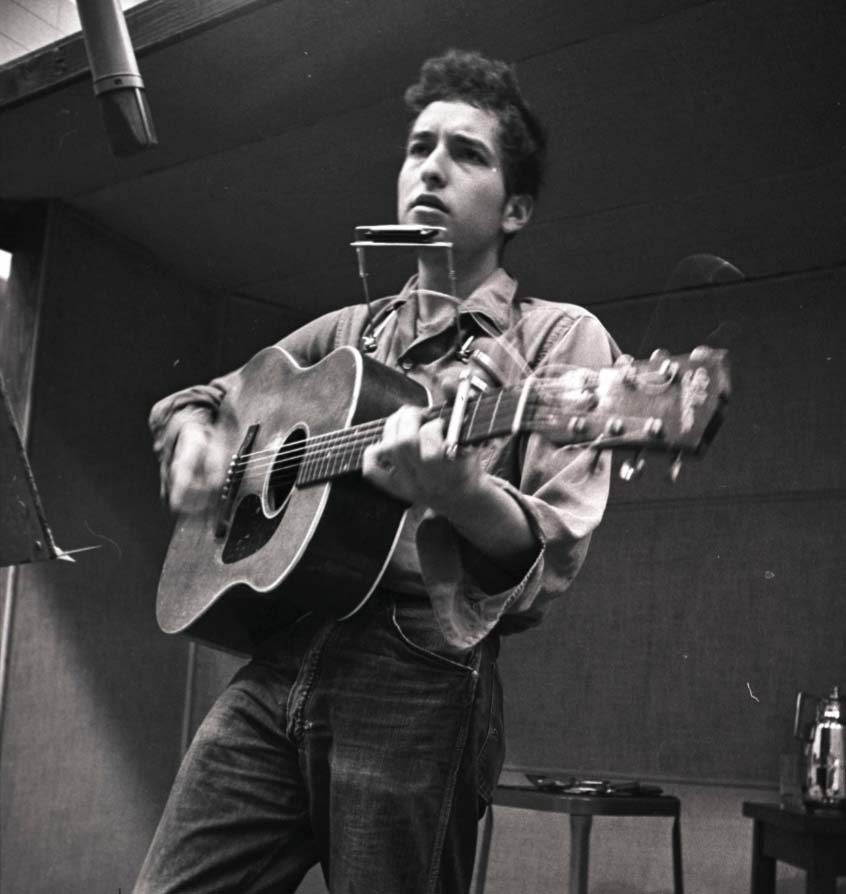
Biography - Bob Dylan Center | Tulsa, OK 

We forget that poetry had its origin in song. The Iliad and The Odyssey were sung (can you imagine memorizing those songs?). The Greek tragedies were sung. So rock music, blues, etc. are much more originary in their poetry than what we now consider to be poetry is. 

Unless you understand what poetry is and its history, nobody should take you seriously as a poet -- least of all yourself. In the same way that if you can't draw a picture of something someone could clearly and obviously recognize, you're not an artist no matter how much paint you fling around, if you can't write a sonnet or some Sapphic verse, you're not a poet. Artists have to know the history of their art if they're ever going to be worth anything. Even such Modern poets like Ezra Pound, who famously said, "make it new," understood that. So has any poet that has ever lasted. Walt Whitman didn't write free verse because he couldn't write a sonnet (which seems to be the case with too many poets these days), but rather he wrote in free verse because, having mastered the forms, he wanted to push poetry into new territory. As an artist, if you don't know where you came from, you are lost. The fact that poetry has its origin in song is vital to understanding poetry at all and thus to making poetry worth reading. In the same way, it's important to understand that your egg came from a chicken if your plan is to make more chickens. But it doesn't matter what animal an egg comes from if you're going to mess it up, break it down, and chew it up -- the end result is crap. I still prefer chicken eggs, though.

So, what is poetry? How can we identify it? Can we talk about its essence? You should at least have read a sufficient amount of what has been identified as poetry -- both past and present -- to have created some sort of concept, even if you can't create a scientifically acceptable definition of poetry. How else will you be able to tell the difference between poetry and prose? I've read poetic prose and read prose broken up into lines. If you can't sing it or dance to it, it's probably not poetry. A lot of prose has been mistakenly called poetry -- but if we call everything poetry, then poetry indeed has no meaning or definition.

The issue of definitions goes back to Socrates (and likely before). Remember that Socrates was always asking experts to define the thing they were expert in. Every time he would do so, he would find them giving him examples of, say, justice or piety or love, but they could never define the thing itself, which Plato developed into a theory that such Ideas or Forms were external to the world, which was just a poor set of shadows of the real. Nietzsche observed that we create ideas or concepts by looking at a set of unidentical similar objects and subtracting away the dissimilarities. Wittgenstein observed that this results in objects being able to be conceived and reconceived due to "family resemblances." A shoe is not a hammer, but it can be used as a hammer, so when you reconceive of a shoe as a hammer, you are saying it has a family resemblance to hammers.

All of this is to say that if we are trying to come up with the Platonic Form of poetry, we will never succeed, since such a form does not exist. However, we should be able to look at a sufficient number of poems and be able to work out their family resemblances. Along those lines, whatever your definition of poetry is is going to be a good start. Can we add to it? Subtract from it? The use of tradition as a criteria (I think one should have that as a criteria in the arts) suggests that we should put quite a bit of weight on past "verbal happenings." If we look at poetry around the world, such works have repeated structures (whether rhythm, rhymes, parallelism, etc.) and are broken up into lines that take optimally 3 seconds to speak -- not coincidentally, our short term memory works best in 3 second chunks. These are typical, but are they necessary?

Let's also return to the issue of song and poetry. There is no question that poetry began as song -- but there is equally no question that there was a bifurcation, resulting in the two traveling down somewhat different (though periodically intersecting) paths. Where does one draw the line? Many poems can be sung -- does that make them songs? I have sung my daughter's Dr. Seuss books to her (had to throw some variety in, since I read her the same books every single day), but I don't think Dr. Seuss intended his books to be sung. I suppose we could look at songs as "low art" vs. the "high art" of poetry -- especially modernist and postmodernist poetry, which is read (and sometimes enjoyed) almost exclusively by overeducated people like me -- but I don't like such distinctions, as it creates an unnecessary bifurcation in the art. A great work of art is one where anyone can enjoy it, but the more you know, the more you appreciate the work, one where repeated readings/viewings/listenings result in your coming to understand the work more and more. Perhaps by reconsidering song as poetry and consciously including it in the tradition, we will come to a better understanding of what poetry is, and become better poets ourselves.

Monday, October 10, 2022

Alienation and Hating Poetry

*

In The Hatred of Poetry, Ben Lerner, a poet himself, makes the argument that people hate poetry because 1) they think that just because they are a language-using human, they ought to be poets themselves, and 2) actual poetry fails to live up to our ideal of Poetry. 

My gut reaction was that this was utter nonsense. However, I came to realize that there are a few other fields in which this is true. Take economics. Everyone thinks they ought to be able to make pronouncements about economist just because they are human beings, we buy and sell in the marketplace, we work, and so on. We make value judgments about people's behaviors, often envy those who are better off than us, and typically believe actual economies fail to live up to our ideal Economy. As a result, most people hate economics and economists. 

I would add to this psychology, sociology, and political science. 

At the same time, there are a number of areas where people don't make this same mistake: math, physics, chemistry, biology, and even many of the other arts, including sculpture and painting (though some Modernist and postmodern works have people saying, "I could have done that" or "My three year old could have done that"), music and acting are typically things we don't think we can do without some degree of expertise.

Why is it that people who don't read poetry and don't like poetry feel a need to express an opinion about poetry when those same people wouldn't do the same thing about recent publications in mathematics? It seems there are a set of things people do that others seem to hold in contempt because they fancy themselves able to do them, while there is another set of things people seem to admire (or at least not hold in contempt) simply because they know they couldn't possibly do them.

The reason people don't like poetry may have something to do with the fact that everyone thinks they can do it, and that bumps up against what actual poets are doing. Much like economists--everyone thinks they understand the economy, and they get mad when an economist comes along and tells them they're wrong about how they think the economy works. There is a disconnect between what the person thinks they can do and what the experts in fact do, between what the experts understand and what the average person understands. 

Why, then, do people who hate poetry love songs? After all, isn't a song really just a poem? Of course. But songs are more directly tied into music, and only rarely are songs constructed such that they are as complex as many poems often are. More, they are heard rather than read, and reading is a difficult cognitive process which we can only do because the brain itself reconstructs itself--certain parts of itself are already designed for other things--in order to be able to read. Then, what is read has to be passed through this section of the brain before it is sent to the language portions of the brain. The musical element poetry (when present) is suppressed relative to songs, so poems are neither really read nor sung while, at the same time, both read and sung. 

We can look at this in another way, by comparing Shakespeare read and Shakespeare viewed/heard. The same people who find Shakespeare "boring" when they read him are excited watching a play (or film). The same things that bore them when they read Shakespeare move them to fear or laughter or tears when they watch the play performed and hear the words spoken. Why is it boring when read and not boring when viewed (ignoring those who still find it boring when viewed, since other issues may be at play there--I am only interested in the disconnect between the attitudes of reading vs. hearing/viewing). This would point to my suggestion that, in the case of poetry, part of the disconnect comes about from the fact that poems are read, which makes them, in many ways, more complicated. 

The fact that poems are read rather than heard also invites contemplation and analysis. One can look at the words and think about their varied meanings. This further complicates one's relationship with poems. The more you interact with a poem, the less likely it seems you are able to write one. Yet, you are still convinced that you ought to be able to write a poem. It's all just language, after all, and you are a member of a language-using species. 

When we take literature classes, it's not uncommon to hear that poetry is a "higher" form of language. The problem is, if poetry is a "higher" form of language, and language makes us human, then poets are logically, it would seem, a "higher" form of human. Who wants to believe there are higher forms of human than themselves? Who doesn't want to be a higher form of human? Thus, many likely feel the poets are looking down on them more than a bit, and this breeds contempt, as all (perceived) elitist behavior breeds contempt for those exhibiting it. It probably doesn't help that many contemporary poets are in fact elites who love to flaunt their elitism in the creation of works that only fellow-poets are capable of understanding (or at least who claim to understand). This, perhaps, is one major source of hatred for (contemporary) poetry.

The same belief doesn't necessarily apply to painters. We may be impressed with the work of a painter, but we don't think the person is a "higher" form of human. We consider them to just be an artist expressing themselves. It's something we can't do, true, but for some reason we just chalk it up to practice or a skill we simply weren't born with. The fact is that, like artists, poets are just artists expressing themselves. Poetry writing is simply a skill honed through practice. There may be something in us that drives us to express ourselves--in our case, in language--but that again makes us no different from any other kind of artist. Language is our medium, but that fact doesn't necessarily make us a higher form of human. 

Lerner suggests that these attitudes many people feel toward poetry are a consequence of Plato's attitude toward poets. The Greeks considered poets to be inspired by the Muses, meaning they were conduits for the gods. They were chosen by the gods. Meaning they were special. This is another way in which people think poets are some kid of elite. While we in the West seem to still have that attitude, even if not quite expressed as God/the gods favoring the poets, the question is if other cultures hold this same view and thus think the same way about poets. Or, are their attitudes toward poets more like our attitudes toward painters and mathematicians? 

I would argue, then, that people tend to express contempt toward those things which they think ought to be easy, but which "experts" in the field keep demonstrating to be complex. They have respect for difficult things they think are difficult, and they likely don't think much at all about those things that they think are easy that are in fact easy (for pretty much everyone), or at least easy to understand. You might not be able to play the guitar, but rock music seems easy to understand. Jazz, on the other hand, is more difficult to understand, and as a result many people don't seem to much care for it (part of this may also be simple familiarity--as we learn to hear something, we grow to like it). 

Overall, I don't think that having or lacking interest in any of these particular things is what's at play here. There are sets of knowledge/skills we seem to respect and others which we do not. A person may not be able to do math, and may not personally like doing math, but still hold a great mathematician in high esteem. They're not going to engage in the math nor make the mistake of having an opinion about the math being done that they cannot do. As a result, they simply respect the mathematicians who can do those things. But when you have a person who is not an economist and is generally ignorant of economics, that doesn't mean they won't have an opinion about economics. The same person who lacks interest in learning math and economics will refrain from having an opinion about math and give their opinion about economics. 

So it seems that interest isn't really what's at play. Again, I think it's precisely the disconnect between apparent simplicity and the real complexity that creates this contempt toward poetry, economics, sociology, and psychology, among other things. I know I don't know anything about how to repair a car, so I respect auto mechanics. For the longest time I thought I could write and understand poems when I really couldn't. Thus, I started out with a hatred of poetry and a degree of contempt for poets--which has changed as I have slowly learned to understand poems and how to write them. I suppose I lost my hatred of poetry because I never really bought into the idea that there was this unattainable ideal of Poetry which can never be realized by any real poem. 

The less disconnect, the less alienation one feels, the less hatred one feels. That's probably something to consider in regards to things well beyond poetry. 

What do you think? Is there anything we contemporary poets can do to reduce the hatred of poetry, short of ostensibly "dumbing down" our poetry? Is the problem the way people write poetry, as esoteric texts? Is the real problem that contemporary poetry, like much contemporary art, is simply not perceived as beautiful? Is it because we only read and rarely ever listen to poetry? (Poetry slams are quite popular, and draw in non-poets, while poetry journals almost never draw in non-poets.) What can we do so readers are no longer alienated from our art?

Syllabics

 If you were to come across a ten-syllable lined poem, you would probably expect it to be iambic pentameter. And you would probably be right...